top of page

By:

Abhijit Mulye

21 August 2024 at 4:59:11 pm

Bhagwat to outline roadmap for next century

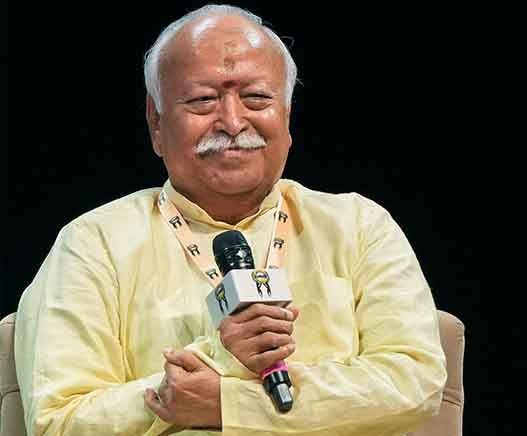
Mumbai: Rashtriya Swayamsevak Sangh (RSS) Sarsanghachalak Dr Mohan Bhagwat will address thousands of volunteers and key political observers at Reshimbagh grounds in Nagpur tomorrow at 7.40 am on the occasion of Vijayadashami, formally concluding the organisation’s centenary-year celebrations. He is expected to deliver an ideological and operational blueprint intended to recalibrate Hindu society, counter ongoing opposition mobilisation across India, and outline internal organisational changes...

Bhagwat to outline roadmap for next century

Mumbai: Rashtriya Swayamsevak Sangh (RSS) Sarsanghachalak Dr Mohan Bhagwat will address thousands of volunteers and key political observers at Reshimbagh grounds in Nagpur tomorrow at 7.40 am on the occasion of Vijayadashami, formally concluding the organisation’s centenary-year celebrations. He is expected to deliver an ideological and operational blueprint intended to recalibrate Hindu society, counter ongoing opposition mobilisation across India, and outline internal organisational changes through a wide-ranging policy address. The annual Vijayadashami address, historically the most definitive forum for the RSS chief to articulate the organisation’s stance on domestic policy, cultural objectives and global affairs, carries heightened significance this year. Marking the completion of 100 years since Dr K.B. Hedgewar founded the organisation on Vijayadashami in 1925, Bhagwat’s address is designed to chart the strategic framework for the RSS as it enters its second century. Over the past 12 months, Bhagwat has personally anchored a series of outreach programmes across four Indian metropolitan hubs and two global nerve centres in the United States and Europe, signalling an appetite to project ideological clarity and broaden the organisation’s institutional footprint beyond traditional shakhas. The address comes against the backdrop of sustained street agitations orchestrated by the Congress party and newly formed groups such as the CJP in the national capital and several states. These demonstrations, centred on unemployment, social justice rhetoric and institutional accountability, have explicitly targeted India’s youth demographic — a constituency that has historically formed the primary recruitment pipeline and ideological backbone of the Sangh. Political observers believe Bhagwat will offer an unyielding response to these attempts to disrupt governance and erode the social coalition, reflecting an unmistakable determination within the Sangh Parivar leadership to resist political attrition and mount an active counter-narrative. The diplomatic and constitutional significance of the event is underscored by the deliberate selection of guests. Former Vice-President Jagdeep Dhankhar and Israel’s Consul General in Mumbai, Yaniv Revach, are attending as special invitees. Revach’s presence hints at possible remarks addressing global geopolitical realignment, the rise of civilisational conflicts, cross-border terrorism and national security challenges. Dhankhar’s attendance provides a platform to reaffirm constitutional patriotism and legislative stability at a juncture marked by sharp parliamentary confrontation. Equally consequential is the invitation extended to Sanjay Gupta, Editor-in-Chief of Dainik Jagran. For an organisation that has historically maintained a measured distance from mainstream media machinery, engaging with the leadership of India’s largest Hindi daily indicates an institutional shift towards proactive public communication. The gesture suggests that the Sangh recognises that narrative warfare in its next century requires strategic engagement with popular media platforms rather than a traditional reliance on insular organisational word of mouth. Beyond external ideological positions, the Nagpur gathering is expected to provide indicators of the structural transitions under way within the RSS. The organisation has been quietly restructuring its administrative echelons, revamping functional wings and adjusting internal deployment models in recent months. With additional leadership realignments slated across key tiers in the near future, Bhagwat’s speech is expected to define the organisational ethos for these generational handovers, emphasising flexibility in outreach while preserving core organisational discipline. As dawn breaks over Reshimbagh, the address will serve both as a balance sheet of a century-old journey and as a declaration of intent for an increasingly combative political era.

Real Fascism

Aug 28
2 min read

The systematic attempt by sections of the so-called ‘left liberal’ elite in the Western, in alliance with Islamic outfits, to suppress RSS Chief Mohan Bhagwat’s address at Madison Square Garden exposes the performative nature of Western ‘free speech’ discourse. For decades, Western institutions have preached pluralism, yet the moment when the head of a major Hindu civilisational organisation seeks to engage with its diaspora, the entire apparatus of Western left-liberal and activist networks mobilizes to enforce ideological censorship while working itself to a frenzy in conjuring the bogey of ‘saffron terror.’


Western democracies have positioned themselves ad nauseam as the ultimate guardians of open dialogue and pluralism, championing free speech as a non-negotiable cornerstone of human rights. This commitment routinely falters when applied to perspectives that challenge Western liberal orthodoxy or the interests of established political blocs. The coordinated opposition against Bhagwat’s international engagements by coalitions of left-liberal political groups and Islamist organizations exposes a selective framework where democratic rights are treated as privileges reserved exclusively for specific ideologies


The coordinate suppression of American Hindus for Engagement and Dialogue (AHEAD), whose X account was targeted and temporarily taken down via automated abuse, is a case study in such censorship.


The political manoeuvres around Bhagwat’s event highlight the stark double standards of figures like New York Mayor Zohran Mamdani, who has consistently targeted democratic Hindu institutions with labels like “fascist” and “exclusionary” while maintaining a notable silence when radical or anti-Hindu rhetoric emerges from political allies or interfaith gatherings.


When figures like Mamdani and various Western activist coalitions mobilize to delegitimize Hindu gatherings, they demonstrate that their allegiance is not to universal free expression, but to an ideological gatekeeping that brooks no genuine pluralism.


The same Western activist networks and academic institutions frequently platform, tolerate or explicitly defend radical Islamist movements, framing their rhetoric under the umbrella of “anti-imperialism” or protecting “minority expression.”


Bodies such as the United States Commission on International Religious Freedom (USCIRF), led by figures like the Pakistani Asif Mahmood, routinely weaponize human rights reporting against India and Hindu organizations, operating with an institutional bias and a complete lack of credibility.


While Western cities regularly host extremist ideologues, controversial political dissidents and radical preachers under the banner of broad constitutional protections, Hindu civil society groups are met with security threats, algorithmic botting and open political hostility.


This convergence of Western left-liberal political networks and Islamist advocacy groups functions as a cartel of speech control. They embrace free expression only when it serves as a vehicle for their own ideological hegemony. It seems the real fascism of our era does not march in uniform but speaks in the language of Western liberalism, operates through algorithmic suppression and brooks absolutely no dissent.

Comments


bottom of page