
Sattire With Swag
- Correspondent
- Sep 6, 2025
- 0 min read

By:
Rajendra Pandharpure
15 April 2025 at 7:55:54 pm
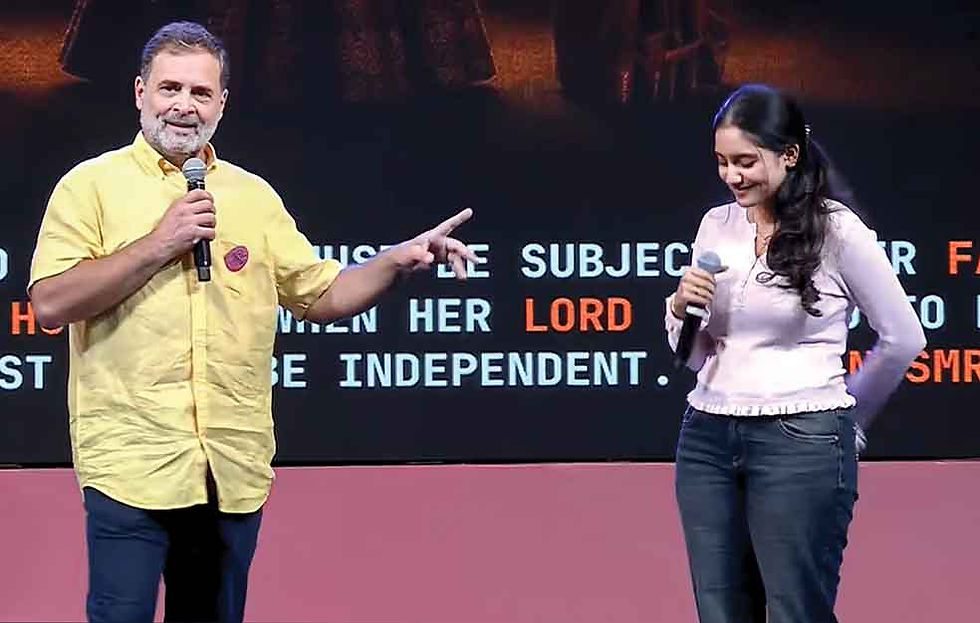
Rahul Gandhi’s student outreach is giving the Congress a boost in western Maharashtra but converting street energy into electoral momentum will be the harder task. Pune: For a party that has spent much of the past dozen years looking politically exhausted, the Congress is finally showing signs of life. It appears that Rahul Gandhi’s Chhatron Ki Goonj (“Voice of Students”) campaign, which brought him to Pune has provided Maharashtra Congress workers with a much-needed sense of political purpose. The Congress’s student wing had already been demanding an inquiry into the NEET examination controversy and the resignation of the Union education minister. After the lathi-charge on students on July 20, the party shifted into a more combative mode with Gandhi attempting to turn the episode into a broader political campaign. He staged a sit-in outside Prime Minister Narendra Modi’s residence and was removed by police. He subsequently appeared at press conferences alongside students injured during the protests and recently accompanied students wounded by pellet guns while filing an FIR with the Delhi Police. Politics of Confrontation By placing students at the centre of his campaign, Gandhi is seeking to reposition himself as a political interlocutor for younger Indians. The response at the Chhatron Ki Goonj gathering in Prayagraj suggested that the message had found an audience. Pune was the next stop. The August 22 gathering brought the campaign to western Maharashtra, a region where the Congress has traditionally had a substantial political footprint but where its organisational machinery has lost much of its old vitality. The event offered Gandhi an opportunity to reconnect with students and young voters while simultaneously energising a state unit that has often appeared trapped between organisational inertia and the dominance of its allies. The significance of the Pune event therefore extends beyond the size of the crowd. For much of the Congress’s recent history, that belief has been in short supply. A high-energy campaign centred on students, examinations, jobs and institutional accountability gives the party a simpler proposition to sell. There is also a wider political calculation. Western Maharashtra remains one of the most politically competitive regions in the state, shaped by the fortunes of the Congress, the Nationalist Congress Party factions and the BJP. The Congress cannot afford to surrender the region to its rivals if it wants to rebuild itself in Maharashtra. Nor can it rely indefinitely on alliances to compensate for weak grassroots mobilisation. Gandhi’s intervention may thus be less about an immediate electoral breakthrough than about rebuilding political muscle. Student politics provides a useful entry point because grievances over examinations, recruitment and employment cut across caste and party affiliations. They also offer the Congress an issue on which it can attack the government without being trapped in the familiar ideological contests of Indian politics. But a crowd at a political event can only demonstrate mood; it cannot by itself produce votes. The real test for the Congress will be whether the energy generated by Chhatron Ki Goonj survives after the microphones are switched off. Can student mobilisation be converted into campus networks, local campaigns and eventually a durable cadre? Can the Maharashtra unit turn Mr Gandhi’s visibility into sustained activity in constituencies where the party has been eclipsed? Those are harder questions. The Congress’s challenge is to ensure that the goonj does not fade once the rally is over.


Comments