
Selective Pluralism
There is something deeply revealing about the reflexive hostility of the global ‘Left-liberal’ establishment and their Westernized Indian counterparts towards the RSS. It seems less interested in what the organisation actually says than in what it has decided the organisation must mean.
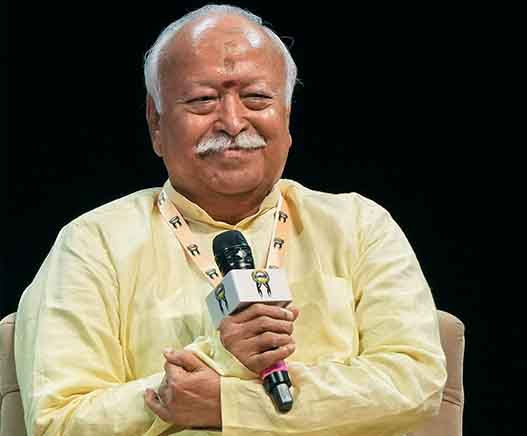
RSS chief Mohan Bhagwat latest remarks in New York that if a Hindu believes there should be no Muslims in Bharat, he is not a Hindu is proof of his inclusivity and that of his organization, which has been relentlessly vilified since Independence.
Bhagwat went further in his remarks, stating that Hinduism required recognition that different paths lead to the same goal and that every human being possesses dignity.
Several people and outfits, not least New York Mayor Zohran Mamdani, had gone out of their way to thwart Bhagwat’s American tour.
He described the RSS as embodying an “exclusionary vision” and invoked the India of his upbringing as a secular, pluralistic republic. It is strange that Mamdani, speaking from an American city he governs, chose to lecture Indians on which organisation does or does not represent their vision of India.
The RSS is routinely described as “right-wing”, “Hindu nationalist”, “paramilitary” and “exclusionary” by Mamdani and his ilk. The organizations enormous network of volunteers and social-service activities, regardless of creed, caste or religion, is either deliberately ignored or dismissed as propaganda. Its philosophy of vyakti nirman - nation-building through the formation of individuals - is scarcely examined by fancy liberals, ensconced in their comfortable perches.
The RSS is often treated as a permanent exhibit in the Left-liberal museum of Indian villainy.
The RSS, like any organisation of consequence, is perfectly entitled to be scrutinised, challenged and criticised. The problem is the refusal to apply the same standard of scrutiny to everyone else.
Where is the corresponding demand that Muslims explicitly reject Islamist supremacism? Where is the insistence that pluralism requires not merely Hindu restraint but reciprocal acceptance? Why is Hinduism endlessly required to prove its commitment to coexistence, while the most uncomfortable strains of Islamist and Christian politics are routinely handled with euphemisms, contextualisation or silence?
Pluralism cannot be a one-way moral contract. A Mamdani or a Rahul Gandhi is entitled to his political views. So are India’s Left-liberal intellectuals. But none of them possess a hereditary copyright over the meaning of secularism, pluralism or Indian identity.
Mohan Bhagwat and the RSS do not need Mamdani’s permission to exist and spread their message. It has spent a century building an enormous voluntary network in India. The BJP’s electoral success has given the broader ideological current associated with the Sangh extraordinary democratic legitimacy, whether its critics like that fact or not.
The real test of pluralism is not whether Hindus are willing to hear criticism. They have heard plenty. It is whether their critics are willing to hear them back.

Comments