top of page

By:

Prasad Dixit

11 October 2024 at 6:39:23 am

The ‘Exclusionary Vision’ Dilemma for Sovereign Countries

Sovereign nations protect their distinct cultural foundations while still upholding an inclusive vision of governance. The same principle should apply to India. The ‘Universal Oneness Celebration’ event that was recently held in New York City attracted criticism that was only to be expected from certain obvious quarters who chastised the Rashtriya Swayamsevak Sangh (RSS) for having an allegedly ‘exclusionary vision’. In a free society, one can always express a personal opinion on the...

The ‘Exclusionary Vision’ Dilemma for Sovereign Countries

Sovereign nations protect their distinct cultural foundations while still upholding an inclusive vision of governance. The same principle should apply to India. The ‘Universal Oneness Celebration’ event that was recently held in New York City attracted criticism that was only to be expected from certain obvious quarters who chastised the Rashtriya Swayamsevak Sangh (RSS) for having an allegedly ‘exclusionary vision’. In a free society, one can always express a personal opinion on the effectiveness with which the stated ideology or philosophy of any organisation is being implemented on the ground. However, labelling an organisation that considers ‘Vasudhaiva Kutumbakam’ as its core belief as having an ‘exclusionary vision’ is curious, to say the least. We are living in a world of different sovereign countries, each with its own history, cultural identity that acts as a foundation for nation-building and, of course, its own international borders and immigration policies. It is interesting to see how different countries look at the cultural identity and ethos that shape them, and how they protect the foundation on which they stand while still championing their own ‘inclusive vision’. Illusion of Contradiction Take France as an example. The principles of Liberty, Equality and Fraternity were born out of the French Revolution. They serve as the guiding star for France. Many other countries in the world have also adopted these principles and drawn inspiration from them. Such noble principles, however, are never sufficient to define the foundation of a sovereign country that differentiates it from others. While Liberty, Equality and Fraternity are held in high regard in France, the French language is the foundation on which France stands as a sovereign country. As it is often said, language carries with it not merely its grammar and vocabulary, but a whole culture of its own. Approximately 13 percent of the population in France has a mother tongue different from French. It is noteworthy how France looks at its cultural foundation — the French language — vis-à-vis the spirit behind the principles of Liberty, Equality and Fraternity enshrined in its Constitution. Article 2 of the same French Constitution explicitly states that France has only one official language — French. From time to time, there are demands to grant official status to other minority languages, but they face tremendous political and legal resistance and are shot down. Other languages are denied even ‘co-official’ status because this is perceived as a direct threat to the deeply rooted ideology of the centralised linguistic unity of France. It goes a step further. There is a concerted, systematic effort to preserve the ‘purity’ of the French language and fight the ‘invasion of English’, called Franglais. It is mandatory under the law, including the Toubon Law, to use the French language in government publications and workplaces, and to include a French translation if any English slogan is used even in a commercial advertisement. Similarly, although Italy recognises a few ‘minority languages’, its official national language is only one — Italian. The approach taken by Germany or Japan is broadly the same. One cannot but wonder whether the same critics of the RSS would call an approach taken by France ‘exclusionary’. The fact is that every sovereign country has its own cultural foundation, which is the cause of its very existence. Countries go out of their way to ‘exclusively’ protect and preserve that cultural foundation. That does not mean, however, that France exclusively belongs only to the majority population whose mother tongue is the same as the national language. Nor does it mean that the State will treat its citizens differently based on their mother tongue, or give preferential treatment to the majority community over linguistic minorities. It is in this perspective that one needs to look at the civilisational ethos dating back thousands of years that forms the foundation of the Indian subcontinent, and the historical context of events that led to India being born as a present-day sovereign country in 1947. How India should treat its cultural foundation is no different from how France, Italy, Germany or Japan should do it. Needless to say, neither India nor any of these other countries discriminate against certain citizens when it comes to governance and the rule of law. There is no contradiction or ‘exclusionary vision’ whatsoever in the approach taken by France, and the same should hold true for India as well. Contextual Similarity As far as the United States of America is concerned, neither any particular language, nor any religion, nor any ethnic origin independently defines the cultural foundation of that country. And yet, there is certainly an ‘American culture’ that defines the country and acts as its foundation. People from all over the world, with very different backgrounds, have migrated to that land and ‘American culture’ has assimilated them. Although it may be difficult to define it very clearly, there is certainly ‘Unity in Diversity’ in American culture. The country calls itself ‘a melting pot’. It goes out of its way to protect this attribute through uniform civil laws that apply to all citizens regardless of their religion or ethnicity. Not everything was just and fair in American history. However, American culture and its democratic ethos not only allow open discussion and debate on what was wrong, but also encourage action on the ground to correct historical wrongs. Former President Bill Clinton summarised it well in one of the presidential debates when he said: “There is nothing wrong in America that cannot be corrected by what is right in America.” When it comes to immigration, whether for tourism or work, the US perhaps has been the most open country for several decades. Its policy towards even illegal immigration has been very soft. It has realised, however, that all this is being taken for granted by many countries and even deliberately misused. Any legitimate attempt, in the larger interest of the country, to change and tighten that policy and stop illegal immigration and settlement invites severe criticism. With that criticism, ironically, an otherwise very open and welcoming country gets painted as being very rigid and intolerant. This specific aspect of American culture, and the criticism it faces, has a clear parallel with the civilisational ethos that forms the foundation of India. Indian culture has also assimilated people from many parts of the world for centuries. It too has its own ‘Unity in Diversity’ that is not very easy for many to define and appreciate. It also welcomes open discussion about historical wrongs and makes a sincere attempt to correct them. The accommodating and welcoming nature — the ‘Atithi Devo Bhava’ psyche — implicit in Indian culture has also been deliberately and rampantly misused. Any attempt to enforce the law of the land invites the same criticism that the US faces. Needless to say, India, like the US or any other country, would and should go out of its way to protect its cultural foundation. Doing so can be termed an ‘exclusionary vision’ only as part of a motivated agenda, if not an absolute unwillingness or inability to grasp and respect the cultural foundations of different countries. There is a need to refine and temper the definition of the so-called ‘exclusionary vision’ for it to make sense in a world of sovereign nations that want to legitimately protect their individual identities in different ways. In other words, the very definition of ‘exclusionary vision’ itself needs to be more ‘inclusive’ in more ways than one. Given its history, the US perhaps is the best country to appreciate what it means to espouse ‘Vasudhaiva Kutumbakam’ as an inclusive ideology. It is also the best country to appreciate the fact that attempts to prevent the deliberate misuse of an inclusive ideology cannot be termed an ‘exclusionary vision’. (The writer has worked in the Information Technology sector. Views personal.)

Thackerays try to encash youth’s sentiments

Jul 26
4 min read

Succeed in pulling crowd that celebrated Dharmendra Pradhan’s resignation with sharp political messaging
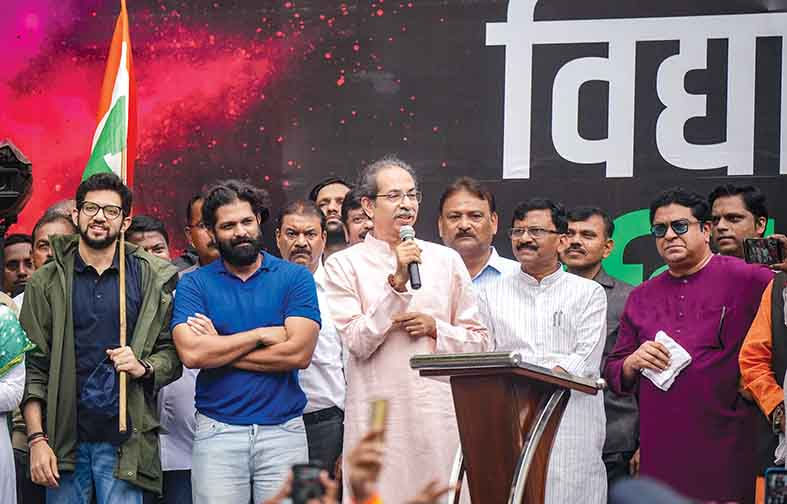
Mumbai: Shiv Sena (UBT) President Uddhav Thackeray and Maharashtra Navnirman Sena (MNS) chief Raj Thackeray came together for the third time in five days at a joint rally at Mumbai’s iconic Shivaji Park on Sunday to celebrate a ‘victory’ they were not part of. They addressed a rally as a celebration of the resignation of Union Education Minister Dharmendra Pradhan a day earlier.


Addressing the massive turnout, Uddhav Thackeray said the student-led agitation had proved that the voice of the people could not be silenced. Calling Pradhan’s resignation a moral triumph for students, he said those who demanded accountability for the alleged examination irregularities had achieved a significant victory. He said the campaign had laid the foundation for a wider fight against the BJP-led Central government. Uddhav said, “This fight is a united fight which is BJP vs India. A cockroach has defeated dictatorship. This is the real avatar of lord Vishnu. Modi ji can steal votes but not youngsters.”


Raj also lauded the students for their determination and perseverance throughout the agitation. He urged the youth to remain aware and actively engaged on issues related to education and governance. He said the success of students' protest proved Gen Z can challenge the government.

He thanked the Mumbai Police for maintaining order during the programme and said the country had seen "the difference between the Maharashtra Police and the Delhi Police," a reference to the thrashing of protesters in the national capital.


Spirited Speeches

The rally featured spirited speeches, slogans and enthusiastic participation by supporters of both parties, particularly young workers. A strong police presence was maintained in and around Shivaji Park, with barricades, traffic diversions and other security measures put in place to regulate the large crowds and maintain public order.


The rally was also viewed as a major political display of unity by the Thackeray cousins, who used the platform to reaffirm their common position on matters concerning Maharashtra and the interests of students.


Sweets were being distributed, slogans were being raised, while many highlighted that one of the grievances of the protesters was also the alleged illegal arrests of the protesters and misbehavior with women protesters.

Crowd was dominated by young teenagers, many of whom were students and were present to enjoy the vibe of a demonstration lacking much deeper insight of the NEET paper leak issue or the larger issue. Minor Children who were as young as nine years old, also stood with slogans written on placards. They had memorized poems to present some thoughts their parents had fed them with, making full use of the platform as a medium to overcome stage fear.


‘Fight against illegal arrests’, say protestors
Several demonstrators, who were a part of the celebrations on Sunday, alleged that they were not against any party but they were against unconstitutional behavior. Alleging illegal arrests to suppress freedom of speech by the Mumbai police, several demonstrators claimed to have joined the fight at the point where they felt that voices were being suppressed, and criticism was not being taken seriously.

A 26-year-old Sharvari Bukane, a practicing advocate at the Bombay High court, was also a part of the celebration. Bukane told ‘The Perfect Voice’ that she had been voluntarily active in expediting smooth release of students who were illegally being detained. “We are not against a person or any party. The nation is in the right hands. I was just doing my part. I am a part of Gen-Z. We will fight against any party or person who does something that is unconstitutional,” she said.

A Member of All India Student Federation Amir alleged that women protesters faced misbehavior and several people were illegally arrested. He said, “We will ensure NEET is abolished. Mahatma Gandhi has taught us nonviolence, Ambedkar taught us the path and Chhatrapati Shivaji Maharaj taught us determination. Youth is politically aware now. We want resignation from (Education minister) Dada Bhuse. Ambani and Adani are providing them money. Trump and Epstein files are by Modi’s side. We will continue to fight against capitalism, and privatisation.”

A 38-year-old working woman Anuja Bhate said, “Today the common man fears expressing opinions on politics because there is a real fear of retribution. For our democracy to become stronger, this fear needs to be eliminated.”


'We want anybody but Modi!’
Rajendra Chavan, a 65-year-old Thane resident and a retired civil Engineer, also joined the celebration with his family and children. He said the youths are desperate for a change as the education system is in shambles. They have no jobs and hence they are ready to go for anyone except Modi.

He said, “Senior citizens are devotees of Modi. They benefited from the free government schools and smooth education in their time, and now they are Modi devotees. The irony is that their children are in US and Europe for better education. My generation is busy worshiping an individual. Indira Gandhi too was defeated in 1975. Anybody but Modi! is the sentiment right now. It will take time, and it should happen democratically.”

"The dictator has been shaken. This is the power of the youth. They need not be told to do anything. They know what they want. The response of Mumbai has been tremendous. Asking questions to the government is not being anti-India. All FIRs against protesters should be withdrawn. The countdown has begun for this government.”

Aaditya Thackeray, MLA, Shiv Sena (UBT)


 “Power and arrogance have to bow before people's power. The youth will now have to rise against the Special Intensive Revision (SIR) and delimitation (referred to the proposed delimitation bill). The youth power led a peaceful struggle against the system unitedly.”

Rohit Pawar, MLA, NCP (SP)


“Sanjay Raut’s agenda is clear which is restoring and settling the careers of Aditya Thackeray and Amit Thackeray. Why is Sanjay Raut not being able to address the public here? He is being prevented from addressing the public so that Rahul Gandhi doesn’t take away the credit of the whole agitation. Raut’s agenda is clear. He has nothing to do with NEET aspirants or youth.”

Navnath Ban, Chief Spokesperson, BJP


“We are open to peaceful protests and voicing concerns lawfully. We are followers of democracy. However, many of these protesters are crossing lines, using obnoxious language and misusing freedom of expression. This is not healthy. Why are people shying away from a discussion in Parliament? That is the place where discussions can bring about a change in law.”

Aniket Nikam, Spokesperson, BJP

Comments


bottom of page