

The AI Mirage: The Limits of Technological Prophecy

Artificial intelligence may change much, but perhaps not quite in the way its prophets and pessimists imagine.
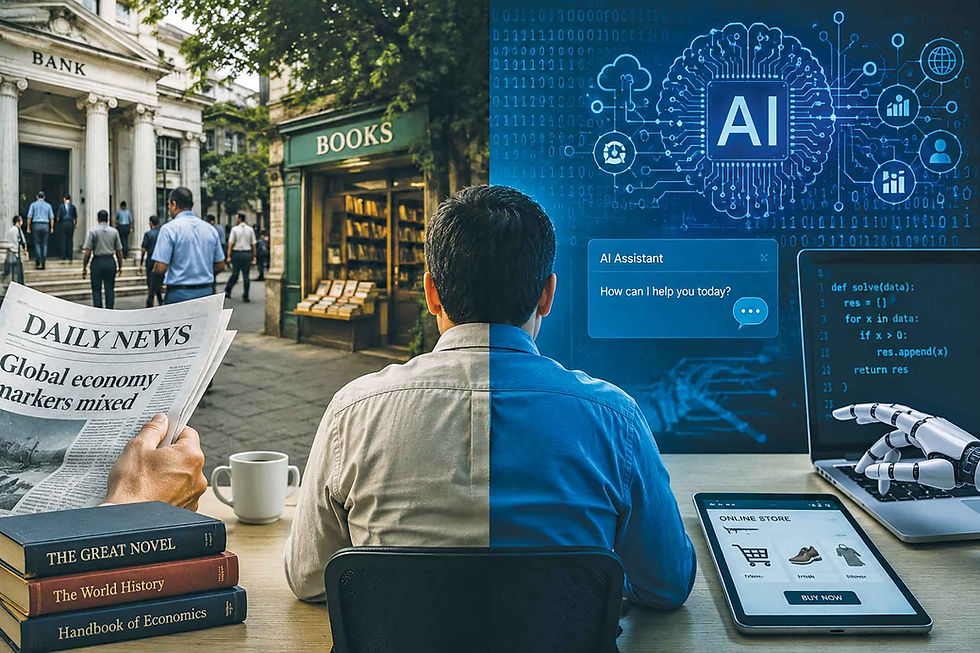
Every discussion about artificial intelligence today seems destined to arrive at one of two destinations. The first is a gleaming utopia in which AI transforms every aspect of human existence, liberating people from drudgery and ushering in an era of unprecedented productivity. The second is a dystopia of mass unemployment, social unrest and economic dislocation, where machines render human labour largely redundant. The truth, as history repeatedly demonstrates, is likely to lie somewhere between these extremes.
Grand Predictions
Technological revolutions have always encouraged grand predictions. The Industrial Revolution, powered first by steam and later by electricity, fundamentally altered economies and societies. The computer revolution did the same. In both cases, jobs disappeared, industries were disrupted and familiar ways of working became obsolete. Yet the overall result was not economic collapse but the creation of new industries, new occupations and higher standards of living. Many observers, however, suspect that artificial intelligence is different. Unlike previous technologies, AI appears capable not merely of assisting human intelligence but of replicating some of it. Hence the widespread belief that humanity may not be lucky a third time.
Such confidence in forecasting the future is curious because history offers a humbling lesson that technological change rarely unfolds in the way experts expect. Some innovations completely replace what came before them. Others coexist with older technologies for far longer than anyone anticipates.
The story of Kodak has become a standard cautionary tale. Digital photography rendered photographic film largely obsolete. Audio and video cassettes disappeared when digital media arrived. Compact discs and DVDs soon followed them into decline. Analog telephones equipped with rotary dials vanished rapidly as digital networks and mobile phones spread across the world. In each of these cases, the new technology was demonstrably superior across almost every relevant dimension. Consumers had little reason to remain loyal to older alternatives.
Yet many other technological revolutions have proved considerably less decisive. Consider banking. When internet banking emerged in India during the late 1990s, many analysts confidently predicted the demise of traditional bank branches. Banking, they argued, would soon become entirely digital. Similar forecasts accompanied the rise of online retailing. Physical shops, it was said, would steadily disappear. The arrival of e-books and digital newspapers was expected to consign printed publications to history. The proliferation of cable television and, later, streaming platforms supposedly threatened the very existence of cinemas.
The automotive sector generated its own set of prophecies. A decade ago, industry observers predicted an imminent future dominated by self-driving, fully connected and entirely electric vehicles. Private car ownership was expected to give way to shared mobility services. The concept of Mobility-as-a-Service (MaaS) was heralded as the next great transformation in transportation.
The software industry was no less ambitious in its predictions. Commercial off-the-shelf software products, cloud computing and Software-as-a-Service models were expected to sweep away decades-old legacy systems. Mainframe computers running COBOL applications appeared destined for the museum.
Complex Reality
Reality, however, has been more complicated. Internet banking has undoubtedly transformed routine financial transactions. Millions of people transfer money, pay bills and manage accounts without visiting a branch. Yet bank branches continue to operate across cities and towns. Indeed, many banks continue to expand their physical presence. Online retail has flourished, but shopping districts remain crowded. Printed books and newspapers continue to attract readers. Theatres still draw audiences despite the abundance of entertainment available at home.
Likewise, the automotive revolution remains unfinished. Electric vehicles have gained ground but remain a small proportion of total vehicle sales in many markets. Hybrid vehicles have enjoyed greater success. Yet the industry has hardly transformed beyond recognition.
The software world offers perhaps the most striking example. Many of the world's largest corporations continue to rely heavily on mainframe systems and COBOL applications developed decades ago. Predictions of their imminent demise have been repeated for years, yet they remain indispensable.
Why do some technologies completely replace their predecessors while others merely coexist with them?
The answer lies in a simple but often overlooked fact: technology does not exist in isolation. Consumers evaluate products and services across multiple dimensions, not merely efficiency.
Internet banking, for instance, is extraordinarily convenient for routine tasks. Yet when dealing with complex financial matters, many customers still prefer speaking directly with a bank employee. Personal interaction inspires confidence in situations involving significant financial decisions.
Similarly, online shopping can replicate visual and auditory experiences, but it struggles to reproduce touch, smell and taste. For many purchases, these sensory dimensions matter.
Reading habits reveal a similar pattern. Many readers continue to find printed books and newspapers more conducive to concentration than digital screens. Physical pages offer an experience that many people perceive as calmer, more immersive and less distracting.
Entertainment follows the same logic. Watching a football match on television may provide convenience and superior camera angles. Yet it cannot replicate the collective excitement of being present among thousands of fellow spectators. Technology can often reproduce part of an experience, but not necessarily all of it.
Consumers rarely abandon established habits merely because a technically superior alternative exists. New technologies succeed when they deliver a substantially better overall experience, not simply a better technical solution.
Artificial intelligence is unlikely to be exempt from these realities.
Take autonomous vehicles, one of AI’s most celebrated promises. For years, enthusiasts predicted fleets of fully driverless cars navigating cities without human intervention. The reality has proved far more challenging. Today’s systems remain largely confined to Advanced Driver Assistance Systems (ADAS), which assist rather than replace human drivers.
Legal, ethical and regulatory questions complicate matters further. Who bears responsibility when an autonomous vehicle causes an accident? How should algorithms make decisions in ambiguous situations? These questions remain unresolved. Consequently, the human driver continues to occupy the seat behind the steering wheel, even if AI makes the journey easier.
Artificial intelligence faces another challenge that is frequently overlooked. Many of its supposedly revolutionary applications are less novel than they appear.
The Society for Worldwide Interbank Financial Telecommunication (SWIFT) enabled global financial communication decades before the internet became a household phenomenon. Retail payment systems integrated point-of-sale terminals long before anyone spoke about the Internet of Things. Warehouses, factories and supply chains relied on interconnected devices years before consumers imagined smart refrigerators ordering milk automatically.
The same pattern can be observed with artificial intelligence. Sophisticated predictive algorithms have long been embedded within inventory management systems, logistics networks and industrial planning tools. What has changed is not the existence of such capabilities but their accessibility to ordinary users.
The arrival of large language models has created the impression of a sudden technological rupture because millions of people can now interact directly with AI. Yet within industry, many organisations were already operating highly sophisticated systems that incorporated forms of machine intelligence.
Much attention has been paid to AI’s ability to generate software code from natural-language instructions. Yet programming languages have been moving steadily closer to human language for decades. Integrated Development Environments have long automated many routine coding tasks.
Similarly, AI-powered chatbots undoubtedly represent an advance in customer service. Yet they often perform functions that were already available through self-service portals, searchable knowledge bases and automated workflows. The improvement is real, but it is not always revolutionary.
The limitations become even more apparent in large enterprises. Many corporations operate mission-critical systems developed over decades. Replacing these systems entirely with AI-generated alternatives would involve enormous costs and risks. Industry experts remain cautious for good reason.
None of this diminishes AI’s extraordinary potential. But understanding AI requires distinguishing between its public spectacle and its industrial reality.
The future of AI, therefore, is unlikely to conform either to the utopian promises of its evangelists or the apocalyptic warnings of its critics. History suggests a more nuanced outcome. Technologies seldom transform society in exactly the manner predicted.
(The writer has worked in the Information Technology sector. Views personal.)


Comments