

The Biological Cost of Drought
Maharashtra’s water crisis is beginning to impose a biological ceiling on the rural economy.
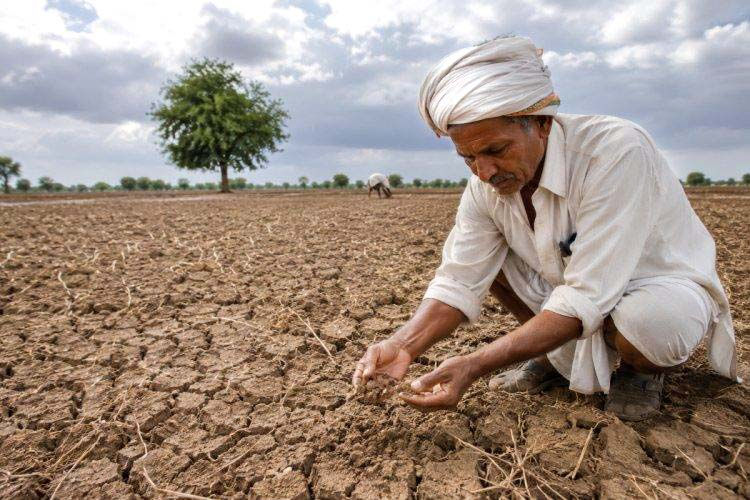
Discussions about drought in Maharashtra tend to be conducted in the language of quantities. How much rain fell? How far have groundwater levels declined? What will happen to yields, farm incomes and food prices?
But they miss an inconvenient variable which is the human body. Conventional economics has a habit of treating labour as an endlessly adjustable input. If the crop requires more work, farmers work longer. If water becomes scarce, they fetch it from farther away. The spreadsheet rarely records what these hours and expenses do to the person supplying them.
Novel Framework
A framework developed by me, the Non-Linear Endogenous Biological Cap (EBC) Model, argues that the physical condition of rural workers can itself become a constraint on economic output. Climate stress does not merely damage crops and soil. It depreciates the health capital on which agricultural production depends.
Analysis of a dataset covering 1,400 farmers across major agrarian zones in Maharashtra points towards an uncomfortable conclusion: food security cannot indefinitely be built on the deterioration of the people who produce the food.
Climate stress does not affect every farm in quite the same way. Its economic consequences vary with the crop, but two broad patterns emerge.
The first is thermal exhaustion. In staple and commercial-crop regions from sugarcane-growing areas around Daund to cotton belts in Dhule and vulnerable rainfed rice systems, water scarcity is accompanied by punishing heat. A farmer’s response is longer hours in the field, more physical effort to secure water and more exposure to dehydration, headaches, muscular pain and other forms of heat stress.
According to statistical estimates, a one-point rise on a 10-point body-pain scale is associated with an additional seasonal medical expense of about Rs. 2,634. Across households, the resulting health deficit can amount to roughly Rs. 29,000.
The second pathway is found in higher-value horticulture. In the grape and pomegranate belts of Nashik and Sinnar, and in areas such as Chandgad's cashew plantations, the problem is less simply one of physical heat. It is a combination of financial and chemical stress.
A valuable crop cannot easily be allowed to fail. When drought encourages pest outbreaks, pesticide applications may increase. Farmers handling chemicals in hot conditions face greater occupational exposure. At the same time, buying tanker water, maintaining drip irrigation and protecting expensive orchards require capital precisely when climate uncertainty is making returns less predictable.
The result is that the farmer spends not only money on keeping the crop alive, but money on dealing with the consequences of doing so.
The estimated seasonal health expenditure in this channel reaches about Rs. 45,000 per household. More troubling still, confidence in reinvesting in the farm can fall below 10 percent.
Non-Linear Economics
This is where economics becomes non-linear. Farm distress is often assumed to behave like a slope: as costs rise, incomes fall proportionately. But households do not necessarily behave that way. They can absorb one shock, then another, until a final expense pushes them into a different economic state.
The study identifies roughly Rs. 35,000 in seasonal medical expenditure as a critical threshold. Beyond it, health costs begin to affect decisions that have little to do with medicine.
A household facing unexpected medical bills may postpone the purchase of better seed. Irrigation maintenance is thus delayed and loans are rolled over rather than repaid.
What begins as a health shock therefore becomes an agricultural shock. This matters greatly in Maharashtra which is not a peripheral player in India’s food economy. It is a major producer of sugar, cotton, fruit and other commercial crops, while its horticultural regions are integrated into domestic and export markets.
If large numbers of farmers simultaneously reach the same biological and financial threshold during a severe drought, the consequences need not remain confined to individual farms. Lower reinvestment can mean lower future output; lower output can mean higher prices; and higher prices can feed into inflation and trade disruptions.
The farmer’s body, in other words, can become an economic variable.
This changes the way schemes such as Jalyukt Shivar Abhiyan 2.0 should be understood. Water conservation is usually presented as an engineering construct. Their less visible function is to reduce the amount of physical and financial stress imposed on the people using the water.
Decentralised water storage and groundwater recharge can reduce the need for farmers to travel farther for water and help make irrigation more reliable. A more stable moisture regime can also reduce some of the conditions that encourage pest pressure and repeated chemical intervention.
Water conservation does not automatically eliminate health risks. Nor can a watershed project guarantee farm profitability in an era of increasingly erratic weather.
It can, however, reduce the frequency with which farmers are forced to choose between protecting a crop and protecting themselves.
India has spent decades investing in irrigation, roads, storage, seeds, fertilisers and agricultural technology. It should be equally interested in preserving the biological capacity of the person who operates all of them.
As temperatures rise and rainfall becomes less predictable, the old assumption that labour can simply compensate for environmental stress is becoming increasingly implausible. There is a limit to how much longer a person can work, how much heat a body can absorb and how much debt a household can carry before production itself begins to suffer.
The ultimate purpose of climate resilience is not merely to keep fields productive. It is to ensure that the people working those fields remain healthy enough, solvent enough and confident enough to plant again.
(The writer is a member of Maharashtra Agriculture Price Commission. Views personal.)


Comments