top of page

By:

Quaid Najmi

4 January 2025 at 3:26:24 pm

Seventy-six mayors ruled BMC since 1931

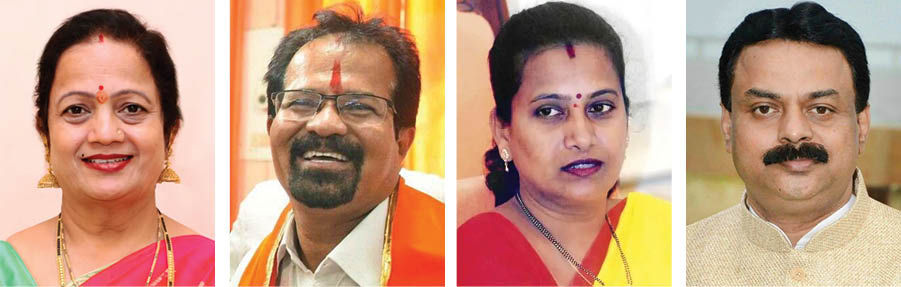
After four years, Mumbai to salute its first citizen Kishori Pednekar Vishwanath Mahadeshwar Snehal Ambekar Sunil Prabhu Mumbai: As the date for appointing Mumbai’s First Citizen looms closer, various political parties have adopted tough posturing to foist their own person for the coveted post of Mayor – the ‘face’ of the country’s commercial capital. Ruling Mahayuti allies Bharatiya Janata Party (BJP) and Shiv Sena have vowed that the city...

Seventy-six mayors ruled BMC since 1931

After four years, Mumbai to salute its first citizen Kishori Pednekar Vishwanath Mahadeshwar Snehal Ambekar Sunil Prabhu Mumbai: As the date for appointing Mumbai’s First Citizen looms closer, various political parties have adopted tough posturing to foist their own person for the coveted post of Mayor – the ‘face’ of the country’s commercial capital. Ruling Mahayuti allies Bharatiya Janata Party (BJP) and Shiv Sena have vowed that the city will get a ‘Hindu Marathi’ person to head India’s richest civic body, while the Opposition Shiv Sena (UBT)-Maharashtra Navnirman Sena also harbour fond hopes of a miracle that could ensure their own person for the post. The Maharashtra Vikas Aghadi (MVA) optimism stems from expectations of possible political permutations-combinations that could develop with a realignment of forces as the Supreme Court is hearing the cases involving the Shiv Sena-Nationalist Congress Party this week. Catapulted as the largest single party, the BJP hopes to install a first ever party-man as Mayor, but that may not create history. Way back in 1982-1983, a BJP leader Dr. Prabhakar Pai had served in the top post in Mumbai (then Bombay). Incidentally, Dr. Pai hailed from Udupi district of Karnataka, and his appointment came barely a couple of years after the BJP was formed (1980), capping a distinguished career as a city father, said experts. Originally a Congressman, Dr. Pai later shifted to the Bharatiya Janata Party, then back to Congress briefly, founded the Janata Seva Sangh before immersing himself in social activities. Second Administrator The 2026 Mayoral elections have evoked huge interest not only among Mumbaikars but across the country as it comes after nearly four years since the BMC was governed by an Administrator. This was only the second time in the BMC history that an Administrator was named after April 1984-May 1985. On both occasions, there were election-related issues, the first time the elections got delayed for certain reasons and the second time the polling was put off owing to Ward delimitations and OBC quotas as the matter was pending in the courts. From 1931 till 2022, Mumbai has been lorded over by 76 Mayors, men and women, hailing from various regions, backgrounds, castes and communities. They included Hindus, Muslims, Christians, Parsis, Sikhs, even a Jew, etc., truly reflecting the cosmopolitan personality of the coastal city and India’s financial powerhouse. In 1931-1932, the Mayor was a Parsi, J. B. Boman Behram, and others from his community followed like Khurshed Framji Nariman (after whom Nariman Point is named), E. A. Bandukwala, Minoo Masani, B. N. Karanjia and other bigwigs. There were Muslims like Hoosenally Rahimtoola, Sultan M. Chinoy, the legendary Yusuf Meherally, Dr. A. U. Memon and others. The Christian community got a fair share of Mayors with Joseph A. D’Souza – who was Member of Constituent Assembly representing Bombay Province for writing-approving the Constitution of India, M. U. Mascarenhas, P. A. Dias, Simon C. Fernandes, J. Leon D’Souza, et al. A Jew Elijah Moses (1937-1938) and a Sikh M. H. Bedi (1983-1984), served as Mayors, but post-1985, for the past 40 years, nobody from any minority community occupied the august post. During the silver jubilee year of the post, Sulochana M. Modi became the first woman Mayor of Mumbai (1956), and later with tweaks in the rules, many women ruled in this post – Nirmala Samant-Prabhavalkar (1994-1995), Vishakha Raut (997-1998), Dr. Shubha Raul (March 2007-Nov. 2009), Shraddha Jadhav (Dec. 2009-March 2012), Snehal Ambedkar (Sep. 2014-March 2017). The last incumbent (before the Administrator) was a government nurse, Kishori Pednekar (Nov. 2019-March 2022) - who earned the sobriquet of ‘Florence Nightingale’ of Mumbai - as she flitted around in her full white uniform at the height of the Covid-19 Pandemic, earning the admiration of the citizens. Mumbai Mayor – high-profile post The Mumbai Mayor’s post is considered a crucial step in the political ladder and many went on to become MLAs, MPs, state-central ministers, a Lok Sabha Speaker, Chief Ministers and union ministers. The formidable S. K. Patil was Mayor (1949-1952) and later served in the union cabinets of PMs Jawaharlal Nehru, Lah Bahadur Shastri and Indira Gandhi; Dahyabhai V. Patel (1954-1955) was the son of India’s first Home Minister Sardar Vallabhbhai Patel; Manohar Joshi (1976-1977) became the CM of Maharashtra, later union minister and Speaker of Lok Sabha; Chhagan Bhujbal (1985-1986 – 1990-1991) became a Deputy CM.

The Prince Who Didn’t Rule

Raj Thackeray’s MNS remains electorally irrelevant but politically potent.

On March 9th 2006, a fiery new force emerged in Maharashtra’s political theatre. The Maharashtra Navnirman Sena (MNS), founded by Raj Thackeray, promised to champion the cause of the Marathi Manoos with the same ferocity once associated with his uncle, Balasaheb Thackeray, though with a tone and trajectory all his own.


19 years on, the party has no MLAs, no MPs, and not a single representative in any major elected body. Yet thousands of karyakartas remain steadfastly loyal to Raj, a testament to his enduring charisma in an age when political allegiance is often as fleeting as a viral trend. In an era marked by scepticism and political churn, such unwavering devotion is not just rare but revealing.


Despite his electoral irrelevance, Raj continues to command disproportionate attention. A recent MNS-led protest demanding the use of Marathi in banks, which spiralled into headline-grabbing incidents including the assault of non-Marathi-speaking staff, put the party back in the national spotlight. Few outfits without legislative clout manage to stay so visible.


Observers suggest the protest may not have been entirely spontaneous. Some speculate it had the tacit blessing of the BJP, which stands to benefit from the rekindling of Marathi identity politics as it navigates its uneasy alliance with both factions of the Shiv Sena - led separately by Eknath Shinde and Uddhav Thackeray. In this context, Raj serves as a useful disruptor: able to attack both camps while the BJP maintains plausible deniability.


In Maharashtra’s ever-shifting political landscape, Raj Thackeray occupies a peculiar perch - without power, yet powerful.


For all his charisma and cultural heft, Raj Thackeray has never translated popularity into power. 20-somethings often wonder if he is so influential, why doesn’t he win?


The answer lies in Maharashtra’s fractured caste landscape. Unlike his uncle, Balasaheb Thackeray, who once rallied a unified Marathi vote under the Shiv Sena banner, Raj has resisted caste arithmetic. He speaks of Marathi pride, not Maratha or Dalit pride. While this gives him ideological clarity, it deprives him of the alliances needed to win elections in an era when politics is carved into caste and community silos.


And yet, despite never holding a seat in the Assembly or Parliament, Raj Thackeray continues to cast a long shadow over the state’s political landscape. With his acerbic wit, his speeches trend on social media, and his hold over the Marathi-speaking urban middle class particularly in Mumbai and Pune remains potent. His warnings are often cultural rather than electoral: that the Marathi manoos is distracted, atomised by caste, seduced by consumerism and forgetful of his linguistic heritage.


For this generation, raised on English and digital consumerism, Raj serves as a paradox: modern in tone, yet rooted in tradition. His insistence that speaking Marathi in Maharashtra is not chauvinism but cultural preservation finds resonance even among critics who disagree with his methods.


His recent protest demanding the use of Marathi in banks, though marred by incidents of aggression, dominated headlines, proving that political relevance need not depend on seats alone. Some observers suspect these agitations are quietly abetted by the BJP, which sees in Raj a useful ally to needle both Shiv Sena factions. His attacks on Uddhav Thackeray and Eknath Shinde, often cutting and personal, offer the BJP a convenient battering ram without soiling its own gloves.


But this strategic ambiguity has begun to chafe at his cadre. The sudden escalation and soft withdrawal of the bank protest raised questions: is Raj still scripting his own battles, or merely acting in someone else’s play?


Still, few leaders in Maharashtra can match his ability to command attention. Even political rivals tread carefully. At a recent gathering, he mocked the sanctimony of religious symbolism, questioned the quality of the Ganga’s water during the Kumbh Mela, and derided the ostentatious wealth of a jailed BJP functionary with the quip: “The whole Assembly is full of Khokya Bhais.” The line went viral.


To sustain this relevance, however, the MNS must go beyond the language plank. It needs a generational pivot, digital-first outreach, issue-based campaigns on housing, education, urban development and a pipeline for young leadership. It must decide: does it wish to remain a voice of dissent, or graduate into a credible governing force?


For now, Raj Thackeray is still the storm that hasn’t yet turned into a cyclone. But Maharashtra’s weather is famously fickle, and if caste politics falters or urban angst grows, the MNS may still find its moment in the sun.

Comments


bottom of page