

The Tariff Tango

While A Modi-Trump phone call has reopened diplomatic space for trade talks, Piyush Goyal now has the harder task of turning a thaw in rhetoric into a workable deal.
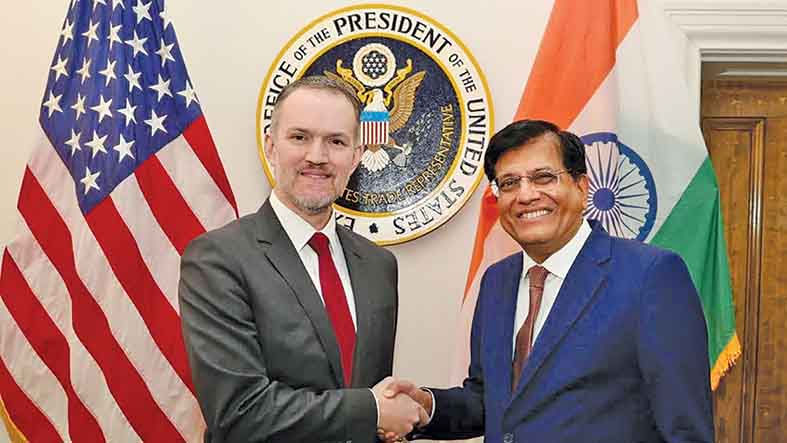
Minister of Commerce and Industry Piyush Goyal is in the United States at a particularly delicate moment in the country’s trade relations with Washington. His visit, from September 29 to October 5, comes as India and the US try to bridge differences over tariffs, market access and the proposed Bilateral Trade Agreement.
The timing has been given an additional diplomatic lift by a telephone conversation between Prime Minister Narendra Modi and US President Donald Trump. The two leaders reviewed cooperation in trade, defence, energy and critical technologies and reaffirmed their commitment to advancing the India-US Comprehensive Global Strategic Partnership. For Goyal, however, the harder work begins at the negotiating table.
He is participating in the G20 Trade Ministers’ Meeting in Milwaukee and holding discussions with American officials, while also meeting representatives of US industry, investors and the Indian community. The objective is to advance a balanced and mutually beneficial trade arrangement at a time when the relationship is being tested by tariffs, energy concerns and competing domestic interests.
Goyal’s task is to determine how much room there is for compromise and whether that room is large enough to produce an agreement that both sides can take home.
The difficulty is that the two countries are negotiating not merely over tariffs but over the very architecture of their economic relationship.
The India-US relationship has travelled a long way to reach this point. During the Cold War, New Delhi and Washington often found themselves on opposite sides of the geopolitical divide. India’s non-alignment and its close relationship with the Soviet Union sat uneasily with American strategic priorities. The relationship began to change after the Cold War, as economic liberalisation in India coincided with the emergence of a more fluid international order.
For India, the American market offers enormous opportunity, but opening it further carries consequences for Indian producers. For Washington, the objective is greater access and what the Trump administration regards as more reciprocal trading arrangements.
The latest complication comes from energy. New US legislation has authorised the President to impose tariffs of up to 100 percent on countries purchasing Russian energy. India, a significant buyer of Russian crude, is potentially exposed to the measure. The provision does not automatically impose a 100 percent tariff on India, but its existence has introduced another uncertainty into an already complicated negotiation.
That makes the Modi-Trump conversation more than diplomatic choreography. Direct communication between leaders can sometimes prevent technical disagreements from becoming political ruptures. But it cannot substitute for the painstaking work of deciding what each side will concede and what it will retain.
Goyal’s unglamorous task is to navigate the gap between strategic friendship and commercial self-interest. India and America can describe each other as strategic partners while disagreeing sharply over tariffs, market access and energy. Indeed, the durability of the partnership may partly depend on whether such disagreements can be contained without allowing them to infect the wider relationship.
The September 30 call at least provided a favourable diplomatic backdrop. Yet the American side has made clear that an agreement is not around the corner. US Trade Representative Jamieson Greer said on October 1 that negotiations were continuing and described his conversation with Goyal as constructive, but said a deal was not imminent.
That is a useful corrective to the temptation to read every diplomatic contact as a breakthrough.
India-US relations have travelled a considerable distance from the estrangements of the past. Defence cooperation has expanded; strategic coordination has deepened and collaboration in critical and emerging technologies has acquired new importance. The economic relationship is now an essential part of that larger partnership.
For Goyal, the immediate objective is to keep the negotiations alive, narrow the areas of disagreement and establish the basis for an interim arrangement without compromising India’s core economic interests. For Modi and Trump, the task is to ensure that a dispute over tariffs does not become a dispute over the partnership itself.
The fortunes of India-US trade will only turn if both sides can find a bargain sufficiently balanced to survive the politics at home and sufficiently useful to strengthen the partnership abroad. Goyal’s real test will be not whether he can produce a dramatic breakthrough, but whether he can make that difficult bargain possible.
(The writer is a foreign affairs expert. Views personal.)


Comments