top of page

By:

Abhijit Mulye

21 August 2024 at 11:29:11 am

Fadnavis writes off Rs 48,000 crore

Mumbai: In a clear indication that the Maharashtra government is leaving no stone unturned to keep the state’s agrarian base happy, Chief Minister Devendra Fadnavis has unleashed yet another massive populist measure. Hot on the heels of relaxing the eligibility criteria to ensure a blanket farm loan waiver, the Chief Minister announced a sweeping Rs 48,000 crore waiver on the pending electricity bills of farmers across the state. Addressing a ‘Krutadnyata Sohala’ (gratitude ceremony)...

Fadnavis writes off Rs 48,000 crore

Mumbai: In a clear indication that the Maharashtra government is leaving no stone unturned to keep the state’s agrarian base happy, Chief Minister Devendra Fadnavis has unleashed yet another massive populist measure. Hot on the heels of relaxing the eligibility criteria to ensure a blanket farm loan waiver, the Chief Minister announced a sweeping Rs 48,000 crore waiver on the pending electricity bills of farmers across the state. Addressing a ‘Krutadnyata Sohala’ (gratitude ceremony) organized by the BJP Kisan Morcha at Mumbai’s Yashwantrao Chavan Pratishthan on Wednesday, Fadnavis declared that farmers using agricultural pumps of up to 7.5 horsepower will see their historical electricity dues completely wiped out. The announcement was met with the traditional sounding of the Tutari and thunderous applause from hundreds of farmers who had gathered from every corner of the state. The Chief Minister framed the mega-sop as a necessary step to “wipe the farmers’ slate clean,” enabling them to write a new chapter of prosperity. Calculated Pitch The timing and scale of the announcement underscore a government that is boldly embracing populist economics to solidify its political footprint in rural Maharashtra. While Fadnavis maintained that these decisions were taken purely in the interest of the farmers—pointing out that the original loan waiver was announced when no elections were in sight—the political undertones were unmistakable. Taking a sharp dig at the opposition, the Chief Minister accused rival parties of running “political shops” in the name of farmer agitations without understanding the government’s genuine intent. Asserting his grassroots connection, Fadnavis proudly claimed, “I do not make decisions sitting in my house. I am a farmer myself, a man of the soil.” He openly defended the government’s recent move to strip away the stringent conditions attached to the blanket farm loan waiver, signaling that his administration will not hesitate to clear bureaucratic hurdles if it means putting money directly into the hands of the rural voter. Balancing Sops Even as he rained freebies, the Chief Minister attempted to balance the populist optics with a dose of economic pragmatism. He acknowledged that handing out repeated loan waivers is a symptom of deep-rooted agrarian distress, not a permanent cure. Pointing to the Rs 95,000 crore in aid currently being pumped into the agricultural sector by the state and central governments, Fadnavis outlined his administration’s shift toward an investment-driven agricultural model. He championed the success of schemes like ‘Jalyukt Shivar’ and ‘Magel Tyala Shettale’ (farm ponds on demand), claiming these initiatives have already empowered farmers to harvest multiple crops a year. Addressing the core issue of farming costs, he noted that the government already subsidises power to the tune of Rs 25,000 crore annually. By coupling this with a push for solar pumps and solar agricultural feeders, he promised that 100 percent of the state’s farmers would receive uninterrupted daytime electricity by the end of the year. Infra Dream Looking beyond immediate financial relief, the Chief Minister laid out a grandiose vision to permanently drought-proof Maharashtra’s most vulnerable regions. A staggering Rs 6 lakh crore infrastructure pipeline is being planned to ensure the next generation never witnesses a drought. Fadnavis detailed ambitious river-linking projects, including the Wainganga-Nalganga link, to divert excess floodwaters to parched regions. The state plans to construct 24 new dams and raise the height of 16 existing ones to ensure not a single district in Vidarbha faces water scarcity. Furthermore, massive engineering feats are on the drawing board to divert 200 TMC of floodwater from Western Maharashtra to Marathwada, and lift 275 TMC of wasted water from the Ulhas basin to quench the thirst of North Maharashtra and Marathwada. By marrying immediate, massive debt relief with long-term infrastructure promises, the Fadnavis administration is aggressively cementing its pro-farmer narrative. As the Yashwantrao Chavan auditorium echoed with whistles and cheers, it became highly evident that the government’s strategy of pairing mega populist waivers with big-ticket rural dreams is striking a powerful chord with the state’s agrarian voters.

‘Tiger’ shrinks to an ‘alley cat’
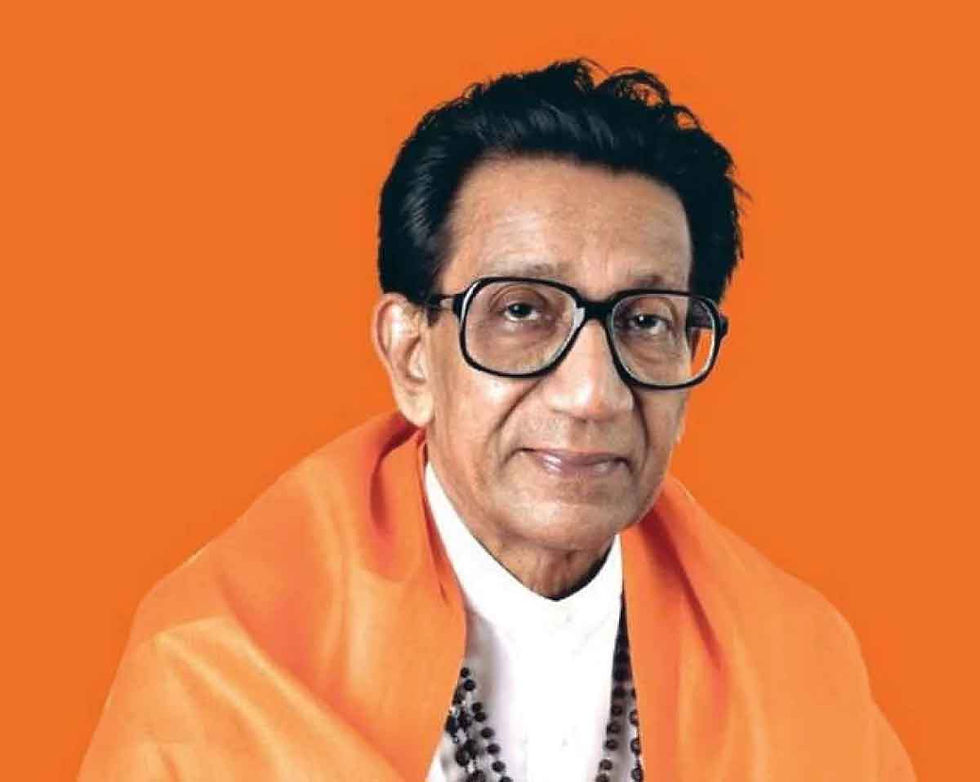
The Shiv Sena founded by the late Balasaheb Keshav Thackeray in 1966 may have little reason to celebrate its Diamond Jubilee tomorrow – in his birth centenary year.


For the second time in four years today, the party – now, Shiv Sena (UBT) - has suffered a potential split, ironically led by Eknath Shinde who first broke away on June 21, 2022.


Political soothsayers aver that this time the bodily harm is serious and the wound goes deep, so the party - which espoused the cause of the ordinary Marathi manoos and the lofty Hindutva - may not survive another hit in future.


In the past 60-years of its high-profile existence - in power for around17-and-half years and the rest in the limelight – the party has had its share of rebellions and splits, but it managed to bounce back due to the sheer awe of the Thackeray surname.


It all started 35 years ago with the doughty Chhagan Bhujbal who dared to bare the Shiv Sena’s shortcomings and quit in Dec. 1991 – stunning the party that ran on the signals or just a wave of Balasaheb’s hand. His abrupt exit along with 18 MLAs after a tiff with his mentor. Though many MLAs returned as Balasaheb roared his disapproval, Bhujbal seemed to politically flourish and made it to the post of Deputy CM, and later as Minister for many years.


After deserting Balasaheb, Bhujbal had joined the Congress, then led by Sharad Pawar who later broke off to form the Nationalist Congress Party (NCP) in 1999 where Bhujbal followed him. However, in July 2023, when the late Ajit Pawar split the party founded by his uncle, Bhujbal went with him, dumping his original Guru, Sharad Pawar, now left with the NCP (SP).


Come 2005, there was another huge blow when ex-Chief Minister and the then Leader of Opposition in Assembly Narayan Rane was expelled by Balasaheb following (Rane’s) differences with Uddhav Thackeray, then the party’s Executive President. Rane hopped over to the Congress on the assurance of getting the CM’s gaddi, but it never came, so he quit the party to form his own outfit, which he merged with the Bharatiya Janata Party and became a union minister.


In November 2005, Balasaheb’s nephew Raj Thackeray resigned from the party after multiple tiffs with his cousin, Uddhav, and four months later, founded the Maharashtra Navnirman Sena (MNS), which has yet to taste power. For nearly two decades, the warring cousins were practically at each other’s political throats, but in mid-2025, they finally hugged, kissed and made up for the larger cause of Marathi language, the Marathi Manoos, and other common points.


When Uddhav broke ranks with the BJP to become the Maha Vikas Aghadi (MVA) Chief Minister, he got a rudest jolt of his life when Eknath Shinde masterminded a rebellion, took away 40 MLAs and toppled him from the ‘gaddi’. Shinde allied with the BJP to become the CM of the Maha Yuti government for almost two-and-half years. However, after the Nov. 2024 elections, the BJP made him the Deputy CM, and later Ajit Pawar joined as the second Deputy CM in July 2023.


When the MVA of SS (UBT), Congress and NCP (SP) notched a spectacular performance in the 2024 Lok Sabha elections getting 31 of the 48 seats they contested, all eyes were on its MPs, but later the Maha Yuti romped home in the November 2024 Assembly elections.


After long planning and strategizing, Shinde allegedly launched the Operation Tiger and is one the verge of weaning away 6 out of 9 SS (UBT) Lok Sabha MPs – a second vertical split the Uddhav-led party suffered in four years.


Over the past three decades, there were other ‘ayarams’ and ‘gayarams’ including the aggressive Sanjay Nirupam, who quit the (undivided) Shiv Sena, joined the Congress and is currently with Shinde’s party.

Comments


bottom of page