

Tracing the Fuel of Stars
GMRT detects radio signal emitted by atomic hydrogen from galaxies that existed more than eight billion years ago.
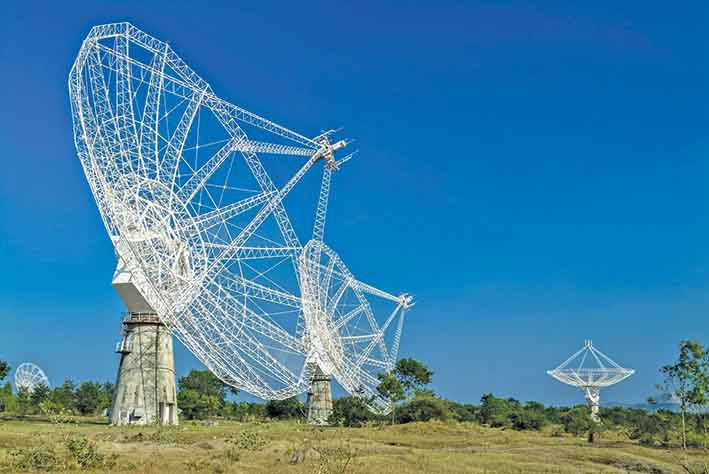
A team of Indian astronomers has used the Giant Metrewave Radio Telescope (GMRT) near Pune to detect the average radio signal emitted by atomic hydrogen, known as the HI 21 cm signal, from galaxies that existed 8-9 billion years ago.
The GMRT detection from the galaxies in a patch of sky known as the COSMOS field is only the second measurement of the average atomic hydrogen content of galaxies 8 billion years ago, and confirms the earlier results by the team in a different part of the sky.
In a galaxy, stars form from molecular hydrogen, and the molecular hydrogen is formed from atomic hydrogen. Atomic hydrogen is thus the primary fuel for the formation of stars in a galaxy. To understand how galaxies evolve over cosmic time, we have to understand the evolution of both the stars and the gas within galaxies. This requires us to measure the mass of both stars and atomic hydrogen in galaxies at different eras in the Universe’s timeline. An important open question in astronomy is how the amount of the atomic hydrogen in these early galaxies changes with time. Of particular interest in the cosmic timeline is the epoch, approximately 8 to 10 billion years ago, of the highest star-formation activity of the Universe.
Specifically, why did the starformation activity in the Universe decline steeply after the peak activity, 8 billion years ago? The amount of atomic hydrogen in a galaxy can be studied by observing a radio signal emitted by the hydrogen atom, at a wavelength of approximately 21 cm.
This is known as the HI 21 cm signal, and can be detected from galaxies using radio telescopes. To measure the atomic hydrogen content of galaxies in the young Universe, 8 billion years ago, we have to detect the HI 21 cm signal from very distant galaxies. Since the signals from these galaxies take billions of years to reach us, we are seeing the galaxies as they were billions of years ago. Unfortunately, detecting the HI 21 cm signals from very distant galaxies is extremely challenging due to the intrinsic faintness of the HI 21cm signal and the presence of strong human-made radio frequency interference signals at the same radio frequencies. “To detect this extremely faint signal, we used the GMRT to look at a region in the sky called the COSMOS field for more than 200 hours. And we aligned the HI 21cm signals of nearly 10,000 galaxies and then averaged them together, to measure the average atomic hydrogen content of the galaxies.”, said Balpreet Kaur, the lead author of the study, currently a post-doctoral fellow at the Inter-University Centre for Astronomy and Astrophysics (IUCAA), Pune, and earlier a Ph.D. student at the NCRA-TIFR, Pune. The GMRT results reveal that these early galaxies contained much more atomic gas compared to galaxies that we see around us today. However, the rate at which these galaxies formed stars is also much higher than that of galaxies today. The GMRT results show that these galaxies 2 consume their gas very quickly in the process of star-formation. If the galaxies do not acquire more gas from their surroundings, they would run out of the fuel for star-formation. Kaur added, “This provides a natural explanation for the observed drop in the star-formation activity of the Universe over the last 8 billion years.”
“The COSMOS region is very interesting because of the vast information available on its galaxies from multi-wavelength observations. We can now try to connect the atomic hydrogen properties of the COSMOS galaxies to their other properties and environments, which has not been possible at these epochs.”, said Jayaram N. Chengalur, a co-author of the study.
The GMRT is a world-class, low frequency radio telescope built and operated by the National Centre for Radio Astrophysics (NCRA), a unit of the Tata Institute of Fundamental Research (TIFR), an aided institute under the Department of Atomic Energy (DAE). The main science goal for building the GMRT, nearly 40 years ago, was to detect the HI 21 cm signal from galaxies early in the Universe. The upgrade of the GMRT nearly a decade ago, with new receivers, a new correlator, and new electronics, has rejuvenated the telescope, allowing astronomers to finally measure the atomic hydrogen properties of early galaxies, significantly improving our understanding of galaxy evolution.


Comments