
Two Roads from Baramati

As NCP (SP) chief Sharad Pawar reaffirms his opposition credentials, NCP leader Sunetra Pawar focuses on consolidating her faction within the Mahayuti.

The two factions of the Nationalist Congress Party (NCP) are pursuing distinct political agendas in Maharashtra. While Sharad Pawar has ruled out a merger or realignment and is seeking to strengthen his party in the opposition, Sunetra Pawar is consolidating the faction aligned with the ruling Mahayuti government, with an eye on organisational stability and upcoming Legislative Council elections. Their recent moves reflect the continuing divergence between the two camps.
Merger Debate
The NCP, one of Maharashtra’s significant political parties, has been divided into two factions for the past few years. One is led by the patriarch Sharad Pawar, the other is headed by Deputy Chief Minister Sunetra Pawar, wife of the late Ajit Pawar, which is part of the ruling Mahayuti alliance alongside the BJP and Eknath Shinde’s Shiv Sena.
Speculation about a possible merger between the two factions, or the Sharad Pawar-led NCP (SP) joining the ruling side, gathered attention in recent weeks. There was also talk of the faction aligning with the BJP-led National Democratic Alliance (NDA) at the national level.
Last month, Sharad Pawar sought to end speculation by addressing party workers in Mumbai. “We are not going anywhere. We will not go with anyone. If you want to come, come with us,” said the 85-year-old leader.
Pawar maintained that the NCP (SP) would remain an independent political entity and would not merge with another party. While those willing to join his organisation were welcome, he made it clear that his faction would not abandon its separate identity.
He also reaffirmed the party’s commitment to the opposition, including the Maha Vikas Aghadi (MVA) in Maharashtra, alongside the Congress and Uddhav Thackeray-led Shiv Sena, and the INDIA alliance at the national level.
Party leaders, including Shashikant Shinde, backed this position, arguing that any future unity would have to take place on Sharad Pawar’s terms, with the other faction joining the NCP (SP).
Pawar also raised concerns about drought and farmers’ distress, warning that his party would take to the streets if the government failed to provide adequate assistance.
Students’ Agitation
While Sharad Pawar clarified his party’s political position, his grandnephew Rohit Pawar, an NCP (SP) MLA, was lending support to a protest by students preparing for examinations conducted by the Maharashtra Public Service Commission (MPSC).
The agitation has centred on allegations of examination irregularities, delays in recruitment and concerns over the commission’s functioning. Students have demanded the resignation of MPSC chairman Vivek Bhimanwar, fair and timely examinations, recruitment to around 70,000 posts, and a more accessible examination schedule throughout the year.
Rohit Pawar joined the students’ march in early September and subsequently announced his support for their sit-in protest. Police denied permission for certain dates because of the Ganesh festival, prompting changes to the protest schedule.
Pawar has remained a prominent political figure at the protest site, sitting alongside students, addressing the gathering and urging the government not to suppress the agitation. He has described the issue as one concerning students’ future rather than merely a political contest.
He has also called on the government to hold discussions with a delegation of students and address their principal demands. The agitation has provided the NCP (SP) with a platform to raise questions about recruitment, examination procedures and employment opportunities for young people.
Council Polls
Sunetra Pawar’s faction, meanwhile, is operating within the ruling alliance while attending to party organisation and electoral preparations.
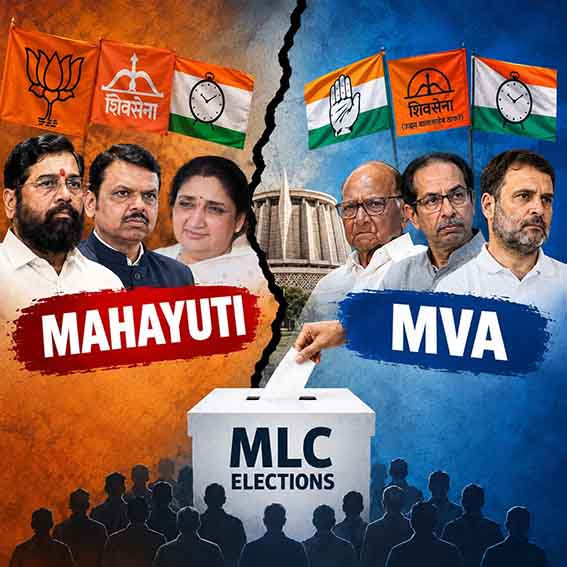
Among the party’s immediate priorities are elections to Maharashtra Legislative Council constituencies representing graduates and teachers. These constituencies have distinct electorates and require parties to mobilise support among registered graduate and teacher voters.
The Mahayuti alliance has finalised a seat-sharing arrangement under which the BJP will contest three seats, the Shiv Sena one and the NCP one. The NCP has been allotted the Chhatrapati Sambhajinagar Graduates’ constituency, formerly known as the Aurangabad Graduates’ seat.
On October 5, NCP state president Sunil Tatkare announced that sitting MLC Satish Chavan would contest the seat again. Chavan has represented the constituency for three consecutive terms since 2008.
The faction is also focusing on teacher and graduate voter groups, strengthening its district-level organisation and coordinating its workers ahead of the polls. These efforts come amid questions about the party’s leadership and organisational direction following Ajit Pawar’s death.
Sunetra’s immediate challenge is to maintain organisational cohesion while managing the faction’s responsibilities within the government and preparing it for electoral contests.
Both factions are also responding to wider concerns in Maharashtra, particularly drought and the distress facing farmers. Sharad Pawar’s faction has pressed the government for relief and threatened agitation if assistance proves inadequate. The ruling alliance, meanwhile, faces the responsibility of addressing these demands while managing the state’s day-to-day administration.
Political attention is also turning towards Baramati, the Pawar family’s traditional stronghold. Prime Minister Narendra Modi has been invited to inaugurate Prerna Sthal at Vidya Pratishthan in Baramati on November 3, an event likely to attract attention because of the family’s long-standing political influence in the region.
For now, the two NCP factions are following separate political trajectories. Sharad Pawar’s NCP (SP) is emphasising its opposition identity, supporting student protests through leaders such as Rohit Pawar and rejecting speculation about a merger or realignment. Sunetra Pawar’s faction is concentrating on its role in the Mahayuti government, maintaining its organisation and preparing for the Legislative Council elections.
The coming weeks will bring further tests for both camps, from the students’ agitation and farmers’ demands to the electoral challenge among graduate and teacher constituencies. Their approaches may differ, but both factions remain engaged in the effort to preserve and expand their respective political bases. How these parallel tracks evolve will shape the next phase of the NCP’s divided politics in Maharashtra.
(The writer is a political observer. Views personal)

Comments