
We Need the Ritual, But Not the Ritualist

The purohita is often condemned as a symbol of Brahminical patriarchy until the same critics suddenly discover the uses of tradition.
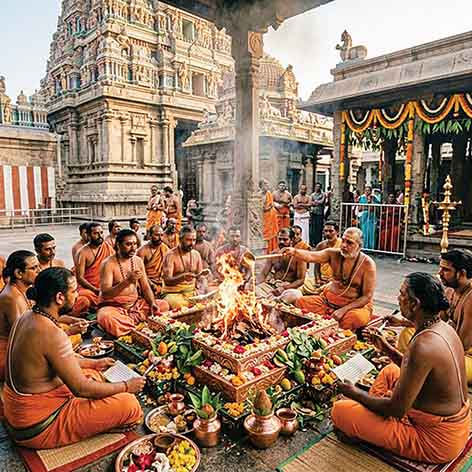
Purohita! Ah, here he comes, the Manuvadi, the alleged emblem of Brahminical hegemony, the agent of ritual hierarchy, the custodian of oppressive Sanskrit, the representative of “upper-caste privilege,” the last surviving relic of an allegedly fossilised social order. Give him a few more academic labels and he can probably be blamed for everything from patriarchy to global warming. He is the Brahminical gatekeeper, the custodian of ritual power, the agent of Sanskritic domination, the beneficiary of graded hierarchy, the reproducer of caste consciousness and, naturally, the fellow who has apparently been sitting in the same corner for a thousand years waiting to oppress somebody. The vocabulary is impressive. But what exactly do these grand terms mean when applied to an ordinary purohita?
Tyrants with Mantras
Brahminical hegemony, what a magnificent phrase! Brahminical hegemony makes him sound like the head of an invisible empire. Ritual hierarchy makes him sound like Hitler, keeping Jews in concentration camps. Sanskritic domination makes learning Sanskrit sound like the Taliban destroying the ancient Buddha statues. Gatekeeping suggests that he personally holds the keys to an enormous fortress called Hinduism.
Reproduction of caste consciousness gives him the extraordinary responsibility of bombing the shelters of other communities every time he recites a ritual mantra. The vocabulary is certainly impressive; the purohita, apparently, is no longer a man performing a ritual but a one-man army of oppression.
Now turn the page. Across Bharat, there are several temples where non-Brahmins serve as purohitas. They recite mantras, perform puja, conduct rituals and carry forward the traditions entrusted to them by their respective communities.
So, if the mere act of reciting a mantra is supposedly an instrument of “Brahminical hegemony,” what happens when the person reciting it is not a Brahmin? Does the mantra suddenly lose its hegemonic power? Does the ritual hierarchy take a day off? Or does Sanskritic domination politely step aside and say, “Sorry, wrong person”? Perhaps the reality is a little more complicated than the vocabulary suggests. Hindu ritual traditions have never been a single, uniform system with one type of ritualist standing at its centre. Different temples, communities, sampradayas and regional traditions have had their own ritual specialists. The moment we acknowledge this diversity, the neat caricature begins to fall apart.
Double Standards
Our beloved former CM of Karnataka, Siddaramaiah Ji, what a man! He challenged Brahminical patriarchy, dismantled the Hindu Sanghi sect, and established AHINDA politics, becoming the great empire-maker of the AHINDA kingdom. He invited Banu Mushtaq to inaugurate Mysuru Dasara at Chamundi Hills! what a progressive leader! And now, according to posts circulating on X, this highly progressive leader invited Hindu priests to perform Gana Homa, Vastu Homa, and Griha Pravesha at his residence according to Hindu traditions. But wait, this man invited purohitas? The very Brahminical gatekeepers, custodians of ritual power, and agents of Sanskritic domination? “Oh, Siddaramaiah Ji! Perhaps he was inspired by his high-command leader Rahul Ji, who has publicly identified himself as a Kaul Brahmin. But then, one wonders, why stop there? If a purohita was invited for the Griha Pravesha, why not invite Rahul Ji or Banu Mustaq Ji as well?
Udhayanidhi Stalin has made his well-known remarks on Sanātana Dharma, while his 2020 visit to the Dharmapuram Adheenam to seek blessings remains a rather curious footnote. The contrast is difficult to miss: Sanātana may be criticised in public, but a traditional Hindu institution can still be approached for blessings. And then there is U. R. Ananthamurthy. Through Samskara and much of his public intellectual life, he subjected Brahminical ritualism, orthodoxy and Hindu social practices to relentless literary and intellectual scrutiny. Yet the irony becomes particularly striking at the end. When his own final samskara had to be performed, the rituals were conducted according to the Madhva Brahmin tradition, with Vedic chants and a team of priests.
Contemporary reports stated that these rites were carried out in accordance with his wishes. So, apparently, the purohita who can become the villain of a literary critique can still become rather important when one’s own final journey arrives. The Brahminical ritual world may be questioned, dissected and challenged in intellectual discourse, but when it came to his own samskara, Ananthamurthy wanted the Madhva tradition to perform the very ritual that would accompany him on his final journey.
And then there is Prakash Raj. A vocal critic of Hindutva politics and someone who has repeatedly questioned what he sees as majoritarian and Brahminical politics. Yet when his wife visited Kukke Subramanya seeking the deity’s blessings, he reportedly responded that she was a devotee and that he respected her faith. Fine. But then comes the obvious question: why should her devotion deserve respect while the devotion of millions of ordinary Hindus deserves ridicule or suspicion? Is her faith somehow more respectable because she happens to be his wife? Are the emotions of ordinary Hindus who stand in the same queue, fold their hands before the same deity and place their faith in the same tradition somehow less worthy of respect? If one genuinely believes in respecting another person’s faith, perhaps that principle should not stop at the family doorstep.
And then cinema adds another layer of irony. In Seethamma Vakitlo Sirimalle Chettu, Prakash Raj plays the father, and Lord Rama appears in the film’s concluding emotional sequence. So the cultural symbols that can become targets of ideological criticism can also become perfectly acceptable when they enter a temple, a family story or a commercial film.
One may reasonably ask: where exactly does ideology end and professional convenience begin? Perhaps the gods have discovered that ideological boundaries become remarkably flexible when faith belongs to the family and Itihasa belongs to the box office. Sadly, this is the situation, faith is respected when it is personal, but ridiculed when it belongs to millions of ordinary Hindus.
Perhaps the real test of progress is not learning to respect one’s own circle, but learning to respect the faith of those outside it too.
Casual Ridicule
Sadly, this is the situation we have created. People become extremely cautious when it comes to criticising certain communities, religions and religious leaders, carefully choosing every word lest it offend someone. But when the subject is the purohita, that caution mysteriously disappears. On Facebook and other social-media platforms, slang, ridicule and even abusive language are casually thrown at purohitas, as though the person performing a religious duty has somehow become an acceptable target for public humiliation. The most striking part is that this is often done in the name of being progressive. So, I have a simple question for them: if you do not believe in the system, why do you have to ridicule the person who performs it? If you do not accept the ritual, don't participate in it. If you don't believe in the mantra, don't recite it. But why turn the purohita himself into an object of abuse?
For many, purohitya is more than a profession; it is a lifelong dedication to learning mantras, preserving rituals and serving a devata and community. India’s ritual traditions are equally diverse. Across villages, temples and Grama Devata traditions, numerous non-Brahmin communities have preserved and performed their own forms of worship for generations. Respect should not depend on whether the purohita is Brahmin or non-Brahmin; the responsibility itself deserves dignity. The purohita is not merely a man standing before a fire, but a human being carrying tradition and responsibility. We may question a ritual or reject a belief, but disagreement need never become humiliation.
(The writer is a Bengaluru-based author and scholar. Views personal.)


Comments