

Why Plastic Persists: It’s All in the Chemistry
- Dr. Sanjay Joshi

- Jan 16
- 3 min read
Plastic pollution has two faces: careless human behaviour and the stubborn chemistry of the material itself.

As I mentioned in my last article, while speaking at the ‘Beat the Plastic Pollution’ seminar, one participant asked how discarded plastic actually pollutes the environment. The answer, I explained, lies on two levels. The first is simple and immediate: our everyday habits of careless disposal—throwing plastic on streets, into drains, water bodies, or open land. This behaviour contaminates soil, air, and water, chokes wildlife, blocks natural drainage systems, and turns public spaces into dumping grounds. This behavioural aspect, rooted in awareness and responsibility, was discussed in detail during that session.
The second answer, however, goes far deeper and is far more complex. It is linked to the very chemical nature of plastics, the enormous volume of waste being generated, their slow degradation, and the toxic substances they release into the environment over time. This is the aspect we now need to examine closely. Let us explore these factors one by one.
As we have learnt before, the average consumer comes into daily contact with all kinds of plastic materials. Most of these plastics are derived from petroleum and can be moulded, cast, spun, or applied as coatings. They are everywhere around us—in packaging, clothing, kitchenware, electronics, construction materials, and countless everyday products.
We have also learnt that plastic is made up of long chains of molecules, arranged in a seemingly endless series of interconnected links. This structure gives plastic its strength, durability, and flexibility. However, it is this very same structure that makes plastic so resistant to breakdown once it is discarded.
In contrast, natural polymers such as rubber and silk are also used and thrown away in large quantities. Yet, these “plastics” made by nature itself have not been blamed for environmental pollution. The reason is simple: they do not persist in the environment for long periods. They degrade or break down naturally. In other words, they are biodegradable and return safely to natural cycles.
Synthetic plastics, however, are very different. Due to their complex chemical composition, most of them are largely non-biodegradable. Not only do they fail to break down easily, but they also resist almost all natural processes of decomposition. As a result, they can remain in the environment for hundreds of years, accumulating steadily with every passing decade.
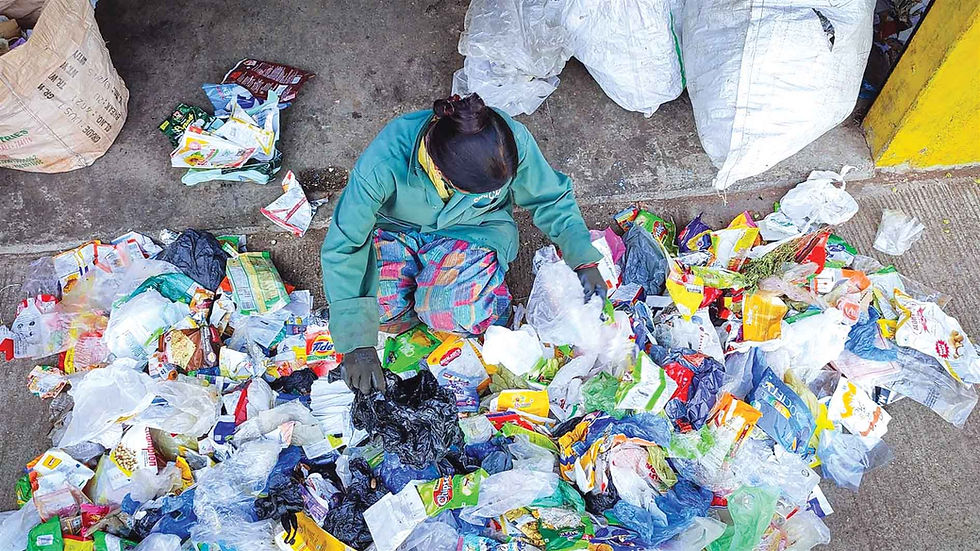
Another major problem lies in the manner in which plastics are disposed of. A large portion of plastic products—especially lightweight, single-use items and packaging—are not properly collected. In fact, such products account for nearly 65 per cent of all plastics produced. Instead of being placed in containers for transport to landfills, recycling centres, or incinerators, they are often discarded carelessly right where their usefulness ends.
They are dropped on the ground, thrown out of stationary or moving cars, buses, or train windows, heaped onto already overflowing dustbins, or simply carried away by a gust of wind. The moment this happens, they begin to pollute the environment. What starts as “just one wrapper” quickly becomes part of a much larger problem.
And sadly, we do not spare even the sea. Consider a ferry ride from the Gateway of India to Alibag or the Gharapuri Caves. During the journey, it is common to see people feeding seagulls with food packed in multilayered plastic pouches and then throwing those empty pouches directly into the water. The sea becomes a dumping ground, right before our eyes.
Nor are our forests and protected areas safe. Forests, wildlife sanctuaries, grasslands, wetlands, and lakes are all increasingly littered with plastic waste. Even the most remote places have not been spared. Plastic has reached Mount Everest, too, carried there by human activity and tourism.
As we shall learn later, the plastic that litters our roads, parks, and public places does not stay there. It is washed into nearby gutters and drainage systems, eventually flowing into rivers and finally into the seas and oceans. What we throw away locally becomes a global problem.
Thank goodness aeroplane windows cannot be opened. Otherwise…! The thought itself is frightening.
Indeed, landscapes littered with plastic packaging have become a common sight in many parts of the world. Illegal dumping and overflowing waste containers further worsen the situation. Plastic pollution today is not just an environmental issue; it is a reflection of how casually we treat our surroundings.
More on this next week. Till then, have a nice weekend!
(The writer is an environmentalist. Views personal.)


Comments