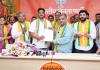
A Setback for the BJP in Western Maharashtra

Pune: The Bharatiya Janata Party’s defeat in the recent Pune Graduates’ constituency election to the Maharashtra Legislative Council is a stark reminder that political influence cannot always be engineered through appointments, strategic alliances and the cultivation of influential families. In Western Maharashtra, where the BJP has been assiduously trying to loosen the longstanding grip of Sharad Pawar and his political network, the result warrants serious introspection.
The constituency encompasses Pune city and a substantial part of Western Maharashtra, a region that has traditionally been Pawar country. Pune, Satara, Sangli and Kolhapur have long been shaped by the political influence of the Pawar family, whose reach extends well beyond electoral politics into cooperative sugar factories, milk producer unions and district cooperative banks. These institutions have historically served as instruments of economic influence and political mobilisation. For the BJP, penetrating this formidable network has been a strategic priority, particularly with an eye on forthcoming Lok Sabha and Assembly elections.
The Pawar Network
The BJP has not been short of ambition or tactical ingenuity. It has attempted to construct an alternative regional leadership by bringing younger Maratha faces into positions of prominence. Murlidhar Mohol’s induction as a Minister of State in the Modi government, alongside organisational responsibilities, was part of this exercise. The party has also accommodated influential members of the Bhosale and Mahadik families in important positions. Chandrakant Patil’s appointment as the Minister for Textiles, meanwhile, carried its own regional significance, given the concentration of spinning mills across this belt.
Taken together, these moves represent a calculated effort to weave a new political network capable of challenging the Pawar establishment. Yet the latest election suggests that political patronage and organisational manoeuvring do not necessarily translate into votes.
The BJP’s choice of Smita Yogesh Jadhav for the Graduates’ constituency was another expression of this strategy. The daughter-in-law of Pratapsinh Jadhav, head of the Dainik Pudhari media group, and granddaughter of the late former Governor D. Y. Patil, she came from a family with considerable political and institutional connections. The Jadhav family has enjoyed a cordial relationship with Prime Minister Narendra Modi, who had personally attended the inauguration of the Pudhari group’s modernised printing facilities. Her husband, Yogesh Jadhav, had also been appointed chairman of the Urvarit Vikas Mahamandal during the first term of the Yuti government.
The family’s political association with the BJP has a longer history. During the crucial 2014 Lok Sabha election, when Modi was seeking a national mandate, Pudhari, a prominent newspaper in Western Maharashtra, extended support to his political project. Its publishers had, moreover, consistently opposed Sharad Pawar’s politics. The Jadhavs’ entry into electoral politics consequently brought them into direct confrontation with Pawar and his followers, who ensured that the family suffered a decisive electoral defeat.
The latest contest has demonstrated that such political equations remain consequential, but they are not necessarily decisive in the BJP’s favour.
Generational Factor
There were other, more immediate reasons for the BJP’s setback. By the time the Graduates’ constituency election was announced, discontent with the Modi and Fadnavis governments had become increasingly visible among sections of the younger population. Youth protests and dissatisfaction over governance created an atmosphere that was unlikely to remain confined to the streets. The ballot provided an opportunity to register that discontent.
The fiercely contested election to the Kolhapur District Cooperative Milk Producers’ Union, popularly known as Gokul, had also altered the political mood. The Congress’s Satej Patil emerged victorious in that contest, giving opposition supporters and younger voters a sense that entrenched political arrangements could indeed be challenged. The sentiment was simple: change was possible.
There are suggestions that Gen Z voters played a significant part in the BJP’s defeat. The winning candidate, Harshada Deshmukh-Jadhav of the Nationalist Congress Party (Sharadchandra Pawar), is the daughter of former civil servant Prabhakar Deshmukh, who entered active politics after retirement. Her victory indicates that the Pawar faction continues to possess the capacity to identify and promote candidates beyond the familiar political families of the region.
The BJP’s contrasting fortunes in the Pune Teachers’ constituency offer another revealing dimension. Its candidate, Kaustubh Gawade, won largely on the strength of his personal standing and family legacy. His grandfather, Sahebrao Salunkhe, founded the Swami Vivekananda Shikshan Sanstha, which has an extensive educational presence across Kolhapur, Sangli and Satara. Chandrakant Patil, the state’s Higher Education Minister, is understood to have played an instrumental role in securing the BJP nomination for Gawade.
But the victory also concealed an alliance problem. Mangesh Chivte of the Shiv Sena, led by Eknath Shinde, had aspired to contest the Teachers’ constituency and made considerable preparations. During the Mahayuti’s seat-sharing negotiations, however, the BJP declined to concede the seat to its ally. The resulting resentment among Shinde Sena supporters appears to have translated into votes for the opposition Maha Vikas Aghadi. BJP spokesperson Navnath Ban’s subsequent public criticism of the Shinde faction has only brought these tensions into sharper focus.
The episode illustrates the difficulties of managing a coalition in which the BJP is the dominant partner but its allies retain independent political ambitions and local support bases. Seat-sharing disagreements, even in elections of relatively limited geographical scope, can acquire consequences disproportionate to the constituencies involved.
Uncomfortable Lesson
The two Pune constituencies together offer an uncomfortable lesson for the Mahayuti. Following its setback in the Gokul cooperative dairy election, the BJP has now suffered another reverse in the Graduates’ constituency. Its alliance with the Ajit Pawar-led Nationalist Congress Party has yielded no discernible electoral advantage in this contest.
None of this necessarily signals a broader collapse of the BJP’s position in Western Maharashtra. Legislative Council elections have their own electoral arithmetic, and graduates’ and teachers’ constituencies do not automatically mirror the preferences of the general electorate. But they can reveal political undercurrents that conventional electoral calculations overlook.
The BJP has invested considerable political capital in Western Maharashtra, seeking to build an alternative to the cooperative networks and local influence associated with Sharad Pawar. Its latest defeat suggests that this project remains unfinished. Political influence in the region is sustained not merely by ministerial positions or prominent surnames, but by durable local relationships, institutional networks and the ability to respond to changing public sentiment.
For the BJP, the challenge is therefore not simply to assemble a countervailing political establishment. It must persuade voters that its presence represents a credible alternative. In Western Maharashtra, that distinction may well determine whether its carefully constructed political architecture becomes an electoral force or remains an exercise in political engineering.