

A Millennium-Long Battle for Memory and Civilisational Continuity

From Raja Bhoj’s famed seat of learning to a modern legal flashpoint, the Bhojshala dispute reflects India’s enduring struggle over its heritage and cultural identity.

The Madhya Pradesh High Court’s recent ruling declaring the Bhojshala to be a temple dedicated to Goddess Saraswati has brought the millennium-old heritage site back in focus. Located in Dhar, often described as the cultural capital of the ancient and medieval province of Malwa, the Bhojshala today stands not merely as an archaeological monument but as the focal point of complex debates surrounding Indian history, cultural identity and religious rights.
From King Bhoj’s famed ‘Gyanshala’ (seat of learning) to the corridors of modern courts, the story of Bhojshala is the chronicle of an enduring contest where faith, politics, archaeology and public sentiment have repeatedly intersected.
Cultural Bastion
In the 11th century, the great Paramara ruler Raja Bhoj had transformed Dhar into a major centre of scholarship and culture. Around 1034 CE, he established what came to be known as ‘Saraswati Sadan’ or the ‘Bhojshala.’ Historians describe it not merely as a temple, but as a large residential Sanskrit university comparable to the ancient traditions of Nalanda and Takshashila. Scholars and students from distant regions are believed to have travelled there for higher learning. In 1035 CE, on the occasion of Vasant Panchami, the idol of Goddess Vagdevi (Saraswati) was consecrated, and for nearly 271 years the institution flourished as a centre of philosophy, literature and education.
Even today, Bhojshala's architectural design bears testimony to that intellectual grandeur. The pillars, ceilings and walls carry inscriptions relating to Sanskrit grammar, linguistic forms and literary traditions. Hymns written in Prakrit, references to classical works such as ‘Karpoormanjari’ and numerous epigraphic records indicate that the complex was far more than a place of worship, yet it functioned as a vibrant centre of knowledge. Raja Bhoj’s memory continues to command deep reverence in Malwa largely because of this enduring cultural legacy.
With Alauddin Khilji’s conquest of Malwa in 1305 CE and the decline of Paramara rule, the character of the Bhojshala gradually changed. Over subsequent centuries, Islamic architectural influences emerged within the complex. The Muslim side maintains that the site evolved into the Kamal Maula Mosque and has long been used for offering namaz. Thus began the conflict between two competing historical claims that one viewing the site as an ancient Saraswati temple and Sanskrit learning centre, the other as a mosque with an established Islamic tradition. It is truly unfortunate that a university and a temple were forcibly seized by the religious followers of an invading foreign ruler, and that, even after the country attained independence, it is the indigenous Sanatanis who are compelled to present evidence in court to reclaim them.
More Controversy
The British colonial period added another layer to the controversy. In 1875, British officer Major Kincaid reportedly conducted excavations at the site, during which a broken idol of Goddess Vagdevi was said to have been discovered. The idol was later taken to England and is believed to remain preserved in the British Museum in London. In 1961, noted historian Dr. Vishnu Shridhar Wakankar attempted unsuccessfully to secure its return to India. Over time, the Vagdevi idol became a symbol of cultural memory and civilisational pride.
After Independence, Bhojshala was declared a protected monument in 1951. The following year, Hindu groups began organising the ‘Bhoj Utsav,’ while from 1953 onwards the Muslim community started conducting annual ‘Urs’ observances. Gradually, an administrative arrangement evolved under which Hindus and Muslims were permitted worship on different days. Yet this uneasy compromise never matured into a permanent resolution.
The 1990s marked a decisive phase in the Bhojshala dispute. Against the backdrop of the Ayodhya movement, Bhojshala too emerged as the centre of a mass mobilisation. Public recitations of Saraswati Vandana and the Hanuman Chalisa in 1994 infused the movement with new momentum. Organisations such as the Vishwa Hindu Parishad, Bajrang Dal and Hindu Jagran Manch transformed it into what they called the ‘Bhojshala Mukti Movement.’ Religious committees were formed across villages, processions were organised, and Dhar became a rallying point for Hindu mobilisation in the Malwa region.
Tensions escalated sharply on December 6, 1996, during a ‘Shaurya Diwas’ programme organised by the VHP. Security forces were deployed, clashes intensified, and Bhojshala entered the national political discourse. In 1997, the then CM Digvijaya Singh government permitted Friday namaz for the Muslim side while restricting Hindu entry and worship, a move that Hindu organisations described as an infringement of religious rights. Women participated in large numbers, and the movement expanded into one of the most significant mass agitations in the region.
Organisers claimed that over 125,000 people assembled in support of the Bhojshala cause. Authorities imposed prohibitory orders under Section 144, curfews were enforced, lathi charges conducted and arrests made. 39 protesters were reportedly seriously injured, while the deaths of two individuals deepened tensions across the region.
Under mounting pressure, a revised administrative arrangement was introduced on April 8, 2003. Hindus were granted daily darshan and permission to perform puja on Tuesdays, while Muslims were allowed Friday namaz. This arrangement continued for years, though tensions resurfaced whenever Vasant Panchami coincided with Friday prayers. In 2013 and 2016, such overlaps once again pushed Dhar into curfew-like conditions amid heightened security.
The dispute entered a decisive legal phase in 2022 when petitioners associated with the ‘Hindu Front for Justice’ and the ‘Bhoj Utsav Samiti’ approached the Indore Bench of the Madhya Pradesh High Court. They sought a scientific determination of the site's original character and unrestricted worship rights. On March 11, 2024, the High Court directed the Archaeological Survey of India (ASI) to conduct a scientific survey of the complex. Over the next 98 days, beginning March 22, ASI employed ground-penetrating radar, excavation and technical analysis before submitting a report exceeding 2,000 pages on July 15, 2024.
The ASI report significantly altered the debate. It identified 106 pillars and 82 pilasters associated with temple architecture and referred to more than 150 Sanskrit and Prakrit inscriptions considered older than the Arabic-Persian records present at the site. According to the report, remnants of earlier structures had been reused within the current complex, while later additions appeared to have been constructed hastily. The Hindu side viewed the findings as validation of its claims, whereas the Muslim side described the report as biased. ASI, however, maintained before the court that the survey had been conducted through entirely scientific and impartial methods.
The hearings before the Indore Bench of the High Court this year brought the long-standing dispute to a critical juncture. Relying on documentary evidence and the ASI report, the court recognised Bhojshala as a temple and a Sanskrit learning centre, while observing that the Muslim side could seek alternative land from the government. The ruling is being viewed not merely as a judicial decision, but as a defining moment in shaping the cultural narrative of Malwa.
The Muslim side is expected to approach the Supreme Court of India, and anticipating such a move, Hindu petitioner Jitendra Singh Vissen has already filed a caveat seeking that no ex parte order be passed without hearing all parties.
The story of Bhojshala is not confined to a dispute between a temple and a mosque. It is the memory of a civilisation that once regarded knowledge itself as sacred. It is also the story of generations who endured curfews, police action and social upheaval while treating the preservation of cultural symbols as inseparable from identity.
The Lost Seat of Saraswati

The Bhojshala of Dhar is not merely an archaeological complex, but it stands as a symbol of India's ancient tradition of learning, a tradition that once transformed the city of Dhara into the intellectual capital of the subcontinent. Established around 1034 CE by the illustrious Paramara ruler Raja Bhoj, the institution functioned as a grand Sanskrit university as well as a temple dedicated to Vagdevi (Saraswati), the goddess of wisdom. Raja Bhoj, who ruled from 1010 to 1055 CE, was not only a formidable monarch but also a scholar-statesman, celebrated for his mastery over 72 arts and 36 branches of military science. He was revered as a poet, philosopher, and patron of culture.
Known variously as Sharada Sadan and Saraswati Bhavan, Bhojshala was an expansive center of learning measuring nearly 200 feet in length and 117 feet in width. It served as a renowned seat of education where Sanskrit, poetry, grammar, yoga, and philosophy were taught. Successive rulers after Raja Bhoj, including Udayaditya, Naravarma, and Arjunavarma, further expanded and enriched the institution. The walls and stone slabs of the complex reportedly bore inscriptions of literary works such as the Kurmashataka, Bhartrihari's Karikas, and nearly 4,000 verses engraved on black stone.

The Parijata Manjari, a dramatic work composed during the reign of Arjunavarma, refers to the institution as ‘Sharada Sadan,’ indicating the presence of eminent scholars and teachers there. Naravarma, a descendant of Raja Bhoj, is said to have commissioned intricate Nagabandha inscriptions on the pillars of the complex, preserving linguistic forms, names, and grammatical suffixes originally created under Udayaditya. The site also housed the revered Saraswati Koop (Saraswati Well), whose waters were traditionally believed to bestow the blessings of the goddess of learning upon those who drank from it.
Under Raja Bhoj’s patronage, Dhara emerged as a cultural center surpassing even Ujjain in intellectual prestige. From Kalhana’s Rajatarangini to Bilhana’s Vikramankadevacharita, numerous literary sources praise Bhoj's scholarship, generosity, and patronage of literature. He also conferred the title of Vidyapati upon the scholar Bhaskarabhatta, son of Trivikrama.
History, however, dealt a harsh blow to this celebrated seat of learning. Following the invasions of Malwa after 1305 CE, the character of the institution began to change. In 1405 CE, Dilawar Khan Ghori converted a portion of the complex into a mosque within a dargah precinct, later known as the "Lat Masjid." Dilawar Khan is also remembered for the destruction of the Vijay Mandir, or Surya Martand Temple.
In 1514 CE, Mahmud Shah Khilji II launched another assault on Bhojshala and attempted to transform it further into a dargah complex. He is said to have encroached upon land belonging to the outer precincts of the Saraswati temple and, more than two centuries after the death of Kamal Maulana, constructed the so-called "Kamal Maulana Tomb" there. It is on this historical basis that later claims emerged portraying Bhojshala primarily as a dargah. Many of the original inscribed stone slabs of the ancient school were broken apart by invaders and laid into the flooring. Although around 60 to 70 such slabs still survive, their inscriptions have largely become illegible.
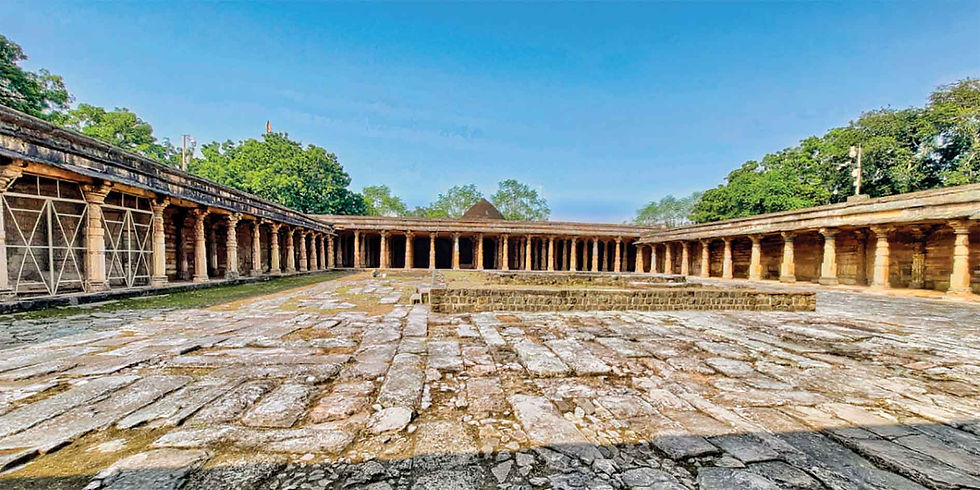
A major archaeological discovery came in 1875, when an idol of Vagdevi (Saraswati) was unearthed during excavations. In 1902, Lord Curzon removed the idol from Bhojshala and had it transported to England, where it has remained preserved in the British Museum for more than a century and a half. In 1961, archaeologist Dr. Vishnu Shridhar Wakankar presented evidence establishing the sculpture's Indian origin, yet the idol still awaits repatriation to India. After Independence, Bhojshala was declared a protected monument in 1951.
In recent years, a 98-day scientific survey conducted by the Archaeological Survey of India (ASI) reaffirmed the antiquity of the Paramara-era structure, documenting 106 pillars, 82 pilasters, and numerous Sanskrit and Prakrit inscriptions. Bhojshala is therefore not merely a matter of faith or dispute, but it represents a civilizational memory of India, a place where knowledge, culture, and intellectual achievement once attained their highest expression.
History on Trial
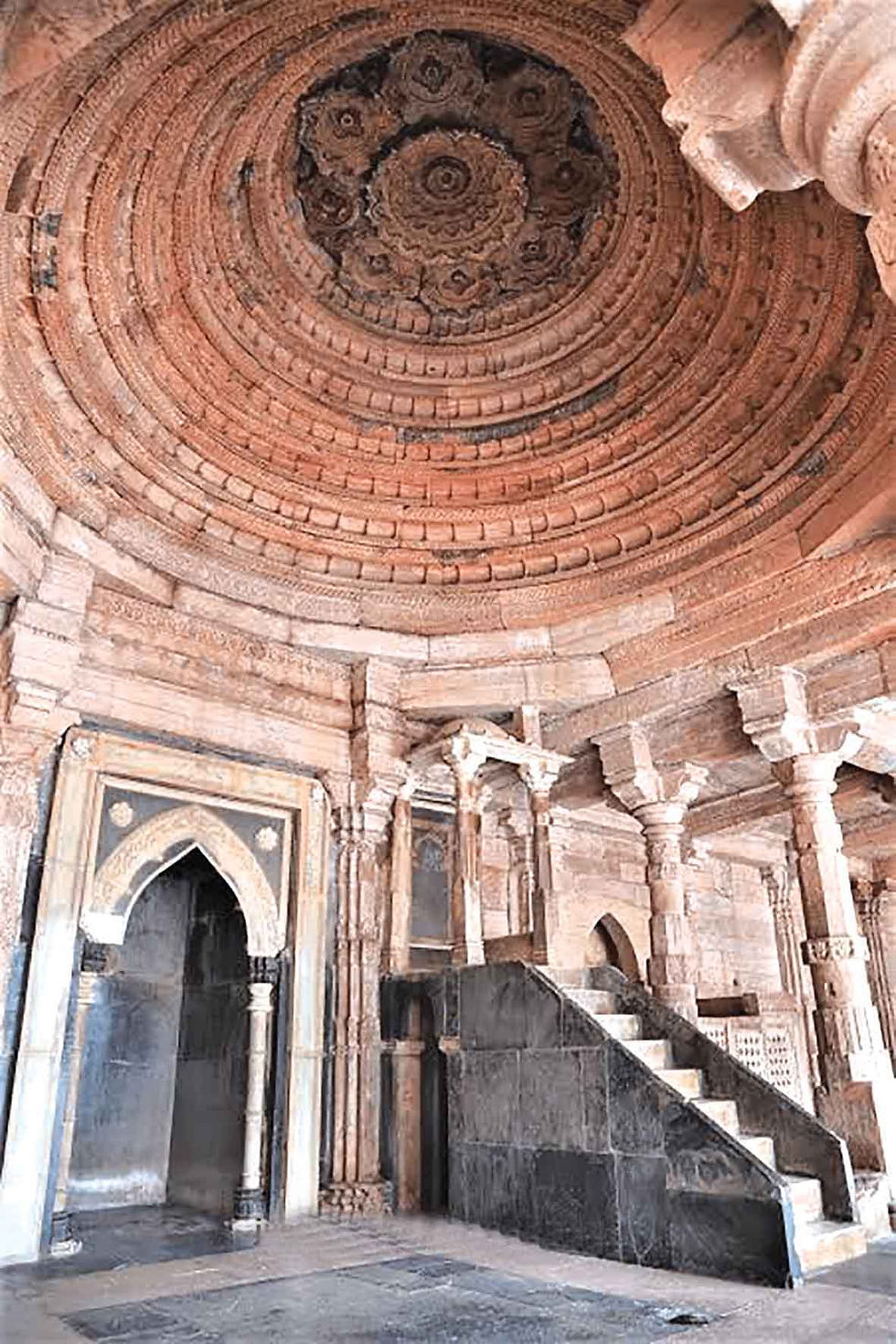
The recent judgment of the Madhya Pradesh High Court regarding the Bhojshala complex in Dhar is far more than a resolution of a property dispute. It represents a significant judicial intervention in the complex and often contentious interplay of history, archaeology, and religious rights.
In its ruling, the Indore Bench comprising Justices Vijay Kumar Shukla and Alok Awasthi recognized the Bhojshala complex as an ancient temple dedicated to Maa Vagdevi (Goddess Saraswati). The court also struck down the administrative order issued on April 7, 2003, under which the Muslim side had been permitted to offer namaz at the site.
The court observed that while the disputed Bhojshala-Kamal Maula Mosque complex is indeed a protected monument, its original religious character is that of a temple. At the same time, the bench noted that the Muslim side may approach the government seeking alternative land. In effect, the judgment affirms the Hindu side's right to worship at the site.
The legal battle entered a decisive phase in 2022, when Ranjana Agnihotri and other petitioners, representing the "Hindu Front for Justice," moved the High Court seeking a formal determination of Bhojshala's religious character and unrestricted worship rights. Subsequently, on March 11, 2024, the High Court directed the Archaeological Survey of India (ASI) to conduct a scientific survey of the premises.
Beginning on March 22, the ASI carried out an extensive 98-day survey and submitted a report exceeding 2,000 pages to the court on July 15, 2024.
During the hearings, the Hindu side relied on pillars, symbols associated with Goddess Saraswati, Sanskrit and ancient Nagari inscriptions, British-era gazetteers, and historical records to argue that Bhojshala had historically functioned as a center of learning and spiritual practice. Advocates Vishnu Shankar Jain and others further emphasized that the architectural features of the complex predated the Islamic period.

The Muslim side, however, questioned the neutrality of the ASI report, describing it as biased. Their counsel argued that the tradition of offering namaz at the site, along with longstanding administrative arrangements, also carried historical legitimacy. The court, however, found the archaeological and documentary evidence presented before it to be more persuasive.
The Bhojshala dispute has remained sensitive for decades. From 1936 to 2016, the site witnessed repeated tensions over worship and prayer rights, including restrictions, curfews, and confrontations. Now, with the Hindu side having already filed a caveat in the Supreme Court in anticipation of a possible challenge, it is evident that this verdict is not merely a judicial pronouncement. It also marks a new chapter in India's ongoing debate over historical memory, cultural inheritance, and competing civilizational claims.


Comments