

Ajinkya Rahane: The Quiet Hero who led by example

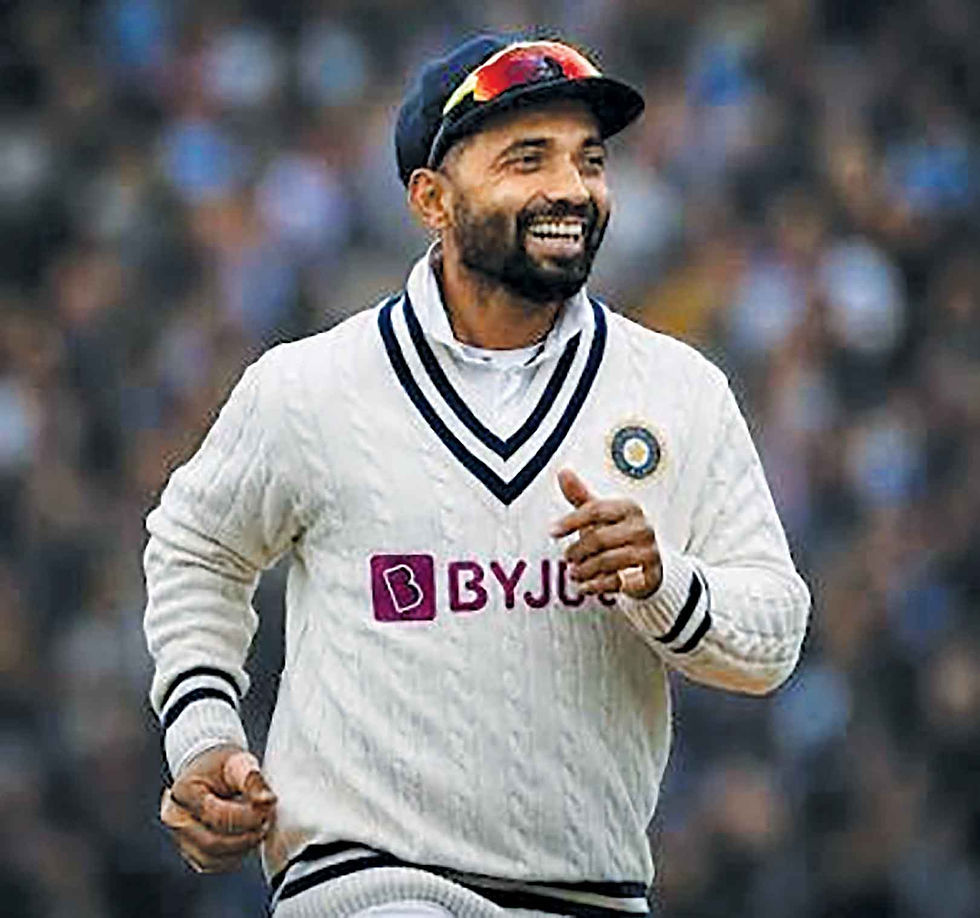
Mumbai: In an era when cricket increasingly celebrated swagger, sound bites and larger-than-life personalities, Ajinkya Rahane chose a different path. He let his bat whisper, his actions inspire and his character define him. As the curtains come down on his international career, Indian cricket bids farewell to one of its finest gentlemen, a cricketer whose greatest triumphs were built not on flamboyance, but on quiet resilience.
There are players who dominate headlines and there are players who define moments. Rahane belonged firmly to the latter.
The Journey
Born and raised in Mumbai, he was shaped by the city’s unforgiving cricket culture, where talent alone is never enough. Countless hours on the maidans, endless inter-school matches and the grind of Mumbai’s domestic circuit moulded him into a technically sound and mentally tough batsman. Before he became an Indian regular, Rahane had already earned the respect of the domestic fraternity with prolific performances for Mumbai in the Ranji Trophy.
Even after establishing himself on the international stage, he never distanced himself from Mumbai cricket. He returned whenever possible, strengthening the side with runs, experience and leadership. His presence was a reminder that domestic cricket remains the foundation of Indian cricket’s success.
When Rahane broke into the Indian team, he was often overshadowed by a star-studded batting line-up. Yet whenever India travelled overseas, he became one of the team’s most dependable performers. His elegant centuries at Lord’s, Wellington, Melbourne, Kingston and Durban were not merely statistical milestones—they were innings crafted in hostile conditions, against world-class attacks, when India needed someone to stand firm.
The right-handed batter scored 5,077 runs in Tests at 38.46 with 12 centuries and 26 fifties, while in 90 ODIs, he made 2,962 runs at 35.26 including three tons and 24 fifties. In 20 T20Is, Rahane made 375 runs.
Captain Rahane
The defining chapter of Ajinkya Rahane’s career unfolded in Australia during the unforgettable 2020-21 Border-Gavaskar Trophy.
Few teams have faced adversity of that magnitude. India had just suffered the humiliation of being bowled out for 36 in Adelaide—their lowest Test total. Captain Virat Kohli returned home after the opening Test. Mohammed Shami was injured. As the series progressed, India lost Ishant Sharma, Ravindra Jadeja, Ravichandran Ashwin, Jasprit Bumrah, Hanuma Vihari, Umesh Yadav and several others. Every match seemed to bring another setback.
The cricketing world expected Australia to complete a comfortable series victory.
Rahane expected something else.
Taking charge with characteristic calm, he walked out at the Melbourne Cricket Ground carrying not just a bat but the shattered confidence of an entire team. His unbeaten 112 remains one of the finest innings played by an Indian captain overseas—not because it was filled with dazzling strokeplay, but because it restored belief. India won the Boxing Day Test, levelled the series and reminded the world that champions are measured by how they respond to failure.
What followed was leadership in its purest form.
Rahane trusted youngsters without hesitation. Shubman Gill blossomed. Mohammed Siraj led the pace attack despite personal tragedy. Washington Sundar and T. Natarajan seized opportunities few imagined they would receive. Every player seemed to perform with freedom, secure in the knowledge that their captain stood firmly behind them.
Then came Brisbane.
The Gabba had been Australia’s fortress for 32 years. India fielded what many jokingly called a “net-bowlers’ attack”. Yet this patched-up side chased 328 on the final day to win the Test and claim the series 2-1.
It was one of the greatest victories in the history of Test cricket.
Quiet Hero
History will remember Rishabh Pant’s winning stroke, Siraj’s courage, Gill’s brilliance and Sundar’s all-round contribution. But at the heart of that extraordinary triumph stood Ajinkya Rahane—the understated captain who united an injury-ravaged team, absorbed immense pressure and never allowed despair to enter the dressing room.
Leadership is often mistaken for volume. Rahane proved it is, instead, about trust.
He never sought the spotlight. There were no extravagant celebrations, no attempts to make victories about himself. He quietly accepted responsibility in defeat and generously shared credit in success. In an age dominated by personal brands, he remained refreshingly selfless.
Indian cricket has produced many great batsmen. It has produced many successful captains. Ajinkya Rahane may not top every statistical chart, but few have embodied the values of discipline, humility and grace as completely as he did.
For Mumbai, he will forever remain one of its proudest sons, carrying forward a legacy built by generations of cricketing greats. For India, he will always be the captain who transformed despair into one of the country’s greatest sporting triumphs.
The scorebooks will record his runs. The record books will preserve his centuries.
But the soul of Indian cricket will remember something greater—a soft-spoken gentleman who, when everything seemed lost, quietly walked to the crease, lifted a wounded team and authored a victory for the ages.
That is Ajinkya Rahane’s enduring legacy.
Not just a cricketer. A custodian of cricket’s finest values. A quiet hero. And forever, a champion.
“The reality of life is that everything has a beginning, and everything has an end. When that time comes, you simply have to respect it and move forward. I always relied on timing in my batting, and I've always understood its important. Today, I feel the timing is right for me to move on and announce my requirement from international cricket, and all formats. From those early days, travelling from Dombivali as a young boy, just to practice, I gave this game everything I had. Every single day, every innings, every opportunity I got to bat, the dream was always to wear the India cap. I look forward to helping the next generation, sharing the values, the sport has taught me, and giving back to the game that has given me everything.”
Ajinkya Rahane


Comments