top of page

By:

Abhijit Mulye

21 August 2024 at 11:29:11 am

Resorts, Rallies, and Rebellion

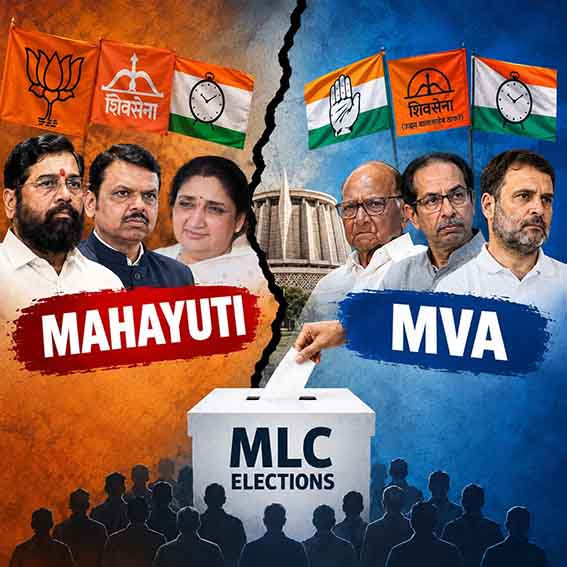
Inside Mahayuti’s high-stakes firefighting for legislative council polls Mumbai: The public posture of ruling Mahayuti alliance radiates supreme confidence. Leaders from the BJP, Shiv Sena led by Eknath Shinde, and NCP led by Sunetra Pawar are predicting a clean sweep. Voting is scheduled for Thursday. Yet, beneath this calm exterior lies intense backstage panic. None of the alliance constituents are leaving any loose ends. No leader wants to take any risks, as everybody is trying to ensure...

Resorts, Rallies, and Rebellion

Inside Mahayuti’s high-stakes firefighting for legislative council polls Mumbai: The public posture of ruling Mahayuti alliance radiates supreme confidence. Leaders from the BJP, Shiv Sena led by Eknath Shinde, and NCP led by Sunetra Pawar are predicting a clean sweep. Voting is scheduled for Thursday. Yet, beneath this calm exterior lies intense backstage panic. None of the alliance constituents are leaving any loose ends. No leader wants to take any risks, as everybody is trying to ensure their real value is recognized and past political scores are waiting to be settled. This volatile environment has triggered widespread fears of cross-voting. It has given a massive boost to resort politics across the state. The upcoming contest spans 17 local self-government constituencies. The unique composition of this electorate makes the election highly unpredictable. The voters are not regular citizens. They are elected corporators, municipal councillors, and Zilla Parishad members. This setup makes the election hyper-localized. It offers a perfect shadow arena for local politicians to exercise leverage. Consequently, ruling alliance leaders are taking extraordinary measures to protect their flocks. Every single vote is being heavily guarded. Poaching Game Political parties have quickly locked down their voters to prevent poaching. Sources reveal that local body members from Sangli, Nanded, and Nagpur are already gone. They have been taken on special tours to Goa under tight supervision. Meanwhile, corporators from Nashik have been moved elsewhere. They are currently staying at a secluded luxury resort near Bhiwandi. These defensive tactics show how deeply the party bosses distrust their own members. Political managers are monitoring every voter’s movement around the clock. The ground reality across key cities highlights this deep regional friction. In Nagpur, the stakes are incredibly high. This by-election became necessary after state BJP chief Chandrashekhar Bawankule vacated the seat. He did so after winning his election to the state assembly. The BJP cannot afford a defeat in its primary ideological stronghold. Similarly, the Wardha-Chandrapur-Gadchiroli constituency presents a tough challenge. The BJP has fielded Arun Lakhani for this crucial seat. However, managing the intricate web of local body representatives in Chandrapur is testing the party machinery. Shifting Loyalties Other regions show similar vulnerability. In seats like Jalgaon, Nanded, and Sangli, traditional political loyalties are shifting. Compounding these internal threats is the BJP’s aggressive campaign strategy. The party chose to treat this council election as an opportunity. They wanted to expand their standalone organisational footprint across the state. Instead of relying on traditional top-down bulk voting through alliance bosses, the BJP targeted the electorate directly. The party organised an array of localised rallies, town hall meetings, and gatherings of the electorate. Some of these events registered an excellent response. However, this unilateral approach deeply irritated their alliance partners and many of these events saw dismal attendance by BJP’s alliance partners. Apart from this general apathy, the real challenge was that of open rebellion within the ruling alliance’s internal ranks. Disgruntled local leaders, disappointed ticket seekers, and ignored district presidents had expressed loud resentment. Even sitting MLAs and MLCs have signaled their displeasure over candidate choices. State BJP leaders had to spend considerable energy for the firefighting and ensuring that rebellion is contained. Yet many leaders are still unhappy with current regional power equations. Frantic Firefighting Fearing massive internal sabotage, the BJP top brass has launched a frantic firefighting operation. Senior leaders have been entrusted with strict responsibilities to oversee specific seats. They are managing all local arrangements personally. Top party managers are literally crisscrossing the state using helicopters and chartered flights. They are conducting last-minute pacification drives in every sensitive district. These leaders are holding urgent, closed-door meetings to placate angry regional chieftains. They are working hard to neutralize rebel factions. No disgruntled leader is being left unattended before Thursday morning. Promises of future political rewards are being distributed generously. Leaders are promising state-run board appointments and fresh development funds to buy peace. The frantic resort lockdowns and endless late-night negotiations reveal the true story of this election. The Mahayuti may still win a majority of these 17 seats through sheer resource dominance. However, the visible fractures in cities like Nashik, Sangli, Chandrapur, and Jalgaon reveal a fragile coalition. This council election has ceased to be a routine legislative exercise. It has mutated into a brutal internal audit of the ruling alliance’s unity. The final results will offer a definitive look at who holds the real power.

Another battle between Pawars on card

Jay desires to contest election in 2029; Rohit reacts strongly

Mumbai: Barely had the voting for Baramati Assembly by-election ended, a potential ‘Pawar versus Pawar’ battle in 2029 spooked the immediate contest in which Nationalist Congress Party President and Deputy Chief Minister Sunetra A. Pawar is the prime contender.


The by-poll itself – compelled by the demise of former NCP chief and ex-Dy.CM Ajit A. Pawar in January – witnessed a large turnout after an emotionally-charged campaign in which even bigwigs from the Nationalist Congress Party (SP) participated.


As the voting progressed, certain remarks from both NCP (SP) MLA Rohit R. Pawar and his cousin Jay A. Pawar, son of Sunetra, indicated that the future of Baramati politics would remain family-dominated, at least till the next Assembly elections in 2029.


Accompanying his mom to the polling centre, Jay claimed that pressure was mounting on him from the commoners and NCP workers urging him to contest the Baramati elections after 3 years.


People’s Desire

“It’s the demand from the party activists and the desire of the people that I should be a candidate in 2029. But from my heart, I wish to continue working as an ordinary party worker and serve everyone,” said Jay, hinting that he would be a reluctant contestant while sparking a mini-row.


Predicting a record voter turnout and a victory margin for his mother, he appealed to the voters to support Sunetra as enthusiastically as they had supported his father, the late Ajit Pawar in the past.


Quickly reacting to Jay’s utterances, Rohit also hinted at the likelihood of a face-off between family members in the next Assembly polls.


“We should heed the sentiments of the party workers and the people… Their party (NCP) is different from our (NCP-SP) party,” Rohit said, making it clear that political loyalties would remain separate despite close family ties.


Yugendra vs Jay

In the eventuality of Jay being fielded by the NCP in 2029, Rohit suggested that another cousin, Yugendra S. Pawar – son of Shrinivas A. Pawar, and nephew of Ajit Pawar – could be a prospective rival from the NCP (SP) – making it another ‘Pawar versus Pawar’ poll duel.


Baramati Assembly and Lok Sabha seats have in the past witnessed politically charged electoral battles between different family members of the Pawar clan, he reminded.


Nevertheless, Rohit also admitted how the masses frowned at such intra-family contests – as in the 2024 Lok Sabha elections - which divided virtually all families in Baramati while Sunetra Pawar and her ‘nanad’ Supriya Sule slugged it out at the hustings.


“It is not the desire of the people to see another ‘Pawar versus Pawar’ fight… There are certain political forces opposed to the Pawar Family which seem keen to foment such divisive contests and weaken its influence here,” Rohit declared.


Keeping the door ajar for a reconciliation between the NCP(SP)-NCP, he said it would be opposed, but the views of the workers, elected representatives and family members tend to complicate the issues, as ‘withdrawing from power’ is not an easy option – making it clear that both the parties would function independently at least for the present.

Shrinivas Pawar reprimands cousins
The statements by the cousins Jay and Rohit evoked sharp response from Shrinivas A. Pawar who pulled them up for raising decisive yet divisive futuristic issues during the polling today.

“What was the need to say all this now? Today is important and everyone has come out for ‘Dada’ (Ajit A. Pawar)… We must all remain united,” emphasised Shrinivas A. Pawar.

Chiding the younger cousin-siblings, Shrinivas said that “if you are aware that people don’t prefer such intra-family contests, why don’t you sit together and resolve these issues”.

Baramati, Rahuri see 50 pc voting
Bypoll to the Baramati assembly seat in Maharashtra's Pune district, where Deputy Chief Minister and NCP president Sunetra Pawar was in the fray, recorded a voter turnout of around 50 per cent till 5 pm on Thursday, officials said.

The voting percentage in Rahuri assembly constituency in Ahilyanagar district, which also saw a bypoll, was 50.74 per cent, they said.

Voting, which began at 7 am, concluded at 6 pm.

The Rahuri assembly seat became vacant after BJP MLA Shivaji Kardile's death in October last year. His son Akshay Kardile was in the fray as a BJP candidate from the seat, and was pitted against NCP (SP) candidate Govind Mokate and Vanchit Bahujan Aghadi's Santosh Chalke.

Comments


bottom of page