

Bihar mandate tilts Mahayuti balance
- Abhijit Mulye

- Nov 15, 2025
- 3 min read
Eknath Shinde and Ajit Pawar lose leverage
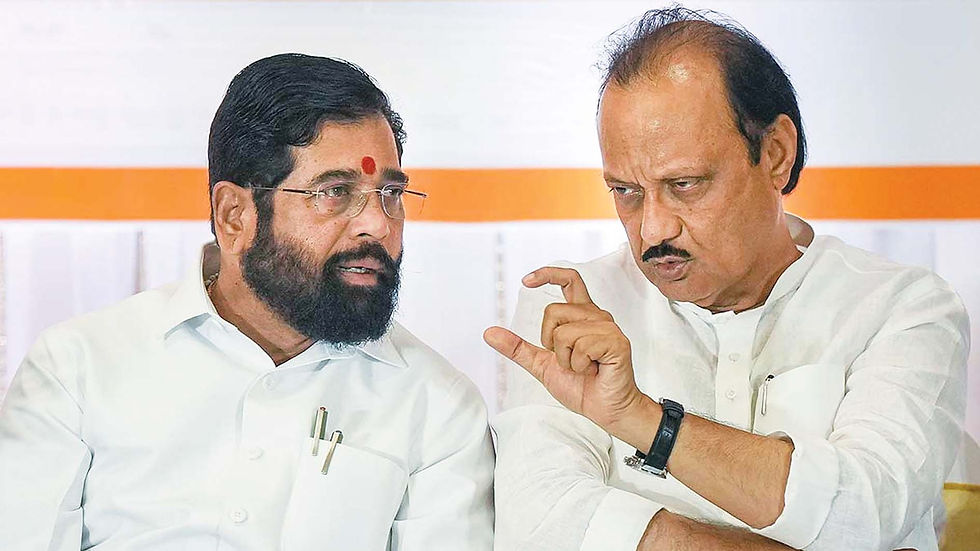
Mumbai: The crushing landslide victory of the National Democratic Alliance (NDA) in the recent Bihar Assembly elections has triggered immediate, profound ripples across the political chessboard of Maharashtra, significantly diminishing the bargaining power of its two crucial allies - the Shiv Sena under Deputy Chief Ministers Eknath Shinde and the Nationalist Congress Party under DCM Ajit Pawar in the ruling Mahayuti. Political analysts unequivocally suggest that the Bihar mandate has drastically emboldened the Bharatiya Janata Party (BJP), positioning it firmly as the undisputed “big brother” within the ruling Mahayuti coalition, especially ahead of the critical local body elections.
The Bihar results, which saw the NDA secure an emphatic majority, have been interpreted by the BJP central leadership and its state unit as a national affirmation of Prime Minister Narendra Modi’s leadership and the efficacy of the "double-engine sarkar" narrative. For the BJP, this victory is a psychological and strategic boost, arriving at a time when its Maharashtra unit had been grappling with persistent internal conflicts and power struggles with its two Deputy Chief Ministers' factions.
Hard bargain
A senior BJP functionary noted that a poor performance in Bihar would have provided the Shinde and Ajit Pawar camps with leverage to "strike a hard bargain" in seat-sharing negotiations for upcoming municipal and Zilla Parishad polls. The opposite has now transpired. The spectacular win has relieved the BJP of pressure, allowing it to dictate terms in the volatile Mahayuti.
The immediate focus has shifted to the local body elections in Maharashtra, particularly the high-stakes Brihanmumbai Municipal Corporation (BMC) poll. For both Shinde and Ajit Pawar, these elections were intended to be a critical "litmus test" to solidify their respective claims over their party namesakes and prove their electoral relevance to the BJP.
Local polls
The Bihar outcome, however, transforms this test into a trial of survival. Analysts point out that both Deputy Chief Ministers have been actively working to retain their separate political identities—a move often viewed with suspicion by the BJP cadre, who worry about the long-term impact on the party's growth. With the central leadership now radiating confidence, the BJP is less likely to yield to hard-nosed demands from its allies regarding seat allocations.
Maharashtra BJP President Ravindra Chavan was quick to declare that the Bihar results are a "sharp indicator of how things will unfold in Maharashtra," expressing confidence in a grand Mahayuti sweep across local bodies. This rhetoric suggests that the BJP will push for a lion's share of seats, leaving the Shinde Sena and Ajit Pawar-led NCP to fight over the remainder.
Many compulsions
While the BJP's hand is strengthened electorally, it is still bound by certain political compulsions. The continued support of the Shiv Sena and NCP is crucial for the stability of the NDA government at the Centre, especially given the BJP's need for coalition partners. The Shinde faction, with its Members of Parliament, and the Ajit Pawar camp are necessary anchors for the central government's strength in numbers.
However, political analysts argue that this central need is secondary to the BJP's long-term goal of state-level dominance. The party’s strategy in Maharashtra remains two-fold: maintain the Mahayuti to defeat the opposition Maharashtra Vikas Aghadi (MVA) – which includes Shiv Sena (UBT) and NCP (SP) – while simultaneously shrinking the space occupied by its current allies. The Bihar mandate gives the BJP the moral and political high ground to execute this strategy aggressively.
For Eknath Shinde and Ajit Pawar, the road ahead is rockier. Their ongoing tussles and the perception of internal conflict have already tarnished the coalition government’s image. The Bihar victory may now force them into an uneasy compliance, prioritizing unity – and the survival of their respective factions – over independent power expansion.
The message from Bihar is clear - the BJP, having demonstrated its formidable electoral machine in a Hindi heartland state, will now expect absolute loyalty and cooperation from its regional partners. The delicate balancing act in the Mahayuti is over; the weight of the balance now rests overwhelmingly in the BJP’s favour.


Comments