

BJP’s mega induction drive in Nashik amid local friction

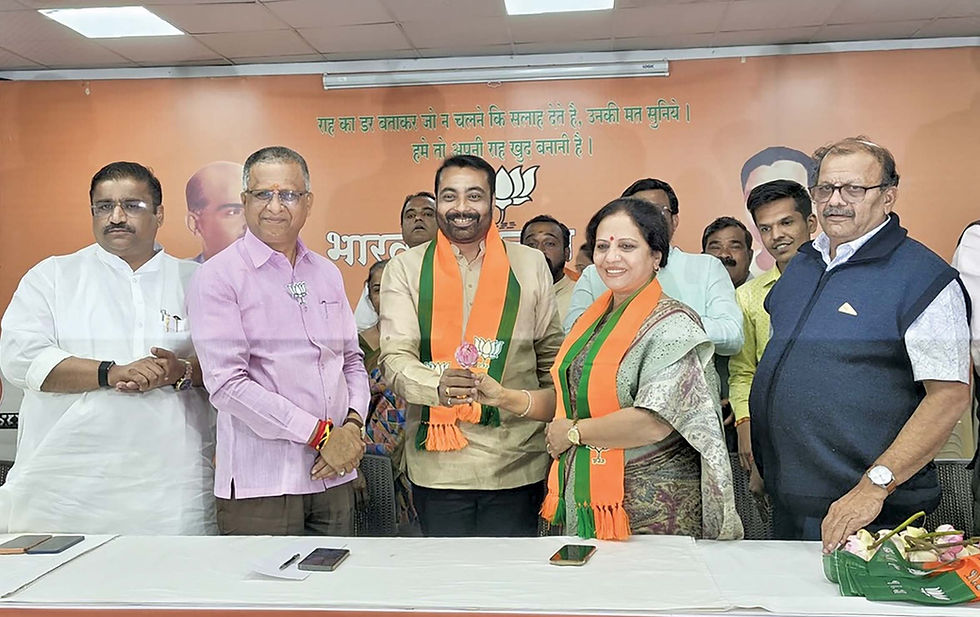
Mumbai: The Bharatiya Janata Party’s (BJP) city office in Nashik turned into a high-stakes political theater on Thursday as the party executed a "mega induction drive" ahead of the crucial Municipal Corporation elections. In a move that signalled both the party's aggressive expansion and rising internal friction, five senior heavyweight leaders from the NCP-SP, Congress, Maharashtra Navnirman Sena (MNS), and Shiv Sena (UBT) officially crossed over to the saffron fold.
Former Nashik Mayor and Shiv Sena (UBT) leader Vinayak Pande, Former Nashik Mayor from MNS and now Shiv Sena (UBT) leader Adv. Yatin Wagh, former MNS MLA now NCP-SP leader Adv. Nitin Bhosle, former Chairpersons of the Standing Committee of the Corporation Shahu Khaire (Congress) and Sanjay Chavan (SS-UBT) and MNS state secretary Dinkar Patil joined the BJP at Nashik along with their respective supporters and several former corporators on Thursday in presence of irrigation minister Girish Mahajan. Local BJP MLA Devyanhi Pharande, who is also the Municipal Corporation election in charge of the party, had been opposing induction of Adv. Wagh, Khaire and Pande into the party. In a social media post early in the morning, she accused the party leadership of keeping her in dark about the induction drive.
Electric Atmosphere
The atmosphere at the BJP headquarters was electric yet tense as the city witnessed the mega induction drive. Supporters of the incoming leaders arrived with drums and garlands, while a noticeable contingent of BJP "loyalists"—long-time party workers who have spent decades building the local unit—staged protest against the drive even as the police controlled them.
Despite a formal protest and "strong opposition" voiced by these senior loyalists the party high command moved forward with the induction. The "grand drama" peaked as the five leaders were welcomed with traditional turbans and BJP scarves, even as some veteran workers briefly staged a silent demonstration outside the main hall, questioning the "dilution" of the party's core ideology for electoral gains.
Pharande, who is in her third term as the party MLA from the city, had been winning on Hindutva plank from the constituency that has a sizable Muslim population. While some of the leaders inducted today had been winning on the basis of the Muslim vote bank in the city, at least two of them are being seen by Pharande as the prospective contenders for the assembly seat she is currently holding. That also explains why she mentioned that she had been a staunch Hindutva warrior, in her social media post, said a senior party sympathiser. Party insiders also said that she was informer only late in the night about the induction drive and there was no response to her calls to the party leadership, which led to demonstrations.
Goal Of 100
However, the induction ceremony was presided over by Mahajan, often referred to as the party’s "crisis manager." Addressing the packed hall, Mahajan made no apologies for the move, framing it as a clinical necessity for the upcoming civic polls. "This induction is aimed at a spectacular victory in the ensuing elections," Mahajan declared. "With the influence and ground-level support these five leaders bring, I am confident the BJP shall win over 100 of the total 122 seats in the city corporation."
The ambitious target of 100+ seats suggests that the BJP is looking to achieve a near-absolute majority, reducing the opposition to a negligible presence in the Nashik Municipal Corporation.
Recognising the simmering resentment among the rank and file, Mahajan spent a significant portion of his speech addressing the "old guard." He assured the veterans that their sacrifices for the party would not be forgotten despite the arrival of new, high-profile entrants. Mahajan explicitly promised that "injustice won’t be done to the old, senior, loyal party workers." He also urged the cadres to "not worry" and instead focus on the larger goal of total dominance in the corporation.
The exit of these five leaders is a significant blow to the Shiv Sena (UBT) and MNS, both of which have recently announced alliances in other parts of the state to counter the BJP. By poaching talent from these specific camps, the BJP has effectively disrupted the local leadership chain of its rivals just as the election machinery begins to churn.


Comments