top of page

By:

Abhijit Mulye

21 August 2024 at 4:59:11 pm

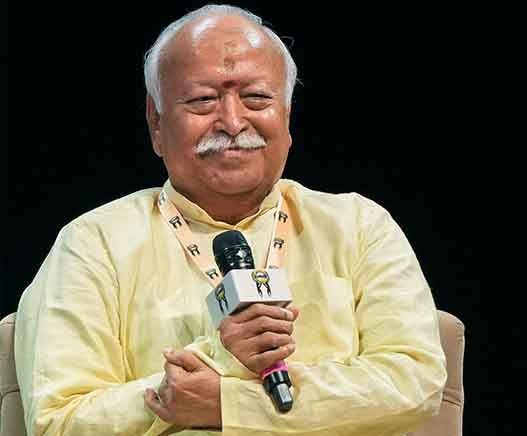
Bhagwat to outline roadmap for next century

Mumbai: Rashtriya Swayamsevak Sangh (RSS) Sarsanghachalak Dr Mohan Bhagwat will address thousands of volunteers and key political observers at Reshimbagh grounds in Nagpur tomorrow at 7.40 am on the occasion of Vijayadashami, formally concluding the organisation’s centenary-year celebrations. He is expected to deliver an ideological and operational blueprint intended to recalibrate Hindu society, counter ongoing opposition mobilisation across India, and outline internal organisational changes...

Bhagwat to outline roadmap for next century

Mumbai: Rashtriya Swayamsevak Sangh (RSS) Sarsanghachalak Dr Mohan Bhagwat will address thousands of volunteers and key political observers at Reshimbagh grounds in Nagpur tomorrow at 7.40 am on the occasion of Vijayadashami, formally concluding the organisation’s centenary-year celebrations. He is expected to deliver an ideological and operational blueprint intended to recalibrate Hindu society, counter ongoing opposition mobilisation across India, and outline internal organisational changes through a wide-ranging policy address. The annual Vijayadashami address, historically the most definitive forum for the RSS chief to articulate the organisation’s stance on domestic policy, cultural objectives and global affairs, carries heightened significance this year. Marking the completion of 100 years since Dr K.B. Hedgewar founded the organisation on Vijayadashami in 1925, Bhagwat’s address is designed to chart the strategic framework for the RSS as it enters its second century. Over the past 12 months, Bhagwat has personally anchored a series of outreach programmes across four Indian metropolitan hubs and two global nerve centres in the United States and Europe, signalling an appetite to project ideological clarity and broaden the organisation’s institutional footprint beyond traditional shakhas. The address comes against the backdrop of sustained street agitations orchestrated by the Congress party and newly formed groups such as the CJP in the national capital and several states. These demonstrations, centred on unemployment, social justice rhetoric and institutional accountability, have explicitly targeted India’s youth demographic — a constituency that has historically formed the primary recruitment pipeline and ideological backbone of the Sangh. Political observers believe Bhagwat will offer an unyielding response to these attempts to disrupt governance and erode the social coalition, reflecting an unmistakable determination within the Sangh Parivar leadership to resist political attrition and mount an active counter-narrative. The diplomatic and constitutional significance of the event is underscored by the deliberate selection of guests. Former Vice-President Jagdeep Dhankhar and Israel’s Consul General in Mumbai, Yaniv Revach, are attending as special invitees. Revach’s presence hints at possible remarks addressing global geopolitical realignment, the rise of civilisational conflicts, cross-border terrorism and national security challenges. Dhankhar’s attendance provides a platform to reaffirm constitutional patriotism and legislative stability at a juncture marked by sharp parliamentary confrontation. Equally consequential is the invitation extended to Sanjay Gupta, Editor-in-Chief of Dainik Jagran. For an organisation that has historically maintained a measured distance from mainstream media machinery, engaging with the leadership of India’s largest Hindi daily indicates an institutional shift towards proactive public communication. The gesture suggests that the Sangh recognises that narrative warfare in its next century requires strategic engagement with popular media platforms rather than a traditional reliance on insular organisational word of mouth. Beyond external ideological positions, the Nagpur gathering is expected to provide indicators of the structural transitions under way within the RSS. The organisation has been quietly restructuring its administrative echelons, revamping functional wings and adjusting internal deployment models in recent months. With additional leadership realignments slated across key tiers in the near future, Bhagwat’s speech is expected to define the organisational ethos for these generational handovers, emphasising flexibility in outreach while preserving core organisational discipline. As dawn breaks over Reshimbagh, the address will serve both as a balance sheet of a century-old journey and as a declaration of intent for an increasingly combative political era.

Build a Business That Depends Less on You

The 4Sync Method goes beyond delegation to help teams make sound decisions independently, with the right information, authority and support.

Between us, we bring complementary experience in strategy execution and technology delivery. Since 1999, Rahul has focused on translating strategy into action through diagnosis, design, governance and vendor selection, while Rashmi has worked in technology delivery since 2004, leading implementation, adoption and handover.


In our consulting work, we kept meeting founders whose businesses were doing reasonably well, yet everyday decisions still came back to them. They had hired people, put systems in place and worked hard to delegate. Still, a customer query or an approval could hold up an entire afternoon. We recognised this pattern not only across the businesses we worked with but also in some of our own experiences. We wanted to understand what would enable capable people to take ownership of their work without the founder having to step in every week.


The problem, we realised, was not necessarily a reluctance to delegate. Delegation is part of the solution, but simply telling a founder to “let go” is easy advice. In our experience, teams are sometimes given responsibility without clear limits on their decision-making authority, access to reliable information or support when circumstances change. The founder steps in because the work genuinely needs help. Unless these gaps are addressed, stepping back can be irresponsible. The real challenge is distinguishing between decisions that genuinely require the owner's judgement and those that reach the owner simply out of habit.


This is the problem our 4Sync framework is designed to address. We begin with a recurring problem and ask why it keeps coming back. We examine four forces: Effort, Environment, Support and Capability. We then use four practical Syncs to change how work gets done: Rhythmsync, Infosync, Rolesync and Goalsync. Together, they help identify what is preventing people from working effectively and what needs to change for them to take greater ownership.


The framework translates into practical changes in everyday work. People need a dependable working rhythm, access to usable information, clarity about their decision-making authority and the ability to deliver what has been promised. These elements must work together; assigning responsibility alone will not solve a problem if the person lacks the information or authority to act. Nor does every difficulty call for a sweeping organisational overhaul. Businesses can begin with a single troublesome handoff or approval, identify its underlying cause and work towards a solution that lasts.


Our approach has also been shaped by the way we work together. As co-founders and husband and wife, we bring different perspectives to the same problem. Rahul tends to ask why a decision keeps coming back to the founder, while Rashmi focuses on what the person doing the work will actually need on a busy Tuesday. We have both had to resist the temptation to solve a problem ourselves simply because it is quicker. Writing the book together repeatedly brought us back to one practical test: can the team keep things running after we step away from the conversation?


That emphasis on practical application has shaped the second edition of our book. We have made it easier to use and more candid about what can go wrong. We have expanded the examples, including instances where changes did not work on the first attempt, and added a field manual and a 90-day implementation path. The new edition also explores how to use AI responsibly and apply 4Sync alongside systems a business may already have. We do not want readers to collect another set of management terms; we want them to improve a real piece of work.


We would ask readers to begin paying attention to the next message that says, “Can you just have a look?” Before stepping in, ask what is actually missing. Does the person need your judgement, or do they lack a standard, information, authority or support? Choose one recurring request and work with the person responsible to address its underlying cause. The real test is whether that person can make a sound decision the next time and explain their reasoning. A quieter phone, by itself, proves very little.


(Rahul and Rashmi Kulkarni are co-founders of PPS Consulting India and authors of ‘The 4Sync Method’.)

Comments


bottom of page