

Degrees Without Skills: India’s Silent Crisis

As other nations rebuild their entire knowledge systems for an AI-driven future, India remains trapped in incrementalism while leaving the deeper architecture of learning untouched.
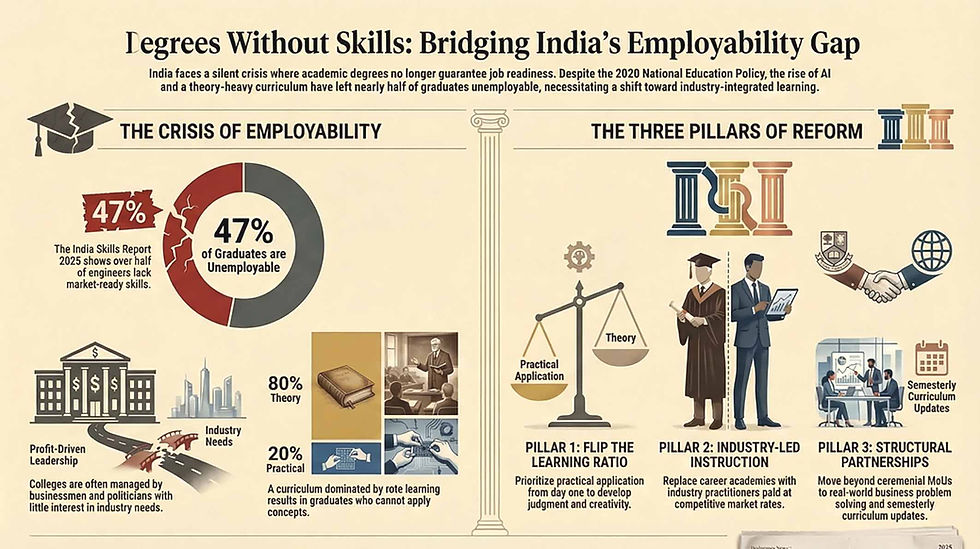
Picture a classroom. Thirty students. Bright faces, packed bags, parents who sacrificed holidays and savings to put them there. Now remove fifteen of them.
Tell them that you studied hard, you passed your exams, you did everything right but are not ready for the world waiting outside this door. That is not a hypothetical. That is today’s India.
The India Skills Report 2025 found that only 47 percent of engineering graduates are considered employable. Across the country, that translates to hundreds of thousands of young people graduating every year and walking into a job market that does not want what they are selling.
To be fair to our policymakers, someone saw this coming. In July 2020, India introduced the National Education Policy - the first overhaul of our education framework in 34 years. On paper, it was everything the country needed. It called for an end to rote learning. It pushed for critical thinking, creativity, and real-world problem solving. It demanded that vocational and academic education stop living in separate buildings. It set an ambitious target of spending 6 percent of GDP on education and was created with a bold vision.
But two years later, the world changed in a way the policy never anticipated. In November 2022, ChatGPT was launched and within months, artificial intelligence moved from a topic in a computer science textbook to a daily tool reshaping every industry on the planet.
By 2023, companies in finance, law, healthcare, and technology were quietly replacing entire categories of entry-level work with AI systems that were faster, cheaper, and available around the clock. The BPO industry, which had employed lakhs of fresh Indian graduates for two decades, began restructuring because AI was better at the work those freshers were being hired to do.
The NEP 2020 was built for a world where the challenge was improving how humans learned. But it had no answer for a world where machines had started doing what those humans were being trained to do.
Deeper Malaise
Most colleges in India are not run by educators. They are run by politicians and businessmen. The college is an asset - a brand, a building, a revenue stream where education is incidental to the business model.
Today, 80 percent of a student's time goes into theory inside a classroom. The remaining 20 percent, laughably called practical, is so disconnected from reality that both students and faculty treat it as a box to be ticked. The result is a graduate who can describe a concept but cannot apply it. Who can reproduce an answer but cannot solve a problem they have not seen before. This imbalance is not uniquely Indian; it echoes an older global model of education that many countries have since abandoned in favour of applied learning.
In much of Europe, for instance, students in technical fields split their time between classrooms and paid apprenticeships, ensuring that theory and practice evolve together rather than in isolation. Germany’s dual education system, often cited as a gold standard, embeds industry exposure into the curriculum from the outset, producing graduates who are job-ready on day one.
Our faculty qualification policy compounds the damage. It demands PhDs, NET certificates, and academic publications. It says almost nothing about industry experience. So, ninety-five percent of professional course faculty have never spent a year working in the field they teach. And those PhDs? India awards among the highest number of doctorates in the world yet ranks near the bottom globally on patents granted and on research converted into commercial products.
Stark Disconnect
This disconnect between academic output and real-world impact is stark when compared with ecosystems like the United States, where universities such as MIT or Stanford University actively encourage faculty to commercialise research, launch startups, and collaborate with industry. In these systems, a professor moving between academia and industry is not an exception but an expectation. Israel, another instructive case, has built a formidable innovation economy despite its small size precisely because its academic institutions are tightly interwoven with defence, technology, and venture capital networks.
Meanwhile, China spends 2.43 percent of GDP on research and development. The United States spends 3.48 percent. India spends 0.64 percent. China has rebuilt its top universities around AI with mandatory industry partnerships and a direct pipeline from campus to commercial deployment. Singapore mandates AI literacy for law students, medical students, and civil servants — not just engineers. South Korea, too, has aggressively aligned its universities with industrial policy, ensuring that research feeds directly into sectors such as semiconductors and robotics. Even smaller economies like Finland have reoriented their education systems to emphasise problem-solving, interdisciplinary thinking, and collaboration with local industries. The result across these countries are graduates who are not merely knowledgeable, but economically productive from the outset.
We are still debating board exam reform. While other nations are redesigning entire knowledge systems for an AI-driven future, India remains trapped in incrementalism, tweaking examinations while leaving the deeper architecture of learning untouched. What this demands is not incremental reform, but a reset in how we think about learning itself.
Learning must become practical from the very first day. The balance needs to shift: theory should support application, not substitute for it. Every concept ought to lead somewhere tangible — a real problem to solve, a live dataset to analyse, a prototype to build. Memory, as a standalone skill, has already been outsourced; the device in every student’s pocket does that better. What cannot be outsourced is judgment, creativity, and the ability to apply knowledge in unfamiliar situations.
The classroom, in turn, must stop being insulated from the world it claims to prepare students for. A practitioner with fifteen years of experience brings something no textbook can replicate: the texture of failure, constraint, and decision-making under pressure. Such professionals should not hover at the margins as occasional guest speakers, but be embedded within institutions as teachers, curriculum designers and decision-makers and compensated accordingly. When institutions resist this, they are implicitly asserting that theory is sufficient when it simply is not.
Meaningful Partnerships
Equally, the idea of ‘industry partnership’ needs to move beyond ceremony. The framed MoUs and logo-lined corridors are often an illusion of engagement. A meaningful partnership is harder and more demanding: it places students inside real problems early in their education, with outcomes that matter beyond the classroom. It expects faculty to engage with industry not as observers but as participants. And it requires curricula to evolve continuously - shaped by present needs, not frozen in the assumptions of a previous decade.
These are not expensive ideas but merely a change in what colleges believe their job actually is.
Remember those fifteen students we asked to leave? They are extraordinary young people who had the misfortune of going through a system designed to produce something the world no longer needs in the same numbers - theory-trained, examination-passing graduates who learned everything about a subject and nothing about how to use it.
As Dr. A. P. J. Abdul Kalam often argued, a nation’s real strength lies in what it can do on its own.
(The author is a strategy and transformation leader who writes extensively on technology and the future of work. Views personal.)


Comments