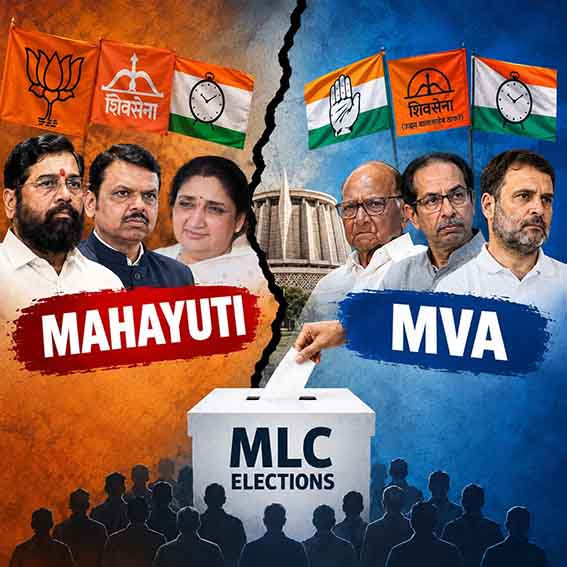
AI Generated Image Mumbai: The upcoming Maharashtra Legislative Council (MLC) elections for the graduate and teacher constituencies have laid bare the deep-seated fissures within both the ruling Mahayuti and the opposition Maha Vikas Aghadi (MVA) alliances. In a significant development that could have far-reaching political implications, multiple rebel candidates, including prominent figures with strong party affiliations, have defied alliance dictates to file their nominations as independents, setting the stage for high-stakes, multi-cornered contests. Mahayuti Turmoil The Mahayuti alliance, comprising the Bharatiya Janata Party (BJP), the Eknath Shinde-led Shiv Sena, and the Ajit Pawar-led Nationalist Congress Party (NCP), is grappling with rebellion on multiple fronts. In the critical Nagpur Graduates constituency, a traditional BJP stronghold, former BJP MLC and Nagpur Mayor Anil Sole has thrown a spanner in the works by filing his nomination as an independent candidate. This move directly challenges the official BJP candidate, Sudhakar Kohale. While the BJP leadership, including state president Ravindra Chavan, has attempted to downplay the situation, asserting that Sole has been "pacified," the former MLC's actions tell a different story. Sole's decision to contest independently is particularly significant given his long-standing association with the Rashtriya Swayamsevak Sangh (RSS) and his previous stint as a BJP MLC from the very same constituency. The situation is equally complicated in the Amravati Teachers constituency. The Shiv Sena (Shinde faction) has officially fielded Kiran Sarnaik. However, adding to the confusion, Sangita Shinde, sister of BJP MP Anil Bonde, has also entered the fray, potentially splitting the Mahayuti vote. The opposition MVA is also facing its share of internal discord here. While the Congress has nominated Aditi Pohre, daughter of former minister Harshvardhan Deshmukh, the Shiv Sena (UBT) has fielded Dattatray Lahane. The presence of numerous candidates representing various teachers' organizations further complicates the electoral arithmetic in this constituency. Opposition Rebellion The Chhatrapati Sambhaji Nagar Graduates constituency has witnessed another surprise development. While the NCP's sitting MLC, Satish Chavan, was widely considered the frontrunner, the BJP's M.K. Deshmukh has unexpectedly filed his nomination as a rebel candidate, catching the Mahayuti leadership completely off guard. The MVA, too, is facing rebellion in this constituency. Although the seat was officially allocated to the NCP (Sharad Pawar faction), Shiv Sena (UBT)'s Dilip Ghuge has also filed his nomination, causing significant heartburn within the opposition alliance. The Pune constituencies present a microcosm of the larger alliance troubles. In the Pune Graduates constituency, the BJP has fielded Dr. Smita Jadhav, the daughter-in-law of Pratap Singh Jadhav, owner of the 'Pudhari' news group and niece of Congress leader Satej Patil. Adding intrigue to this contest is the fact that she is contesting against Harshada Deshmukh-Jadhav, the official candidate of the NCP (Sharad Pawar faction). However, the real drama is unfolding in the Pune Teachers constituency. The BJP's official candidate, Koustubh Gawde, is facing a formidable challenge from Mangesh Chiwate, a close confidant of Chief Minister Eknath Shinde. Chiwate, a former journalist who handled the CM's medical aid cell while Shinde was the CM, has claimed that his party leadership has provided him with the crucial 'AB' form, signaling official backing. Commenting on the chaotic situation, Chief Minister Devendra Fadnavis acknowledged that seat-sharing talks remained inconclusive in some areas but expressed hope that the alliance partners would eventually reach an agreement. The true picture of the electoral battlefield will only emerge after Friday, October 9th, the last date for the withdrawal of nominations. Until then, both alliances will be working overtime to contain the rebellions and present a united front, but the deep cracks exposed by these developments suggest that the upcoming MLC elections will be fiercely contested and highly unpredictable.



Comments