

Drains and Waterways Are Not for Dumping Plastic
- Dr. Sanjay Joshi

- Mar 14
- 3 min read
Plastic does not simply disappear after we throw it away — it clogs drains, chokes rivers, and worsens floods.

In my article last week, we followed a trail with Meir and Advay and learned how the plastics we discard travel to the seas and oceans — through small and large gutters, rivers, estuaries, and creeks.
Now, let us see what this plastic waste does to those waterways before it finally reaches the sea.
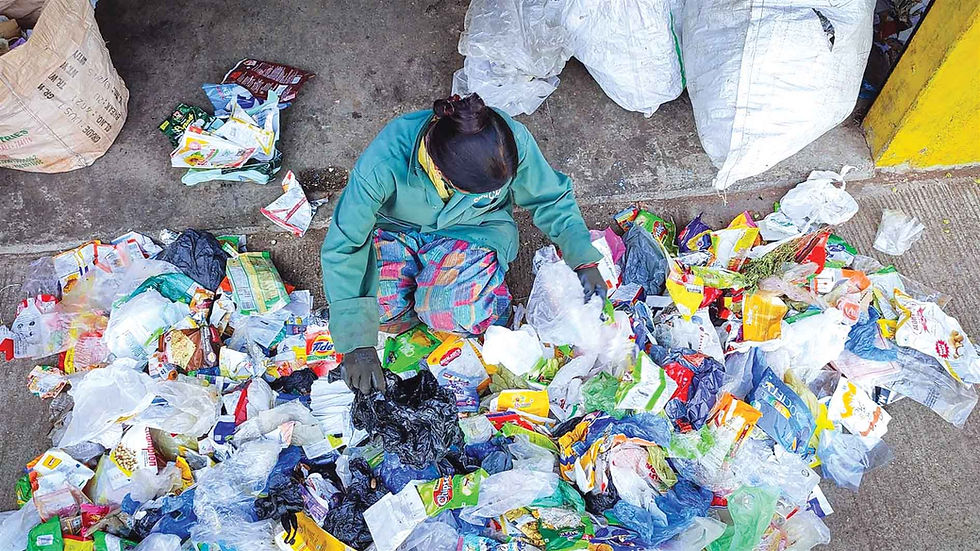
Many a time, you may have seen photographs, reels, or documentaries showing safai kamgars climbing down into manholes with sewage water flowing below, pulling out heaps of plastic bottles, polythene bags, wrappers, and other plastic waste, all smeared with muck.
That disturbing image tells us something important: plastic does not simply “go away” after we throw it out. It gets trapped in drains, chokes waterways, and blocks the natural flow of water.
Do you remember 26th July 2005? That day, unprecedented rains caused devastating floods in Mumbai and the surrounding region, bringing the city to a standstill. Mumbai’s lifelines were disrupted. Many lives were lost. People were stranded in local trains, buses, offices, homes, and on roads for long hours, some even overnight.
Later, it emerged that the city’s century-old stormwater drainage system had been clogged at several places with garbage—much of it was plastic waste—along with silt.
The Mithi River, which serves as the primary stormwater drain for the city, has also been choked with sludge, sewage, and waste, much of it plastic, preventing floodwater from draining into the sea.
While the July 2005 deluge was exceptionally severe, such scenes are not unique to Mumbai.
Across India, in both cities and smaller towns, drains and waterways are routinely clogged with plastic waste. During heavy rains, the result is often the same: waterlogging, flooding, property damage, disruption of daily life, and sometimes, tragic loss of life.
And the journey of plastic does not stop there.
Plastic waste from gutters and drains eventually flows into rivers — directly or indirectly. Rivers then become the great carriers of this waste, transporting it over long distances before dumping it into the sea.
A paper published in Science Advances in 2021 noted that more than 1,000 rivers across the world carry nearly 80 per cent of the total plastic waste entering the oceans.
What is especially striking is this: it may not be only a few large rivers that are responsible. Many smaller, urban rivers may together be contributing a major share of the plastic that reaches the oceans.
India ranks second among the top twenty countries with high riverine plastic emissions, both nationally and globally.
Studies show that the Indus, Brahmaputra, and Ganga are among the country’s biggest plastic-carrying rivers and are part of the ten rivers worldwide that drain over 90 per cent of total plastic debris into the sea.
Among them, the Indus is believed to carry the second-highest amount of plastic to the sea globally, while the Brahmaputra and Ganga together rank sixth.
And this waste does not come only from large cities.
It also comes from smaller towns and villages located along riverbanks, where plastic is often dumped carelessly, carried away by rainwater, or swept into streams and tributaries that feed the larger rivers.
Apart from everyday plastic waste, rivers also carry another major category of plastic pollution: abandoned, lost, torn, and discarded fishing gear.
This includes ropes, strings, nets, floats, and fishing lines.
These items are made from different forms of plastic, including nylon, polyethylene, PCT (a high-performance thermoplastic polyester), HDPE, and PP.
Fisherfolk often try to repair and reuse torn nets. But many damaged nets eventually get discarded.
When there is little awareness about proper disposal, and when regulations are weak or poorly enforced, these worn-out fishing gears often pile up along riverbanks—or end up directly in the river itself—adding to the growing plastic burden.
So, the story of plastic pollution is not only about what floats in the sea.
It begins much earlier — in our streets, our drains, our rivers, and our everyday habits.
The trail will continue. Till then, have a wonderful weekend!
(The author is an environmentalist. Views Personal.)


Comments