

Dunya Goal Hai: Why the World Speaks Football

From the beaches of Brazil to the streets of Naples, football remains the one spectacle capable of uniting and dividing the globe like no other.

Next week, the 2026 FIFA World Cup will kick off across North America, the largest edition of the tournament ever staged. Yet beneath the spectacle of 48 nations and packed stadiums lies a deeper truth: football remains the world's most powerful expression of national character, cultural identity and collective passion.
It is impossible to measure the importance of football to people in regions where for many it remains the only escape from life’s harshest realities. In Central America, countries have gone into war in its name. And, in an increasingly borderless Europe, it remains the only event to still stir strong nationalistic fervour. Starting 1930, so far only eight countries from these two continents could take the World Cup home - Brazil, Argentina, Italy, Germany, Spain, Uruguay, England and France.
Cultural Nuances
Wherever football has been introduced, it has developed its own style, absorbing and reflecting the cultural nuances and social influences of its host; and it is this intriguing contrast of styles that makes each World Cup such an occasion of expectations and excitement. For instance, everything about Brazilian football is different from that of English. When English lads find themselves with a football, they throw a couple of jumpers on the ground and start playing three-goals-and-in. When Brazilians have a kick about, they stand in a circle and play magic flicks. The ball goes from foot to head to heel to thigh. It never touches the ground: chest; knee; overhead flicks. It goes on for hours, this celebration of ball mastery. The difference in philosophy is profound.
Nowhere is that contrast more apparent than in the way the game is approached in England, where it was first organized in to a league structure, and Italy, where it has reached its European peak in popularity and passion. Nowhere in the world is football’s attraction stronger than in Italy where football is the country’s whole life while in England it is still largely viewed by the authorities as “a game for gentlemen, played – and watched – by hooligans.”
England is the originator of the game, but even today, it is viewed as the domain of the mental gnome. The English person of culture and class still has a negative reaction to the sports; football, how frightful, not worth the time of any person of intelligence. In Italy, sport is regarded as part of the pursuit of the whole man. Love for football flows through every stream of Italian society.
On the pitch, the Phrase “Italian Style” has a connotation reflecting skill, technique and patience – and the occasional tendency to histrionics. The English style is combative, inspirational, fearless and brave to the point of foolhardiness. The team is often distracted by the off-field activities of its notoriously violent supporters. When the Italian World Cup – winning team scored its third goal in the 1982 Final in Spain, the President of Italy sprang to his feet in the VIP box, his fist clenched in a victory salute – like any other fan. It is hard to imagine a similar reaction from a much younger Tony Blair or Gordon Brown should the victor be England. This football loving country has won the world cup four times, only one less than the Brazilians.
Magical Artistry
To the Italians, and most other Europeans, the ball is a valuable asset, which requires much effort to regain if lost and therefore not to be given away lightly. Spain invented and used its most artistic variation known as Tiki-Taka. But, ultimately the South Americans have perfected the art, with the Brazilians making it virtually an integral part of their very being. Brazilian’s magical artistry with the ball has obviously created the number of heroes, whose names and faces are recognized by millions world-wide. While their collective brilliance resulted in five world cup wins, it also resulted in some unexpected setbacks. While they are a visual treat to watch in action, they are not as consistent as the Germans during the last two decades.
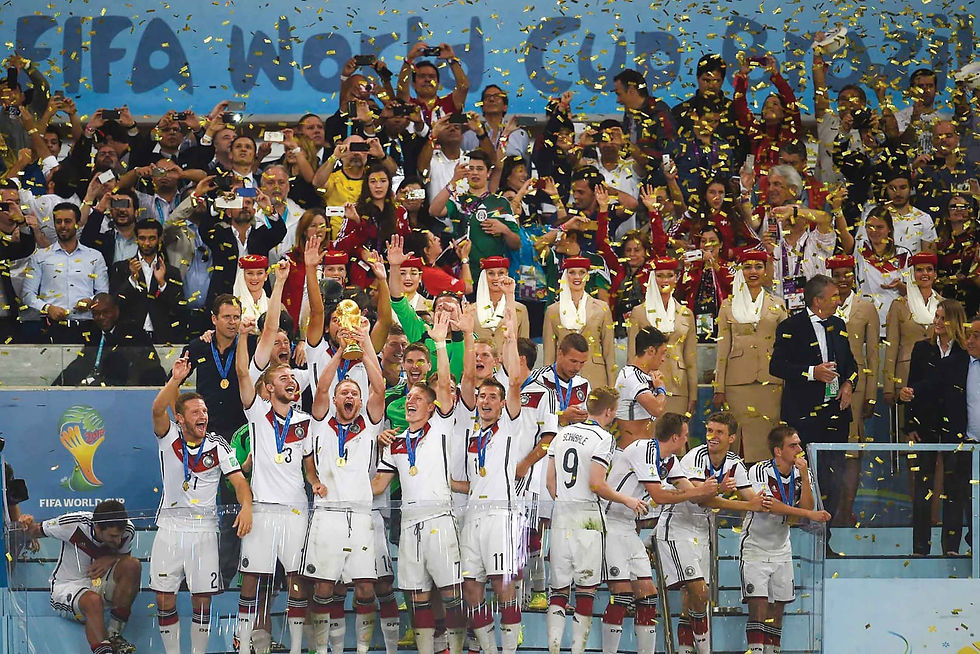
The German team, often lacking any superstar to talk about, reached the finals, often banking on their sheer diligence and consistency. In absolute contrast to the Brazilian way, the hallmarks of Germans are technical proficiency and teamwork. Their winning formula is quite simple – gather a group of technically proficient players, spice it up with one or two top class performers and then gel them into a team capable of producing more than the sum of its parts. With this formula and backed by their national traits, Germany reached the finals seven times, equalling Brazil, and won the championship three times.
The Brazilian attitude to the game has ingredients of fun and artistry, where the result (apparently) takes a back seat. But other South American nations are far more serious about the outcome. And, for that victory Uruguay was ready to do everything on the ground. Players all over the world think that a really good foul early in the game will give opponents a respect that lasts until the final whistle. The Uruguayans had merely organized it better than the other. Up until 1986, when a strong referee did his stuff, the Uruguayans adopted an approach of utter cynicism. Call it realism if you prefer, or if you want to take Uruguayan’s point of view. With this kind of fervour, Argentina and Uruguay, won the Cup twice each, followed by France and England who took the World Cup home only once.
In contrast, an average Frenchman watching the World Cup will probably think the World Cup is great but ultimately unimportant. Incidentally, now only average Frenchmen do not mean the French side (for that matter other European side), which reached its zenith of success about a decade back. It has a large share of “beur” boys, born out of African parentage. So, the generation led by Zidane Zidane added that little extra winning punch which the earlier generation of Michel Platinni could not deliver. Today even Russia has Brazilian born Mario Fernandez.

Every nation plays football to the same set of rules, but rules are no more than the framework in which moral differences are expressed. One nation’s hard-but-fair player is another’s animal. One man’s “bit of character” is another’s assassin.
Grand Passion
The so-called Maradona incident is the best example. In a tight, enthralling game against England, Maradona made the final breakthrough by scoring a goal with his hand. He went to head the ball, was not high enough, and tipped it with his hand over the advancing Shilton in goal. He described the goal, unforgettably, afterwards: “A little bit the hand of God, a little bit the head of Diego.” All England went “we wuz robbed.” And so they were, but any footballer would have done the same. And the Cronica newspaper of Buenos Aires was unambiguous: “We blasted the English pirates with Maradona and a little hand. He who robs a thief has a thousand years of pardon.”
Small wonder then, there is great passion, great folly, great excitement, great expectations resulting in the great spectacle of World Cup football. While some players will rise to the occasion and play magnificently, others will fall from grace and behave appallingly before half the world. Some may even manage both (as Maradona did).
Thus, every four years, the world gathers together under the banner of football to celebrate its unbridgeable differences. Folly it certainly is, but it is good that such folly exists. After all, there are ways of sorting out national differences that are far more foolish.
(The author is a senior journalist based in Navi Mumbai. Views personal.)

Football is often called a universal language because it has the unique ability to connect people from different cultures, backgrounds, and generations. Whether it is a local match or a major international tournament, the sport creates shared experiences that bring fans together through passion, emotion, and competition. Discussions about football rarely end with the final whistle, as supporters continue analyzing performances, tactics, and memorable moments. While exploring sports-related entertainment and digital trends, I came across stake app, which provides information about betting options and a variety of sporting events. It is interesting to see how technology continues to give fans new ways to follow competitions and stay engaged with the games they love. In the end, football remains special because…