top of page

By:

Amey Chitale

28 October 2024 at 5:29:02 am

El Niño and India’s Economic Future

Even with better forecasting and policy preparedness, El Niño remains a significant risk to agriculture and inflation. With rising temperatures in April, forecasts of the southwest monsoon become a focal point across India. In India monsoon is crucial for agriculture, water availability, food security, and rural incomes. Its performance influences economic activity, stability and welfare and is closely tracked by policymakers, businesses, and farmers. A normal monsoon supports agricultural...

El Niño and India’s Economic Future

Even with better forecasting and policy preparedness, El Niño remains a significant risk to agriculture and inflation. With rising temperatures in April, forecasts of the southwest monsoon become a focal point across India. In India monsoon is crucial for agriculture, water availability, food security, and rural incomes. Its performance influences economic activity, stability and welfare and is closely tracked by policymakers, businesses, and farmers. A normal monsoon supports agricultural production, replenishes reservoirs, boosts rural consumption, and helps contain inflation. Conversely, deficient or delayed rainfall can lower crop yields, raise food prices, strain government finances, and slow growth. Elevated Risk In 2026, climate models highlighted an elevated risk to India owing to potential influence of El Nino on monsoon rainfall. El Nino is the warm phase of the El Nino–Southern Oscillation (ENSO), a natural climate cycle with three phases namely El Nino, La Niña and neutral. During an El Nino event, sea surface temperatures in the central and eastern equatorial Pacific Ocean rise above normal levels. This warming alters wind patterns, atmospheric pressure and cloud formation, influencing weather systems worldwide resulting into shifts in rainfall, higher temperatures, drought conditions in some regions and broader impacts on agriculture, food supplies and economic activity across the globe. In La Niña, the central and eastern equatorial Pacific Ocean becomes cooler than normal and trade winds usually strengthen. For India, El Nino is usually viewed with concern because it can increase the possibility of below normal or uneven monsoon rainfall. La Niña, on the other hand, is often associated with stronger monsoon conditions, although it can also bring risks such as excess rainfall and floods in some regions. Neither El Nino nor La Niña guarantees a fixed result for India. They influence probability, not certainty. El Nino does not affect every country in the same way. In Indian context the relationship between El Nino and drought is not linear. It increases risk, but the outcome depends on many other factors, including the Indian Ocean Dipole (IOD) , local weather systems, sea surface temperatures in the Arabian Sea and Bay of Bengal, and regional atmospheric circulation. Alongside El Nino, IOD is another crucial climate phenomenon that impacts India's rainfall. The IOD measures the difference in sea surface temperatures between the western Indian Ocean, near Africa, and the eastern Indian Ocean, near Indonesia. When the western region is warmer than normal and the eastern region cooler, a positive IOD develops, typically enhancing monsoon rainfall over India and, at times, offsetting some of the adverse effects of El Nino. Conversely, a negative IOD, characterized by warmer waters near Indonesia and cooler waters in the west, can weaken the monsoon and increase the likelihood of below-normal rainfall. Climate Regulator Much like ENSO in the Pacific Ocean, the IOD acts as a climate regulator in the Indian Ocean. Since both El Nino and the IOD influence atmospheric circulation and moisture transport over the subcontinent, meteorologists closely monitor their interaction. Indeed, the strength and distribution of India’s monsoon rainfall often depend on the combined influence of these two ocean-atmosphere systems rather than on El Nino alone. Historical experience shows that strong El Nino episodes have often been associated with weak monsoons and drought conditions in India. The 1982–83 El Nino reduced rainfall to about 81 percent of the Long Period Average (LPA), resulting in widespread crop losses and a sharp decline in agricultural output. The 2002–03 event was equally severe, with rainfall again falling to around 81 percent of the LPA. During the 2009–10 El Nino, India experienced its worst drought in nearly four decades, with monsoon rainfall dropping to 78 percent of the LPA, leading to substantial agricultural losses and higher global food prices. Similarly, the powerful 2015–16 Super El Nino contributed to consecutive years of deficient rainfall, affecting millions through water shortages and reduced farm incomes. However, historical data indicate that fewer than half of all El Nino events since 1951 have resulted in severe drought conditions in India. Although El Nino and IOD are the primary drivers of monsoon variability, scientists have found that sea surface temperature (SST) anomalies in the extratropical North Atlantic Ocean can also influence India's summer monsoon. This phenomenon is known as an Extratropical North Atlantic SST teleconnection, where ocean temperature changes in one region affect weather patterns thousands of kilometres away. When the North Atlantic experiences warmer-than-normal temperatures, atmospheric circulation patterns over Europe and Eurasia are altered. These changes can affect temperatures over the Eurasian landmass and the Tibetan Plateau, strengthening the land-sea thermal contrast that drives the Indian monsoon. As a result, monsoon winds and rainfall over India may become stronger. Conversely, cooler North Atlantic waters can weaken these processes and suppress rainfall. Although its influence is generally weaker than that of ENSO or the IOD, the North Atlantic acts as an important background climate signal. Modern forecasting models therefore monitor Atlantic SST conditions too to improve the accuracy of seasonal monsoon predictions. After the strong El Nino event of 2023–24, Pacific Ocean conditions moved into a brief La Niña phase during late 2025, which gradually weakened and transitioned to ENSO-neutral conditions in early 2026. However, climate models indicate that El Nino conditions have re-emerged during 2026 and are likely to strengthen through the second half of the year, with some forecasts suggesting the possibility of a strong event by late 2026. The IOD phenomenon is projected to be neutral to mildly positive. The combined impact would have adverse impact on rainfall during the latter part of the season. On the backdrop of current heavy rains, it would be too premature statement to say that El Nino has become weak. Economic Challenges A weak monsoon can trigger wide-ranging economic challenges, with food inflation often emerging as the most immediate impact. Insufficient rainfall reduces the output of key agricultural commodities, thereby adversely impacting food security. Food supply constraints can drive up consumer prices and weaken household purchasing power. Lower farm incomes may also curb rural spending on agricultural inputs, vehicles, and consumer goods, dampening overall economic momentum. Additionally, poor rainfall limits the replenishment of reservoirs and groundwater, exacerbating water shortages and reducing hydropower generation. Higher heatwave risks can further lower labour productivity, while the energy sector faces the combined challenge of rising electricity demand and declining hydropower availability. El Nino is a natural climate phenomenon, but now operates in a world already warmed by climate change. This means its effects may combine with long-term warming, making heatwaves more intense and weather extremes more damaging. WMO has noted that even when La Niña has a temporary cooling influence, human-induced climate change continues to increase global temperatures and intensify extreme weather risks. India’s preparedness against monsoon shocks rests on a robust monitoring and response framework. The Ministry of Agriculture, working with the IMD and ICAR, continuously tracks rainfall, soil moisture, reservoir levels and crop conditions, while vulnerability assessments identify drought-prone districts requiring priority attention. When rainfall risks emerge, District Agriculture Contingency Plans are activated, promoting drought-resistant crops, short-duration seeds, revised sowing schedules and water-conservation measures such as farm ponds, check dams and rainwater harvesting. Livestock and fodder management plans further reduce rural distress. Financial safeguards, including PM-KISAN, PMFBY crop insurance and Kisan Credit Cards, help protect farm incomes and credit access. Complementing these efforts are long-term investments in micro-irrigation, PM-KUSUM solar pumps, climate-resilient agriculture and RBI-led climate-risk frameworks, all of which have strengthened India’s resilience to monsoon variability and El Nino-induced disruptions. That said, El Niño remains a significant risk, making sustained investment in water security, climate-resilient agriculture, early-warning systems and AI-driven forecasting essential. As India pursues its Viksit Bharat dream, climate resilience is no longer an environmental priority but an economic imperative. (The writer is a Chartered Accountant with a leading company in Mumbai. Views personal.)

From Expansion to Execution

India’s BRICS presidency will be judged less by declarations than by its ability to translate ambition into economic cooperation.
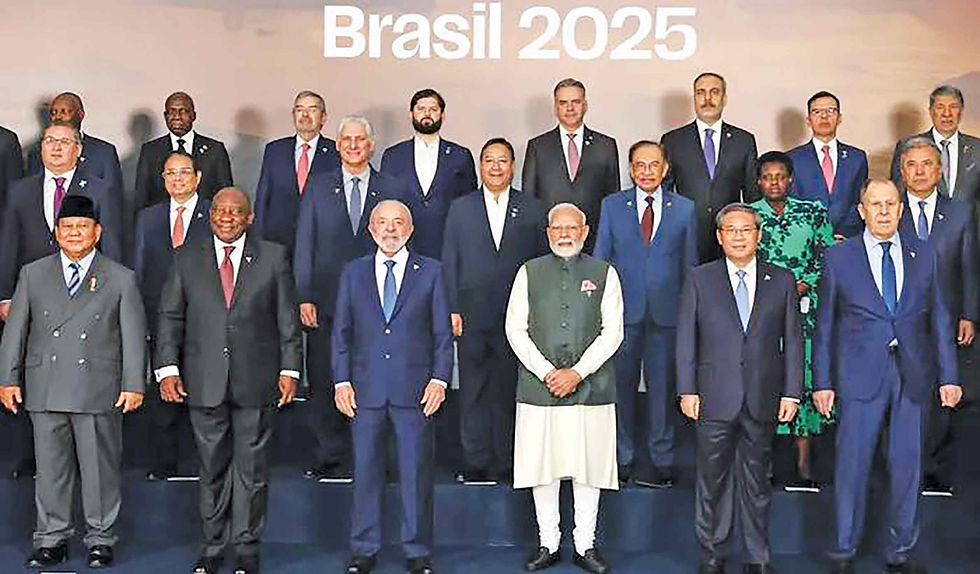
Following the BRICS Summit, attention has quickly shifted from the bloc’s expanding membership to India’s upcoming presidency. While BRICS now represents a larger share of the global economy than ever before, the question is no longer about whether the grouping matters, but whether it can deliver tangible economic outcomes. India’s presidency presents an opportunity to move BRICS beyond ambitious declarations and towards practical cooperation in trade, development finance, resilient supply chains, and digital governance.


In recent years, BRICS has gone from being a group of five countries to a wider coalition that seeks to raise the Global South’s voice. Its increasing size and share of global GDP, population and trade have given it more geopolitical and economic weight. Yet, expansion alone cannot define the bloc's success. With the growth of its membership, harmonizing diverse economic interests, political priorities, and development paths have become increasingly difficult.


Delivering Results

To maintain credibility, BRICS needs to move from issuing ambitious statements to delivering measurable results. Be it through trade, development finance, resilient supply chains or cooperation in new technologies, the relevance of the bloc will more and more rest upon implementing concrete actions that respond to changing demands of its members.


This evolution is also reflected in the Rio Declaration, which places renewed emphasis on cooperation in artificial intelligence, governance, climate finance, and the enhancement of South-South cooperation. These priorities are important, but their success will rest on continued action, not on ambitious commitments alone.


India's presidency comes at this critical juncture. Rather than focusing solely on broad declarations, it has an opportunity to steer the bloc towards practical cooperation in areas where shared interests already exist. By prioritising implementation over rhetoric, India can help position BRICS as a platform that not only represents emerging economies but also delivers meaningful economic cooperation.


India’s presidency presents a unique opportunity to move BRICS towards an implementation-focussed agenda rather than one centred on aspiration. The first priority should be the strengthening of economic resilience via diversified and reliable supply chains. Recent geopolitical tensions, trade disruptions, and the growing importance of critical minerals have highlighted the need for trusted partnerships. BRICS can facilitate greater collaboration in manufacturing, logistics, and investment to reduce vulnerabilities while supporting sustainable growth.


A related focus should be on strengthening development finance. The New Development Bank stands out as one of BRICS’ most concrete accomplishments, but its reach is dwarfed by the magnitude of global infrastructure and climate finance demands. India could advocate for reforms that enhance project delivery, promote local currency financing when suitable, and broaden assistance for sustainable infrastructure among developing nations.


Lastly, India is also well placed to take forward collaboration in digital public infrastructure as well as emerging technologies. Its experience with platforms like Aadhaar and UPI under the Digital Public Infrastructure framework has received attention globally. By promoting knowledge sharing, interoperability, and cooperation in AI and digital governance, India can help BRICS develop more inclusive digital models for emerging economies.


In sum, these priorities represent a move away from large political pronouncements and towards economic practicality. If followed through successfully, these will enhance the credibility of BRICS as a platform that offers real results rather than symbolic assurances.


Challenges Ahead

Translating this agenda into concrete results doesn’t come without challenges. The recent expansion of BRICS has made the group more representative, but has also increased the complexity in decision-making. The member states have very different economic priorities, political systems, and strategic interests, which makes the implementation of ambitious initiatives more difficult to achieve. In addition, a changing world with stronger protectionist tendencies, interruptions to supply chains and regional tensions makes it increasingly difficult to work towards a unified economic front.


Unlike formal multilateral institutions, which have binding enforcement mechanisms, BRICS operates through consensus and voluntary cooperation. This flexibility has made it possible for the bloc to evolve, but it could also hinder timely action and diluting commitments. The challenge for India will be to generate a broad consensus on a small number of concrete and realistic priorities, rather than having an expansive agenda.


The success of India’s presidency rests not only on its leadership but also on its ability to build trust, cultivate sustained cooperation, and convert commitment into actionable progress. A focused and action-oriented presidency will further enhance the credibility of BRICS, instead of another round of ambitious declarations.


With India taking over the BRICS presidency, it inherits a bloc that is bigger, more influential, and more ambitious than before. But the real test of its success will not be lie in the number of declarations or partnerships, but whether it can translate shared aspirations into meaningful economic outcomes.


Through focus on the facilitation of trade, enhancing development finance, building resilient supply chains and promoting digital cooperation, India can seek to transform BRICS into a more actionable platform for the Global South. Although the tensions caused by competing national interests and institutional capacity will no doubt remain, a focussed and pragmatic agenda can serve to narrow the gap between ambition and implementation.


Ultimately, India's presidency presents not just an opportunity to lead, but it's a chance to redefine what effective multilateralism looks like in a more fragmented global economy. If India is able to move BRICS from expansion to execution, its presidency will not be remembered by the declarations it produced, but for the economic outcomes it is able to deliver.


(The author is an economics postgraduate from Jawaharlal Nehru University with research interests in economic policy, trade and global governance. Views personal.)

Comments


bottom of page