

From muscle-flexing to rationalising
- Abhijit Mulye

- Dec 22, 2025
- 3 min read
The council polls reset Mahayuti’s power balance
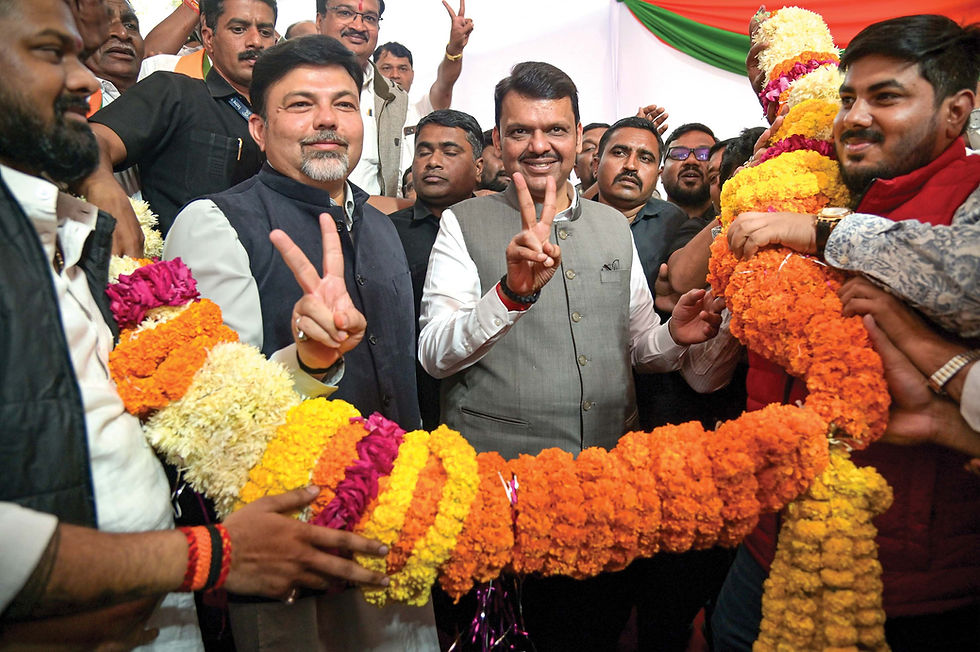
Mumbai: The recently concluded Municipal Council and Nagar Panchayat elections have delivered a sobering "reality check" for Maharashtra’s ruling Mahayuti alliance. While the BJP emerged as the single largest force, bagging approximately 100 Nagar Palikas and 30 Nagar Panchayats, the results have fundamentally altered the internal power dynamics between Chief Minister Devendra Fadnavis and Deputy CMs Eknath Shinde and Ajit Pawar.
On paper, the BJP’s performance is dominant. The party’s haul is more than double that of its closest allies, providing CM Devendra Fadnavis with significant political leverage. However, the internal mood within the BJP remains "disturbed."
Sources indicate that internal surveys had projected the party winning 200 out of 256 Chairperson seats that it contested on its own party symbol. Even after the first phase, estimates were pegged at 175. Finishing below the 130-mark suggests that the BJP’s "micro-management" strategy failed to account for the tenacity of regional strongmen. Despite this "inflated claim" being exposed, the sheer volume of seats won allows the BJP to maintain its "Big Brother" status within the alliance.
Bargaining Power
The most immediate impact of these results is the dilution of the bargaining power previously held by Deputy Chief Ministers Eknath Shinde (Shiv Sena) and Ajit Pawar (NCP). Earlier this month, both Deputy CMs had engaged in visible "muscle-flexing," demanding a larger share of seats for the upcoming 29 Municipal Corporation elections.
With the BJP now holding a commanding lead in the rural and semi-urban hinterlands, the Shinde and Pawar factions are being forced to "rationalize" their demands. CM Fadnavis has already signalled that these results are a precursor to the Corporation polls, effectively telling his partners that seat-sharing formulas will now be dictated by "ground reality" rather than political posturing.
Regional Defiance
Despite the BJP's overall dominance, the results highlighted critical vulnerabilities in the party’s armour, like the Shinde Factor in Nashik, where the BJP laid claim to several seats but Shinde’s Shiv Sena delivered a "surprise" performance, outperforming expectations and proving that his faction retains a grassroots base independent of the BJP.
Similarly, the NCP kept its bastions intact. Ajit Pawar’s NCP demonstrated continued supremacy in Western Maharashtra and showed resilience in parts of Marathwada. These localized victories provide the NCP with a shield against a total BJP hegemony within the alliance.
The Municipal Council results serve as a strategic "galvanising" force for the Mahayuti. While the BJP has been humbled by its own high expectations, and the allies have been forced to lower theirs, the alliance now has a clearer map of its collective strengths and weaknesses.Political analysts suggest that the internal friction over seat-sharing for the 29 Municipal Corporations – including the high-stakes Brihanmumbai Municipal Corporation (BMC) – will likely settle into a more pragmatic arrangement. The BJP is expected to use its "mammoth" numbers to claim the lion's share of seats, but the "surprising" performance of Shinde in Nashik and Pawar in Marathwada ensures that the junior partners cannot be ignored entirely.
As the state shifts its focus to the "Mega-Battle" of the Corporations, the Mahayuti enters the fray with a bruised ego but a clarified hierarchy. For the BJP, the goal is to bridge the gap between "claims and reality," while for Shinde and Pawar, the mission is to protect their remaining turf from their own ally’s expansionist ambitions.


Comments