top of page

By:

Rik Amrit

10 September 2025 at 1:11:22 pm

Five Generations, One Sacred Text: Inside the Manuscript Birju Maharaj Guarded Like the Gītā

Some books arrive with the weight of history on their pages. ‘Saṅgīta-darpaṇaḥ’ is one such work; a 200-year-old manuscript that has travelled through five or six generations of the legendary Kalka–Bindādin Gharānā before finding its way to print. Published just weeks after Paṇḍit Birju Mahārāj's passing in January 2022, this book feels less like an academic exercise and more like a parting gift from a maestro to the world of classical arts. The story behind this publication is as compelling...

Five Generations, One Sacred Text: Inside the Manuscript Birju Maharaj Guarded Like the Gītā

Some books arrive with the weight of history on their pages. ‘Saṅgīta-darpaṇaḥ’ is one such work; a 200-year-old manuscript that has travelled through five or six generations of the legendary Kalka–Bindādin Gharānā before finding its way to print. Published just weeks after Paṇḍit Birju Mahārāj's passing in January 2022, this book feels less like an academic exercise and more like a parting gift from a maestro to the world of classical arts. The story behind this publication is as compelling as its contents. Carefully preserved by Pt. Birju Mahārāj's ancestors, the manuscript was written in a difficult-to-decipher calligraphic script, with verses running continuously without spaces, a common practice in pre-modern texts but a nightmare for modern readers. Previous attempts to decode it had failed. It took a dedicated team led by Arjun Bharadwaj, with support and a foreword from the renowned scholar Śatāvadhānī Dr. R. Ganesh, to finally bring this work to light. What makes this edition special is not just the translation but the transparent scholarly apparatus. Bharadwaj doesn't hide the manuscript's imperfections, the scribal errors, the missing verses, the regional dialect influences. Instead, he documents them meticulously, allowing future researchers to revisit his interpretations. In his moving acknowledgment, he describes how Pt. Birju Mahārāj would tap his walking stick to the rhythm of the druta-vilambita meter in which many verses are composed, treating the manuscript with the reverence one reserves for the Bhagavad-gītā. Saṅgīta-darpaṇaḥ is structured as a conversation between Lord Śiva (called Gaurīśvara here) and Tomara, a gandharva-rāja (celestial musician). The text opens with a beautiful creation myth: how Brahmā seeks to see his father Mahāviṣṇu, performs intense tapas, and in the form of Hayagrīva (the horse-headed incarnation), Viṣṇu appears. Nārada impresses everyone not just with his devotion but with his artistic skills, he performs sāmagāna and tāṇḍava-nṛtya with gati-bhedas. This establishes a fundamental principle of the text: artistic excellence can be as powerful as spiritual practice in reaching the divine. Disappointed at receiving fewer divine blessings than Nārada, Tomara, another son of Brahmā, embarks on a cosmic quest to understand why art pleases the divine. His journey takes him through the abodes of various deities until Śiva reveals the answer through the Nāda-vidyā, the knowledge of sound itself. From Śiva's ḍamaru emerge the fourteen and thirteen nādas that birth both Sanskrit grammar and this very treatise. Pārvatī creates rāgas and rāgiṇīs in anthropomorphic form, Viṣṇu blesses the musical knowledge, and finally Gaṇeśa narrates while Śāradā transcribes the entire Saṅgīta-darpaṇa at the dawn of Satya-yuga, making divine knowledge accessible to mortals. A note of personal preference: Chapter 5 holds a special place for this reviewer. There is something deeply satisfying about this particular chapter, and it rewards patient readers who have followed Tomara's journey from his initial disappointment through his cosmic wandering to his ultimate enlightenment. The treatise then moves into technical territory, covering 13 chapters on: The birth and classification of rāgas and rāgiṇīs, svaras, śrutis, and their mystical associations, tālas (36 types are described), mārga-bheda and musical ensembles, gaṇas, prabandhas, and letter classifications, musical instruments including the making of kiṅkiṇī-vīṇā, the emotions of nāyikās and principles of abhinaya, various dance forms and movements. The final section, nine verses on Pt. Durga Prasad’s family lineage connects the divine knowledge transmitted through Tomara to the Mahārāj family, creating a direct link between celestial gandharvas and the earthly practitioners of Kathak. One of the book’s many strengths is how Bharadwaj balances academic precision with accessibility. The critically edited Sanskrit text appears alongside English and Hindi translations, with extensive footnotes explaining technical terms. But what sets this edition apart is the additional material: new compositions by Pt. Birju Mahārāj inspired by the treatise, previously unknown works from Pt. Lachchū Mahārāj's diaries, fresh paintings of rāga–rāgiṇīs, and photographs showing practical applications of dance elements described in the text. The Introduction is itself a valuable contribution. Bharadwaj carefully dates the work to somewhere between 1600–1780 CE, distinguishes it from other similarly named treatises attributed to Catura-dāmodara and Harivallabha, and provides a detailed comparative analysis. He lists 18 specific ways in which Gaurīśvara's work differs from Catura-dāmodara's Saṅgīta-darpaṇa, from unique terms like dvirukta to the presence of Gaṇeśa-kautha (found nowhere else). In his Foreword, Dr. R. Ganesh raises an important point about the mindset needed to approach such texts. He warns against two extremes: scholars who can edit texts but lack understanding of practical performance, and performers who lack philosophical grounding. He praises this edition for bridging that gap as it is the work of someone who understands both śāstra (theory) and prayoga (practice). The book is not without limitations, though. As Bharadwaj frankly acknowledges, medieval treatises like this one provide inadequate information for reconstructing rāga–rāgiṇīs in practice today. The text mentions that all rāgas should have the same aṃśa (predominant note), graha (starting note), and nyāsa (ending note), which is hard to imagine in actual performance. The descriptions of tālas, while detailed, are often so complex and unintuitive that few would be practical for contemporary use. There are also segments that remain difficult to interpret, concepts like āvarta and svalpa-bhedas in Chapter 11, and the entire section on Nāyikā-bhāva-prakaraṇa in Chapter 13, contain material not found elsewhere and require further research. The book is a beginning, not a conclusion. What makes this publication deeply moving is how it demonstrates the continuity of knowledge transmission in Indian classical arts. The manuscript was not locked away in some dusty archive, it was actively consulted by generations of Kathak maestros. Pt. Birju Mahārāj and his students could see parallels between the treatise’s descriptions and their own practice. Some ancestral compositions whose meanings had been forgotten suddenly made sense when read against this text. The book includes comprehensive appendices: a glossary, indices of rāgas, technical terms, poetic meters, geographical locations, and profiles of scholars. There is even a transliteration guide for those unfamiliar with Devanāgarī script. Saṅgīta-darpaṇaḥ is more than an academic publication; it is nothing short of a cultural event. It makes available a text that has remained within one family for two centuries, offers insights into the medieval understanding of music and dance, and provides a foundation for future research into the Lucknow–Ayodhyā school of classical arts. Is it essential reading for every classical arts enthusiast? Perhaps not, its technical nature and the gaps in reconstructing practical applications make it primarily valuable for serious students, performers, and researchers. But for those interested in how our classical traditions have been theorized, preserved, and transmitted across generations, this book is a treasure. The real achievement here is not just bringing an old manuscript to print, but doing so with integrity, transparency, and a deep respect for both the tradition it represents and the questions it leaves unanswered. In an age where we often see either uncritical glorification or dismissive rejection of traditional knowledge, Saṅgīta-darpaṇaḥ offers a model of ‘critical conservatism,’ honouring the past while engaging with it rigorously. As Pt. Birju Mahārāj had hoped in his preface, this work is now available to “the entire Kathak world” and beyond. It deserves a place on the shelves of anyone seriously interested in understanding the theoretical foundations of North Indian classical arts. (The author is a Natyashastra scholar, theatre director and producer whose work bridges traditional Indian performance theory with contemporary theatre economics. Views personal. )

From Polypropylene to Polystyrene: Decoding Plastic Codes

Not all plastics are created equal—codes 5, 6 and 7 show why some materials recycle easily, while others pose serious challenges.

ree

In the earlier parts of this series, we examined the first set of Resin Identification Codes. Let us now continue our exploration of the remaining codes and their uses.


Code no. 5

This code is assigned to products made from polypropylene (PP). It is a highly versatile polymer, widely known for its durability, chemical resistance, and light weight. Polypropylene is commonly used in food containers and textiles, as well as in automotive parts and medical devices. When exposed to high temperatures, it melts rather than burns; hence, it is classified as a thermoplastic.


PP is easily mouldable and recyclable, and it offers an excellent strength-to-weight ratio. These properties make it an ideal raw material across many industries. In fact, it is the most commonly used thermoplastic in the world. It is extensively used in medical devices such as syringes, medical vials, petri dishes, pill containers, and specimen bottles.


Polypropylene is particularly well-suited to applications that require repeated bending and manipulation without breaking. Examples include hinges on medication pots, lids or caps on shampoo bottles, and various types of plastic bottles and containers. Beyond packaging, PP is also used to manufacture ropes, twine, tape, carpets, upholstery, clothing, and camping equipment. Its waterproof properties make it especially effective for use in the marine sector.


Although polypropylene is recyclable, there are certain limitations. Rigid items, such as containers and bottle caps, are easily accepted for recycling, whereas flexible films made from PP are more difficult to recycle.


Code no. 6

This code is assigned to products made from polystyrene (PS). Polystyrene is a hard and brittle plastic that may be transparent or opaque. It is available in three distinct forms, each used for different applications.


The first type is GPPS (General Purpose Polystyrene). This form is commonly used for disposable items such as cups, cutlery, and food trays. It is also used in rigid packaging, cosmetic boxes, toys, lighting diffusers, and laboratory ware.


The second type is High Impact Polystyrene (HIPS), which is modified to improve toughness and impact resistance. HIPS is widely used in packaging, retail displays, and signage, as well as in consumer electronics, including housings for televisions, computers, and toys. It also finds applications in automotive interiors, such as trims and panels.


The third type is Expanded Polystyrene (EPS). This form is hard and brittle yet extremely lightweight and is more commonly known as 'styrofoam' or 'thermocol'. EPS is generally used as moulded foam packaging for televisions, computers, household appliances, and other fragile goods. It is also commonly found in trays used for meat, fish, and similar products, as well as in egg cartons. In addition, EPS is used to make disposable items such as cups, plates, bowls, lids, and cutlery, and it is also used as an insulating liner in refrigerators and air conditioners.


Technically, polystyrene is 100% recyclable. However, because it is lightweight, bulky, and often contaminated with food residue, recycling it is not economically viable in many regions. The process requires specialised facilities and handling systems, which are not widely available.


Code no. 7

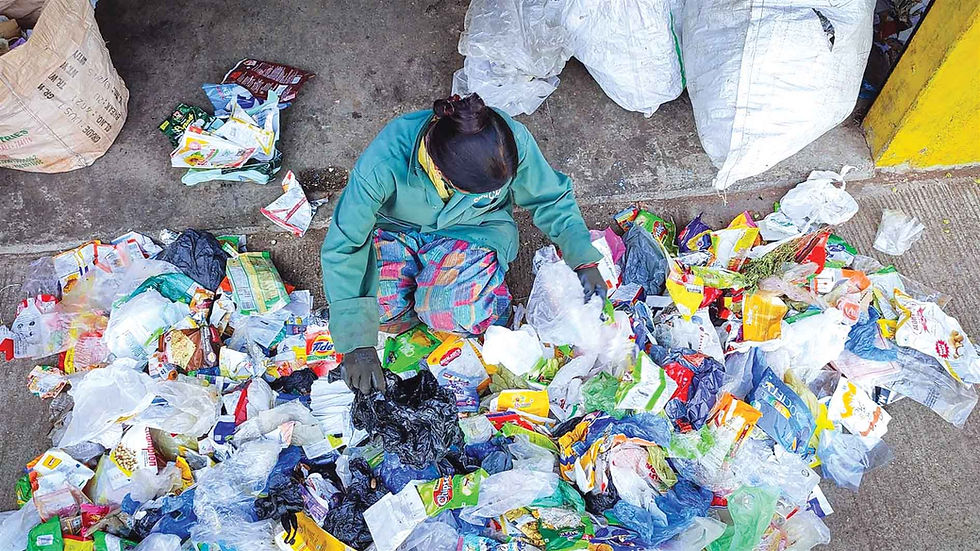
This code is assigned to plastics that do not fall under any of the six categories discussed earlier. It generally includes a broad group labelled as “other” plastics, such as polycarbonates (PC), acrylic, nylon, multilayered composite plastics used in sachets or pouches, and fibreglass composites used in automotive parts, industrial containers, and similar applications.


Polycarbonates are commonly used in products that require strength and impact resistance, such as safety goggles and reusable water bottles. Acrylic, also known as Plexiglas, has a wide range of applications and is frequently used in light fixtures, display units, and packaging windows. Nylon is valued for its strength and flexibility and is typically used in products such as toothbrush bristles, gears, and other mechanical components.


Because of their complex and mixed compositions, plastics classified under Code 7 are generally not recyclable.


Will continue in the next week. Till then, have a nice weekend!


(The author is an environmentalist. Views personal.)


Comments


bottom of page