top of page

By:

Rashmi Kulkarni

23 March 2025 at 2:58:52 pm

Loss Aversion Is Why Your Good Idea Fails

Your upgrade is their loss until you prove otherwise. Last week, Rahul wrote about a simple truth: you’re not inheriting a business, you’re inheriting an equilibrium. This week, I want to talk about the most common reason that equilibrium fights back even when your idea is genuinely sensible. Here it is, in plain language: People don’t oppose improvement. They oppose loss disguised as improvement. When you step into a legacy MSME, most things are still manual, informal, relationship-driven....

Loss Aversion Is Why Your Good Idea Fails

Your upgrade is their loss until you prove otherwise. Last week, Rahul wrote about a simple truth: you’re not inheriting a business, you’re inheriting an equilibrium. This week, I want to talk about the most common reason that equilibrium fights back even when your idea is genuinely sensible. Here it is, in plain language: People don’t oppose improvement. They oppose loss disguised as improvement. When you step into a legacy MSME, most things are still manual, informal, relationship-driven. People have built their own ways of keeping work moving. It’s not perfect, but it’s familiar. When you introduce a new system, a new rule, a new “professional way,” you may be adding order but you’re also removing something  they were using to survive. And humans react more strongly to removals than additions. Behavioral economists Daniel Kahneman and Amos Tversky called this loss aversion where we feel losses more sharply than we feel gains. That’s why your promised “future benefit” struggles to compete with someone’s immediate fear. Which seat are you stepping into? Inherited seat:  People assume you’ll change things quickly to “prove yourself”. They brace for loss even before you speak. Hired seat:  People watch for hidden agendas: “New boss means new rules, new blame.” They protect themselves. Promoted seat:  Your peers worry the old friendship is now replaced by authority. They fear loss of comfort and access. Different seats, same emotion underneath: don’t take away what keeps me safe. Weighing Scale Think of an old kirana shop. The weighing scale may not be fancy, but it’s trusted. The shopkeeper has used it for years. Customers have seen it. Everyone has settled into that comfort. Now imagine someone walks in and says, “We’re upgrading your weighing scale. This is digital. More accurate. More modern.” Sounds good, right? But what does the shopkeeper hear ? “My customers might think the old scale was wrong.” (loss of trust) “I won’t be able to adjust for small realities.” (loss of flexibility) “If the digital scale shows something different, I’ll be accused.” (loss of safety) “This was my shop. Now someone else is deciding.” (loss of control) So even if the new scale is better, the shopkeeper will resist or accept it politely and quietly return to the old one when nobody is watching. That is exactly what happens in companies. Modernisation Pitch Most leaders pitch change like this: “We’ll become world-class.” “We’ll digitize.” “We’ll improve visibility.” “We’ll build a process-driven culture.” But for the listener, these are not benefits. These are threats, because they translate into losses: Visibility can mean exposure . Process can mean loss of discretion . Digitization can mean loss of speed  (at least initially). “Professional” can mean loss of status  for the old guard. So the person across the table is not debating your logic. They’re calculating their losses. Practical Way Watch what happens when you propose something simple like daily reporting. You say: “It’s just 10 minutes. Basic discipline.” They hear: “Daily reporting means daily scrutiny.” “If numbers dip, I will be questioned.” “If I show the truth, it will create conflict.” “If I don’t show the truth, I’ll be accused later.” In their mind, the safest response is: nod, agree, delay. Then you label them “resistant.” But they’re not resisting change. They’re resisting loss . Leader’s Job If you want adoption in an MSME, don’t sell modernization as “upgrade”. Sell it as protection . Instead of: “We need an ERP.” Try: “We need to stop money leakage and order confusion.” Instead of: “We need systems.” Try: “We need fewer customer escalations and less rework.” Instead of: “We need transparency.” Try: “We need fewer surprises at month-end.” This is not manipulation. This is translation. You’re speaking the language the system understands: risk, leakage, blame, customer loss, cash loss, fatigue. Field Test: Rewrite your pitch in loss-prevention language Pick one change you’re pushing this month. Now write two versions: Version A (your current pitch): What you normally say: upgrade, modern, efficiency, best practices. Version B (loss prevention pitch): Use this template: What are we losing today?  (money, time, customers, reputation, peace) Where is the leakage happening?  (handoffs, approvals, rework, vendor delays) What small protection will this change create? (fewer disputes, faster closure, less follow-up) What will not change?  (no layoffs, no humiliation, no sudden policing) What proof will we show in 2 weeks?  (one metric, one visible win) Now do one more important step: For your top 3 stakeholders, write the one loss they think they will face  if your change happens. Don’t argue with it. Just name it. Because once you name the fear, you can design around it. The close If you remember only one thing from this week, remember this: A “good idea” is not enough in a legacy MSME. People need to feel safe adopting it. You don’t have to dilute your standards. You just have to stop selling change like a TED talk and start selling it like a protection plan. Next week, we’ll deal with another invisible force that keeps companies stuck even when they agree with you: the status quo isn’t a baseline. It’s a competitor. (The writer is CEO of PPS Consulting, can be reached at rashmi@ppsconsulting.biz )

From PVC to LDPE: The Plastics Hidden in Everyday Life

From packaging to household goods, RIC 3 and 4 plastics are everywhere. Learn how to identify them at a glance.

In my previous article, we explored the first two Resin Identification Codes—RIC 1 (PET), commonly used in beverage and food containers, and RIC 2 (HDPE), found in sturdy household bottles and a wide range of utility products. Both plastics are among the easiest to recycle, making them central to responsible waste management and to the broader shift towards more sustainable patterns of consumption. With this foundation in place and a clearer understanding of how these codes guide our daily choices, let us now move on to the remaining classifications in the Resin Identification System and understand what each one signifies.


Code 3: PVC

Code 3 refers to products made from polyvinyl chloride, or PVC—a remarkably versatile and inexpensive plastic valued for its durability, water resistance, and excellent electrical insulation. As the world’s third most produced plastic, PVC is manufactured in both rigid and flexible forms, each designed to meet a wide array of everyday needs. Flexible PVC, produced using plasticisers, appears in raincoats, boots, shower curtains, handbags, and imitation leather upholstery. It is also used in bottles for non-food items such as shampoos and cosmetics, in clear blister packaging for medicines, and in cling film that helps preserve the freshness and quality of food.


Rigid PVC, prized for its strength and longevity, is used to manufacture credit cards, debit cards, national identity cards, and various inflatable items—from pool toys and floats to air mattresses. It is also present in yoga mats, sports equipment, and numerous DIY and craft materials that require durability and ease of handling.


One of the most significant industrial uses of PVC is in piping. Rigid PVC pipes have increasingly replaced metal pipes in water supply, sewage, and drainage systems due to their resistance to corrosion, leakage, and environmental wear. Unplasticised PVC (uPVC) is widely used for window and door frames, offering excellent insulation, weather resistance, and minimal maintenance requirements. Vinyl flooring—produced as tiles, sheets, or planks—is another major PVC-based product, valued in homes, offices, and hospitals for its durability, affordability, and ease of cleaning. PVC’s strong insulating properties also make it ideal for coating electrical wires and cables, while PVC membranes and siding provide long-lasting, weather-resistant coverings for roofs and exterior walls.


Although PVC can be recycled, the process is considerably more complex than with many other plastics. The numerous additives used to improve its flexibility, strength, and stability often interfere with the recycling process and can reduce the quality of the recycled material, limiting its suitability for certain applications.


Code 4: LDPE

Code 4 identifies products made from low-density polyethylene, or LDPE—one of the most widely used plastics thanks to its lightness, flexibility, and overall durability. LDPE is commonly found in stretchable grocery bags, shopping bags, and general-purpose garbage bags. It is also extensively used in milk pouches, bread and frozen-food packaging, cling film, snack and toiletry pouches, and other everyday wrapping materials. Many squeeze bottles for glue, paints, condiments, and household liquids are made from LDPE, as are numerous lids and caps. Additionally, LDPE forms the waterproof inner lining of juice and milk cartons, helping protect the contents and extend shelf life.


Beyond packaging, LDPE serves as a protective coating in various products, appears in trash-can liners, and is widely used in children’s toys such as buckets and play balls due to its resilience and safety profile. Some household goods—including certain cutting boards—are also manufactured from LDPE, benefiting from its strength and ease of cleaning.


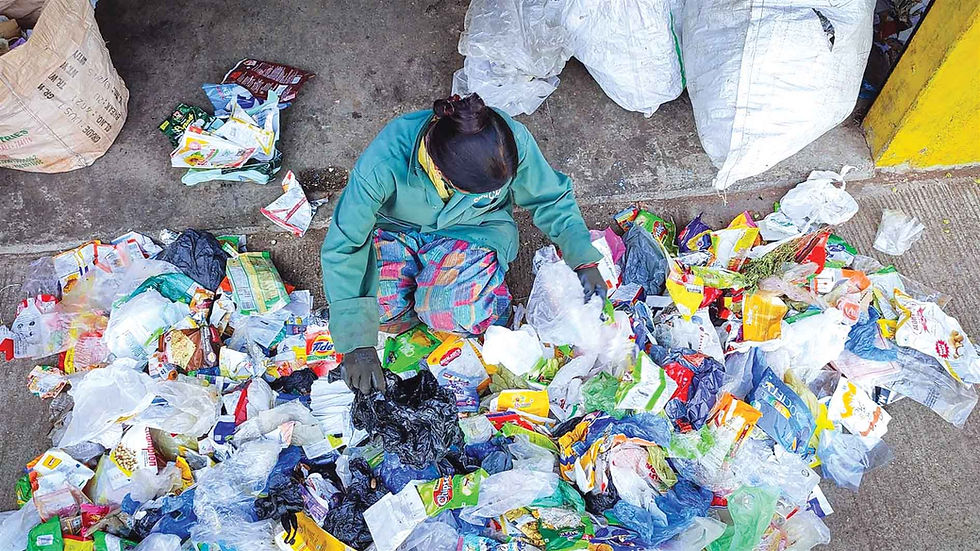
Despite its versatility and widespread use, LDPE poses notable challenges for recycling. Rigid LDPE products are somewhat easier to process, but thin bags, wraps, and cling films are difficult to collect, separate, and recycle efficiently. As a result, a significant proportion of these items unfortunately ends up in landfill.


Our discussion will continue in next week’s instalment, where we will explore the remaining Resin Identification Codes in greater depth and understand how they influence recycling practices. Until then, I wish you a pleasant and enjoyable weekend.


 (The author is an environmentalist. Views personal.)


Comments


bottom of page