

India’s Magnet-Free Moment

A Bengaluru startup’s breakthrough in magnet-free electric motors is a strategic step towards freeing India’s industrial future from China’s rare-earth dominance.
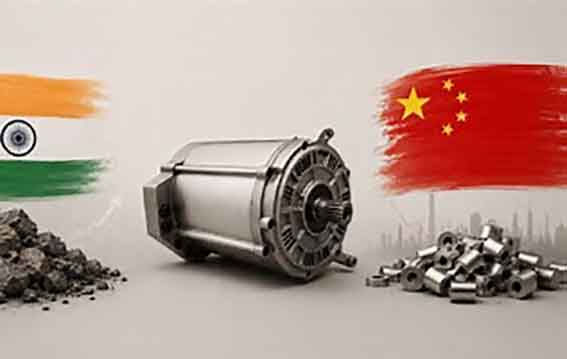
For years, the global transition to electric mobility has rested on an uncomfortable paradox. The technologies powering a cleaner future have themselves depended on a supply chain controlled overwhelmingly by one country. Permanent magnets used in high-performance electric motors require rare-earth minerals, and China dominates not only their mining but, more importantly, their refining and magnet manufacturing. This concentration has given Beijing enormous leverage over global manufacturing.
Significant Breakthrough
India’s recent breakthrough in magnet-free electric motor technology therefore deserves to be seen as much more than another startup success story. Bengaluru-based Vimag Labs has developed a software-defined electric motor that eliminates the need for permanent magnets altogether. If successfully commercialised at scale, the innovation could become a strategic milestone in India's quest for technological self-reliance, reducing dependence on Chinese rare-earth supplies while strengthening the country's automotive, industrial and even defence sectors.
The significance of this achievement lies in understanding what makes conventional electric motors work. Most modern electric vehicles rely on permanent magnets made from rare-earth materials such as neodymium and dysprosium. These magnets generate the magnetic fields that allow the motor to produce torque efficiently. The drawback, however, is that these minerals are neither widely available nor easy to process. China currently controls roughly 90 percent of global rare-earth processing and nearly 94 percent of the world's production of high-performance neodymium-iron-boron magnets, giving it an extraordinary grip over global electric vehicle manufacturing.
The search for alternatives has therefore become a strategic imperative for countries seeking resilient supply chains.
Magnet-free motors represent one such alternative. Rather than relying on permanently magnetised materials embedded inside the motor's rotor, these designs generate magnetic fields electronically through intelligent combinations of copper windings, steel cores, advanced power electronics and sophisticated software algorithms. In effect, software replaces scarce minerals.
Advanced Innovation
Several technological approaches have emerged worldwide. Separately Excited Synchronous Motors use copper windings in both the stator and rotor, energising the rotor only when required. Reluctance motors eliminate both magnets and rotor windings, instead exploiting carefully engineered steel geometries to create torque. Vimag’s innovation belongs to perhaps the most advanced category - the Virtual Magnet Synchronous Motor (VMSM). Here, proprietary software continuously controls electromagnets in real time, creating what engineers describe as a “virtual magnet” capable of matching or even exceeding the performance of conventional permanent magnets.
The implications extend well beyond engineering elegance. First comes supply-chain security. Modern manufacturing has learnt painful lessons about excessive dependence on single-country suppliers. The COVID-19 pandemic exposed global vulnerabilities across semiconductors, pharmaceuticals and industrial components. Rare-earth magnets proved no exception. When geopolitical tensions combine with concentrated supply chains, industrial production itself becomes hostage to strategic decisions taken elsewhere.
India experienced precisely this vulnerability during the pandemic. During the first COVID-19 wave in 2020, Vimag Labs found its shipment of rare-earth magnets stranded at Shanghai port. For most companies, the disruption would merely have delayed product development. For Vimag’s founders, led by CEO Manish Seth, it became the catalyst for a radically different approach. Rather than wait for fragile supply chains to recover, they decided to eliminate dependence on rare-earth magnets altogether.
Permanent magnets gradually lose strength under prolonged exposure to high temperatures and extreme operating conditions. Electromagnetically generated fields, by contrast, do not suffer permanent degradation. Their magnetic strength can also be controlled dynamically through software, allowing engineers to optimise efficiency under different driving conditions. At highway speeds, the system can minimise energy consumption; during acceleration, it can maximise torque. Such precise control offers the possibility of improving vehicle efficiency without relying on expensive rare-earth materials.
This software-defined architecture also reflects a broader technological shift underway across industries. Increasingly, competitive advantage lies not merely in physical hardware but in the algorithms controlling it. As automobiles become computers on wheels, innovations that replace scarce materials with intelligent software may prove more valuable than incremental improvements in conventional engineering.
The strategic implications are equally significant. High-performance motors are critical across defence platforms, industrial automation, aerospace, robotics, renewable energy systems and precision manufacturing. Any disruption in rare-earth supplies could affect sectors vital to national security. Technologies capable of removing that vulnerability therefore acquire strategic importance far beyond commercial markets.
Vimag’s progress has already moved beyond laboratory research. The company has secured an Indian patent for its software-defined magnet-free motor platform under the title A Robust Rotating Transformer Excited Synchronous Motor and Its Control. The patent strengthens India’s growing intellectual property base while providing the company with protection as it moves towards commercial deployment.
That said, established automotive manufacturers are naturally cautious about adopting entirely new motor architectures, particularly when reliability expectations stretch over decades. Commercial success will depend on whether magnet-free motors consistently deliver performance equal to or better than existing permanent-magnet technologies while remaining economically attractive. That, however, should not diminish the importance of what has already been achieved.
India has long aspired to become more than a manufacturing destination. It seeks to become a creator of core technologies. Success will depend not merely on assembling products designed elsewhere but on producing foundational innovations protected by domestic intellectual property. Vimag’s achievement points precisely in that direction.
India intends to build an electric future that is truly self-reliant, this breakthrough may well be remembered as the moment when the country discovered that the strongest magnet of all was innovation itself.
(The writer is a retired naval aviation officer and a defence and geopolitical analyst. Views personal.)


Comments