

India will emerge as world's largest weapons exporter: Rajnath

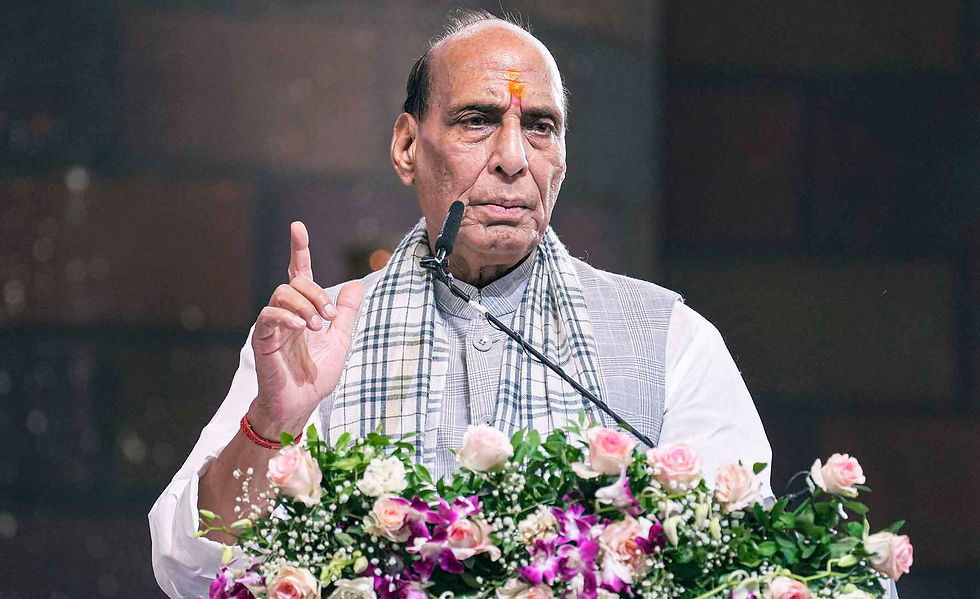
Shirdi: Defence Minister Rajnath Singh on Saturday asserted that India is on an unstoppable trajectory to emerge as the world’s biggest weapons exporter within the next 25 to 30 years. He was speaking while inaugurating a massive, state-of-the-art ammunition manufacturing facility at Shirdi. Chief Minister Devendra Fadnavis, Chief of Defense Staff General Anil Chauhan, minister Radhakrishna Vikhe-Patil and Nibe Group Chairman Ganesh Nibe were present.
The event marked a historic milestone in India's transition from a long-standing defense importer to an indigenous manufacturing powerhouse.
Singh emphasised that India’s strategic ecosystem is undergoing a profound transformation driven by policy reforms and a massive surge in local production. Singh stated that while India was once perceived primarily as a major weapons importer, the nation has dismantled old dependencies. Over the next two to three decades, India will spearhead global military exports. "Only those countries who make their weapons hold the capacity to write their own destiny," the defence minister said.
He explained that future conflicts will be decided not by sheer manpower, but by technological automation and robust domestic ammunition production capacities. He also said that consequently defense manufacturing is being treated as a cornerstone of India's long-term economic resilience rather than an isolated military requirement.
Thrust on Atmanirbharta
Central to this industrial evolution is the principle of Atmanirbharta, or self-reliance, the defense minister said highlighting that the government has enacted a strict positive indigenization list featuring more than 5,000 defense items. This ensures these technologies will no longer be imported and must be built domestically by Indian hands.
This aggressive pursuit of the "Make in India" and "Make for India" visions is already securing a powerful response from global defense leaders. Highlighting the global competitiveness of the Shirdi hub, Ganesh Nibe said that the government of Israel has already booked the export-oriented facility for its own defense production needs. He also said that the group aims at becoming the one stop shop for the defence manufacturing.
The event also served as a platform for signing several high-tech international agreements, including a major joint venture between the Nibe Group and global space firm BlackSky to assemble advanced optical satellites, alongside additional agreements for domestic seaplane manufacturing.
Private Ecosystem
Singh said that the government’s strategic roadmap includes a concerted push to elevate private sector participation in defense manufacturing to 50 percent. Singh praised private enterprises for their agility, willingness to experiment, and precision, stating they are vital to enhancing the capabilities of the armed forces.
CM Devendra Fadnavis lauded the transformation of local entrepreneurs like Nibe, who evolved from importing technology to establishing a 100 percent export-oriented defense ecosystem. Fadnavis added that Maharashtra now leads India’s defense production sector, noting that four crucial defense corridors spanning Nashik, Pune, Ahilyanagar, and Nagpur have been put on a fast track by the central government.
Regional Economy
Spanning an impressive 200 acres in the Ahilyanagar district, the newly inaugurated Nibe Group facility represents a fully integrated solution for defense production. Constructed with nine massive manufacturing sheds—each stretching 500 meters in length—the plant possesses the precision and capacity to produce ammunition capable of sustaining an extended conflict. The unit will manufacture 5 lakh artillery bombshells annually while simultaneously supporting the high-tech aerospace segment.
Looking ahead, plans are already underway to establish a secondary 25,000-tonne ammunition manufacturing factory at Srigonda within the district. Local leaders emphasized that this hub will act as a major socio-economic catalyst, generating direct and indirect employment for 2,000 people in the region while injecting vital business into local startups and micro, small, and medium enterprises.


Comments