top of page

By:

Bhalchandra Chorghade

11 August 2025 at 1:54:18 pm

Micro-Zoning, RR proposal: A reform opportunity

Mumbai: The government’s proposed introduction of micro-zoning and differentiated Ready Reckoner (RR) rates marks a significant shift in the way property valuations are determined across the state. The initiative, which seeks to assign distinct RR rates to high-rise buildings, slums, chawls and redeveloped properties within the same locality, has largely been welcomed by the real estate sector. Industry stakeholders, however, caution that the reform’s effectiveness will depend less on its...

Micro-Zoning, RR proposal: A reform opportunity

Mumbai: The government’s proposed introduction of micro-zoning and differentiated Ready Reckoner (RR) rates marks a significant shift in the way property valuations are determined across the state. The initiative, which seeks to assign distinct RR rates to high-rise buildings, slums, chawls and redeveloped properties within the same locality, has largely been welcomed by the real estate sector. Industry stakeholders, however, caution that the reform’s effectiveness will depend less on its intent and more on the framework governing its implementation. The proposal comes at a time when property markets in major urban centres, particularly Mumbai Metropolitan Region (MMR), are witnessing increasingly diverse development patterns within the same neighbourhoods. Experts argue that uniform RR rates often fail to capture the substantial variations in infrastructure quality, redevelopment status, accessibility and market demand that exist even within small geographical pockets. Real estate professionals believe that a micro-zoning approach could help bridge the gap between official property valuations and actual market realities. More accurate valuation mechanisms can improve transparency in transactions, provide a fairer basis for stamp duty calculations and create a more nuanced framework for urban planning. Experts’ Comments Kamlesh Thakur, President, NAREDCO Maharashtra and Co-Founder & Managing Director, Srishti Group, believes the concept has merit but warns that the execution framework will determine whether the reform succeeds or creates fresh challenges. “The concept of micro-zoning and differentiated Ready Reckoner rates has the potential to make property valuation more reflective of local market realities and development potential. However, its success will depend entirely on the framework adopted for implementation. Unless there is a clear, transparent and objective policy with well-defined parameters, the introduction of micro-zoning could lead to increased discretion at the administrative level, resulting in uncertainty and inconsistent outcomes,” he said. According to Thakur, valuation systems that allow excessive room for subjective interpretation can generate disputes, create inconsistencies in assessments and undermine business confidence. His concerns reflect a broader industry apprehension that redevelopment projects—already burdened by lengthy approval processes and rising costs—could face additional uncertainty if valuation criteria vary across administrative jurisdictions. Kaushal Agarwal, Chairman, The Guardians Real Estate Advisory, views the proposal as a logical evolution of property valuation practices, particularly in rapidly transforming urban markets. “The move towards differentiated Ready Reckoner rates through micro-zoning is a progressive step, as property values can vary significantly within the same locality depending on factors such as infrastructure, accessibility, building quality and surrounding development. If implemented effectively, it has the potential to make property valuations more realistic and aligned with actual market dynamics,” he said. Transparency, Methodology At the same time, Agarwal emphasized that transparency and data quality will be critical to ensuring credibility. “However, the success of this initiative will depend on the transparency of the methodology, the quality of data used, and the consistency of its application across micro-markets. Buyers, investors, and developers value clarity and predictability in valuation mechanisms. A well-defined and publicly accessible framework will be essential to avoid ambiguity, strengthen market confidence, and ensure that the new system delivers greater accuracy without creating uncertainty in transaction pricing or investment decisions,” he noted. Uniformly Implemented Echoing similar concerns, Dhruman Shah, Promoter, Ariha Group, said the government must ensure that the system remains easy to understand and uniformly implemented. “The move towards micro-zoning reflects an effort to modernize property valuation and make it more representative of actual market conditions. However, it is important that the system remains simple, transparent and uniformly enforced across regions. If multiple layers of interpretation emerge during implementation, it could lead to disputes and delays, particularly for redevelopment projects that already involve complex approval processes. Industry consultation at every stage will help create a practical and effective framework,” Shah said. As the state explores one of the most significant changes to its property valuation mechanism in recent years, the industry appears broadly supportive of the objective. Yet the consensus remains clear: the success of micro-zoning will depend on transparency, consistency and stakeholder consultation. Without these safeguards, a reform intended to improve valuation accuracy could inadvertently introduce new layers of uncertainty into an already complex real estate ecosystem.

Jarange turns the ‘heat’ on Mahayuti
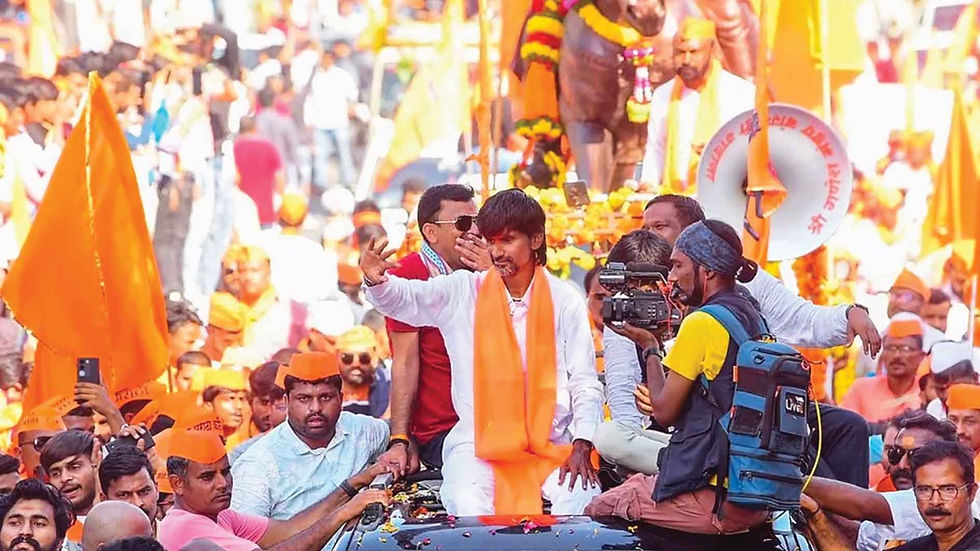

Mumbai: Turning up the heat on the Mahayuti government amid blistering temperatures touching 40C, Maratha quota crusader and Shivba Sanghatana President Manoj Jarange-Patil launched a fast-unto-death at his native Antarvali -Sarati village, as thousands of supporters joined.


Unfazed by the scorching sun, Jarange-Patil sat bare-headed in the open, occasionally covering himself with a scarf. Even as he exposed himself to the harsh conditions, he urged supporters to remain under shade and take precautions against the extreme heat.


The seventh hunger strike in three years began a day after a government delegation led by Minister Radhakrishna Vikhe-Patil and BJP leader Prasad Lad made a last-ditch effort to cajole Jarange-Patil to withdraw the agitation, but the marathon meeting failed to break the deadlock.


During the discussions, an aggressive Jarange-Patil bombarded Vikhe-Patil’s team with a barrage of questions over the issuance of Kunbi certificates, the government's stand on the Hyderabad Gazette, a crucial document cited by quota supporters to establish Maratha-Kunbi links since the past three years.


Making his position clear, Jarange-Patil declared that he would grant “no further extension” to the government and reiterated that he was willing to sacrifice himself for the cause of Maratha reservations.


Adding political muscle to the agitation, Kolhapur Congress MP Chhatrapati Shahu Maharaj - the 12th descendant of Chhatrapati Shivaji Maharaj - visited Antarvali-Sarati today and met Jarange-Patil in the sweltering heat.


Expressing solidarity to Jarange-Patil, Chhatrapati Shahu Maharaj said that Chhatrapati Rajarshi Shahu Maharaj-Shahu IV, had pioneered reservation policies in India, but historical records from Kolhapur have been ignored since long.


“The Maratha community has been misled for years and has gained little from repeated assurances. Marathas and Kunbis are essentially one community. All Marathas are Kunbis and all Kunbis are Marathas,” Chhatrapati Shahu Maharaj  asserted.


While expressing concern over the lack of clarity surrounding the ongoing negotiations between the government and Jarange-Patil, he demanded that the Kolhapur Gazette be given the same importance as other archival documents being considered by the government.


Quota Benefits

Supporting his observations, hundreds of members of the Sakal Maratha Samaj gathered near the statue of Chhatrapati Rajarshi Shahu Maharaj to express solidarity with the agitation. They raised slogans and demanded that the Kolhapur Gazette be included alongside the Satara Gazette while determining reservation benefits for the community.


Maratha supporters across Marathwada and other parts of the state echoed similar sentiments. :Just as Jarange-Patil is enduring the blazing sun, we are standing with him. Marathas are farmers; heat and hardship are part of our lives,” said one activist, while another warned that if the government continued to ignore their demands, it could trigger a larger backlash from the community.


As Jarange-Patil settled into his makeshift open to sky protest camp, reports of protests and demonstrations came from districts like Latur, Beed, Jalna and other parts of the state, with agitators ranting slogans against the government and renewing their demand for immediate implementation of Maratha reservation.


Marathas staged a brief but dramatic ‘rasta roko’ on the busy Mumbai-Nagpur Samruddhi Expressway near Varud Navha, paralysing traffic in both directions and causing queues stretching nearly two kilometres before police intervened to restore vehicular movement.


  • Issue Kunbi certificates to all Marathas in the Marathwada region by May 29th.
  • Issue a Government Resolution (GR) pertaining to the former princely states of Satara, Kolhapur, Aundh, Pune, and Miraj; on the lines of the 1994 resolution.
  • Reinstate all schemes and initiatives under the SARTHI institute.
  • Disburse all pending reimbursements from SARTHI.
  • Grant official validity to all Kunbi certificates that are already issued.
  • Disband the Maratha Sub-committee as it serves no useful purpose, and its Chairman lacks any substantive role.
  • Set up an independent Ministry for Kunbi and Maratha affairs.
  • Grant an extension to the Shinde Committee and ask it to thoroughly scrutinize all relevant records.
  • Withdraw all criminal cases filed across Maharashtra in connection with the agitation.
  • Ensure jobs in Mahavitaran and MIDC for the families of those who sacrificed their lives during the Maratha stirs.

Comments


bottom of page