top of page

By:

Shoumojit Banerjee

27 August 2024 at 9:57:52 am

Classroom of Courage

In drought-scarred Maharashtra, a couple’s experiment in democratic schooling is turning child beggars into model citizens In the parched stretches of Maharashtra, from Solapur to the drought-hit villages of Marathwada, a modest social experiment has quietly unfolded for nearly two decades. It is neither a grand government scheme nor a corporate-backed charity. Since 2007, the Ajit Foundation, founded by Mahesh and Vinaya Nimbalkar, has worked with children living at the sharpest edges of...

Classroom of Courage

In drought-scarred Maharashtra, a couple’s experiment in democratic schooling is turning child beggars into model citizens In the parched stretches of Maharashtra, from Solapur to the drought-hit villages of Marathwada, a modest social experiment has quietly unfolded for nearly two decades. It is neither a grand government scheme nor a corporate-backed charity. Since 2007, the Ajit Foundation, founded by Mahesh and Vinaya Nimbalkar, has worked with children living at the sharpest edges of society in Maharashtra. The foundation has become a home for out-of-school children, those who have never enrolled, the children of migrant labourers and single parents, and those who scavenge at garbage dumps or drift between odd jobs. To call their foundation an “NGO” is to miss the point. Vinaya Nimbalkar describes it as a “democratic laboratory”, where education is not merely instruction but an initiation into citizenship. The couple were once government schoolteachers with the Solapur Zilla Parishad, leading stable lives. Yet what they witnessed unsettled them: children who had never held a pencil, begging at traffic signals or sorting refuse for a living. Prompted by this reality, the Nimbalkars resigned their jobs to work full-time for the education of such children. Leap of Faith They began modestly, teaching children in migrant settlements in Solapur and using their own salaries to pay small honorariums to activists. Funds soon ran dry, and volunteers drifted away. Forced out of their home because of their commitment to the cause, they started a one-room school where Vinaya, Mahesh, their infant son Srijan and forty children aged six to fourteen lived together as an unlikely family. The experiment later moved to Barshi in the Solapur district with support from Anandvan. Rural hardship, financial uncertainty and the pandemic repeatedly tested their resolve. At one stage, they assumed educational guardianship of nearly 200 children from families that survived by collecting scrap on the village outskirts. Eventually, the foundation relocated to Talegaon Dabhade near Pune, where it now runs a residential hostel. Twenty-five children currently live and study there. The numbers may seem modest, but the ambition is not. Democracy in Practice What distinguishes the Ajit Foundation is not only who it serves but also how it operates. Within its walls, democracy is practised through a Children’s Gram Panchayat and a miniature Municipal Council elected by the children themselves. Young candidates canvass, hold meetings and present their budgets. Children maintain accounts and share decisions about chores, activities and certain disciplinary matters. In a country where democratic culture is often reduced to voting, the foundation’s approach is quietly radical. It treats children from marginalised backgrounds as citizens in formation. The right to choose — whether to focus on sport, cooking, mathematics or cultural activities — is respected. “We try never to take away what is their own,” says Vinaya Nimbalkar. Rather than forcing every child into a uniform academic mould, individual abilities are encouraged. A boy skilled in daily calculations may not be pushed into hours of bookish study; a girl who excels in cooking may lead the kitchen team. For children who have known only precarity, standing for election, managing a budget or speaking at a meeting can be transformative. On International Women’s Day, the foundation seeks visibility not just for praise but for partnership. If you are inspired by their mission, consider supporting or collaborating—your involvement can help extend opportunities to more children in need.

Maharashtra Congress-VBA ally for civic polls

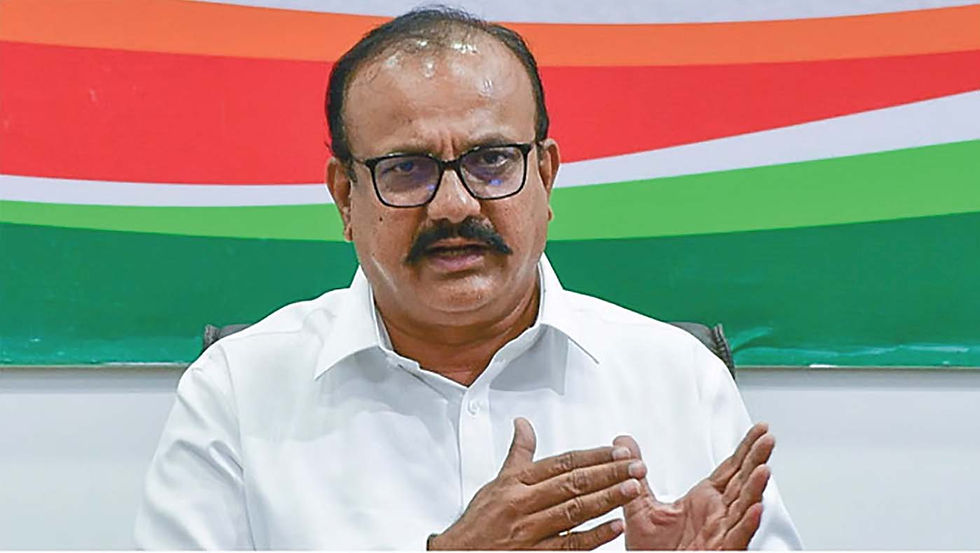
Harshwardhan Sapkal
Harshwardhan Sapkal

Mumbai: In a significant strategic shift, the Maharashtra Congress has formally cleared the decks for need-based, local-level alliances with the long-isolated Vanchit Bahujan Aghadi (VBA) led by Prakash Ambedkar, for ongoing and upcoming civic elections, top leaders of both sides said.


State Congress President Harshwardhan Sapkal said the decision balances the party workers’ strong preference to contest civic polls independently with the political realities at the district level.


“The party respects the sentiments of its workers to go solo in the civic elections,” he said, urging them to maintain patience as ground-level plans of action evolve in the coming days.


In a subtle snub critique of some partners within the Maha Vikas Aghadi (MVA) and the INDIA bloc, Sapkal observed that the alliances performed impressively in the 2024 Lok Sabha elections when they contested unitedly.


However, the Congress fared poorly in the 2024 Maharashtra Assembly and also in 2025 Bihar Assembly polls, despite a broad coalition of 10 parties in Bihar, besides the earlier debacle in Haryana. These repeated setbacks have caused disquiet among party cadres, he said.


The Bihar outcome, Sapkal hinted, was particularly disheartening because of what he termed as the alleged “vote-theft” - now being widely debated in both state and national political circles and the social media.


Against the backdrop of the consecutive electoral defeat the mood among Congress workers has shifted decisively toward contesting the state civic polls independently, and the party officially announced the stance for BrihanMumbai Municipal Corporation (BMC) polls last week.


“The field activists’ sentiments must be respected.  We have authorised district leaders to form suitable alliances with the VBA, which has also taken a similar position. Local leadership has begun discussions accordingly. If any obstacles arise, senior leaders from both sides will intervene and resolve them,” Sapkal reaffirmed.


A senior Mumbai Congress functionary added that while the city unit intends to contest the BMC polls solo, its doors are “wide open” to engaging with the VBA if necessary.


Meanwhile, Sapkal emphasized that the Congress’ broader ideological alignment with MVA partners remains intact, though any understanding with Raj Thackeray’s Maharashtra Navnirman Sena (MNS) is effectively ruled out.


“The Congress’ ideological battle is against the BJP-RSS-Capitalists, who believe only a handful should prosper. Leader of Opposition in the Lok Sabha, Rahul Gandhi, has already blown the conch for the biggest struggle against this mindset,” Sapkal said.


He urged all like-minded parties to join this fight to protect democracy and uphold the ideals of Chhatrapati Shivaji Maharaj, Chhatrapati Shahu Maharaj, and Mahatma Jyotirao Phule.


VBA wooed in civic polls

VBA Vice-President Siddharth Mokle said the alliance had already crystallised in Buldhana, while discussions were underway in several other districts.


“Once district leaders send us a proposal, we clear it. The field-workers in both parties believe this partnership can yield rich political dividends. However, if the election authorities play foul, then even God himself cannot help anybody,” Mokle chuckled, chatting with The Perfect Voice.


Prior to the 2024 Parliament polls, the VBA had claimed considerable strength in 18 of Maharashtra’s 48 Lok Sabha constituencies and had made repeated attempts to join the MVA. It was brutally spurned both times, even as the MVA suffered massive setbacks in the Assembly elections.


Gently flexing muscles again, Mokle asserted that in the past couple of years, “the VBA has expanded its organisational and electoral base manifold”, which will become evident in any free and fair election.


Comments


bottom of page