

Maharashtra’s Politics of Perpetual Motion
- Abhijit Joshi

- Feb 20
- 4 min read
In the State that once prized stable alliances, power now changes hands faster than loyalties can be explained.

Maharashtra was once celebrated for its political geometry. Alliances were durable and the rivalries intelligible while ideological battle-lines, though often blurred, were nonetheless broadly recognisable. Since 2019, that architecture has collapsed. What has replaced it is not a new order but a condition of permanent uncertainty. The state’s politics today mutates continuously, often overnight, sometimes between breakfast and dinner.
This is not a story of opportunism alone. Indian politics has always allowed room for tactical adjustment. What is different in Maharashtra is the velocity and normalisation of political shape-shifting. Leaders denounce defections as ‘moral collapse’ when they occur elsewhere, only to defend identical manoeuvres as strategic compulsion when undertaken at home. Ideology is performed loudly during campaigns and quietly suspended once results arrive. Arithmetic, not conviction, is the only constant.
Power Games
The past year has intensified this trend. Since November, Maharashtra has been in near-constant election mode, culminating in the recent Nagar Parishad and Panchayat polls. The outcomes consolidated the position of the ruling Bharatiya Janata Party, which emerged as one of the largest beneficiaries across local bodies, installing mayors and nagaradhyakshas in multiple municipalities. Yet the deeper significance of these contests lay less in who won than in how power was subsequently assembled.
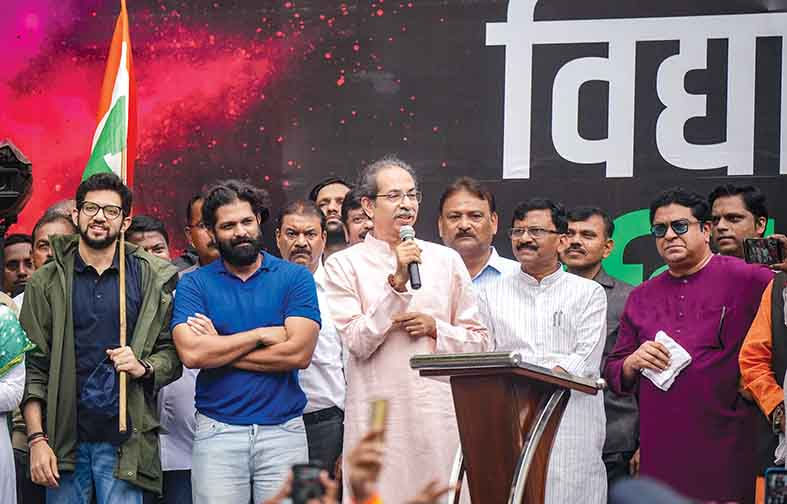
The pre-election atmosphere had suggested a different story. The long-anticipated thaw between Raj Thackeray and Uddhav Thackeray, estranged cousins and rival heirs to the Shiv Sena legacy, electrified urban Maharashtra. Their apparent convergence after nearly two decades generated feverish speculation, especially in Mumbai, Pune and the industrial belts of Thane. Commentators dusted off old vocabularies of Marathi asmita and regional pride. Could a reunited Thackeray axis recapture the Brihanmumbai Municipal Corporation? Would the next mayor of Mumbai emerge from a Thackeray-backed front?
The rhetoric had matched the anticipation. At rallies, both cousins trained their fire on Chief Minister Devendra Fadnavis and his deputy Eknath Shinde. Accusations of corruption, betrayal and ideological apostasy flowed freely. For a moment, Maharashtra appeared to be rediscovering its old habit of structured antagonism.
Rampant Opportunism
Then the results arrived and with them, reality. The BJP–Shinde alliance emerged stronger than expected. Nowhere was this more evident than in Kalyan-Dombivli. Despite months of mutual hostility, post-result negotiations produced unexpected handshakes. To keep the BJP from claiming the mayor’s post, the Shinde-led Sena faction aligned tactically with the Maharashtra Navnirman Sena. Ideological disputes that had dominated the campaign dissolved into spreadsheets. The questions of pride and principle that animated speeches yielded swiftly to the mathematics of survival.
Chandrapur offered an even starker illustration. There, the Indian National Congress emerged as the single largest party and seemed set to secure the mayoralty with independent support. Instead, internal feuds among its senior leaders hollowed out its advantage. Sensing an opening, the BJP stitched together an unlikely arrangement with the Uddhav Thackeray-led Sena faction, depriving Congress of the post. The irony was hard to miss: parties that vilified each other at the hustings collaborated smoothly once power was within reach. At the grassroots, meanwhile, workers resumed trading insults as if nothing had happened, underscoring the widening gap between leadership pragmatism and cadre sentiment.
If Kalyan-Dombivli and Chandrapur demonstrated tactical flexibility, Bhiwandi-Nizampur revealed the politics of grievance. The BJP, having emerged as the largest party, initially named Narayan Chaudhary as its mayoral candidate, only to replace him with another nominee. Offended, Chaudhary defected with nine corporators to Congress, which promptly declared that ‘revenge’ for Chandrapur had been exacted. Municipal politics became a theatre for settling scores generated elsewhere. Vendetta, it seemed, had descended to the ward level.
Rattled Voters
For voters, the cumulative effect is disorienting. Campaigns are fought as moral crusades, with stark binaries between virtue and vice. Yet once ballots are counted, adversaries become partners with barely an apology. Ideological commitments appear endlessly negotiable; numbers are sacred. The lesson absorbed by the electorate is a corrosive one: what matters is not whom you oppose, but whom you can tolerate long enough to hold office.
Mumbai, the ultimate prize, captures this fluidity best. The MNS secured only a handful of seats in the BMC but sought representation through nominations from the Uddhav Thackeray camp. When that support failed to materialise, tensions flared. A subsequent meeting between Raj Thackeray and Eknath Shinde was read, instantly and perhaps deliberately, as a signal that alternative alignments were always possible.
Leaders often reach for a soothing aphorism to justify these manoeuvres: “Matbhed aahet, manbhed nahi” (“we may have differences of opinion, but not differences of heart”). Once a gesture of conciliation, the phrase has become a code for post-election expediency. It reassures allies that today’s opponent may be tomorrow’s partner, and warns supporters not to take yesterday’s rhetoric too seriously.
Defenders of this order argue that such flexibility reflects maturity in an era of fragmented mandates. Coalitions, they say, are unavoidable; adaptability is a virtue. Critics counter that Maharashtra is paying a price for its improvisation. When electoral verdicts are endlessly reinterpreted through post-poll bargaining, voter trust erodes. Politics begins to resemble a market rather than a contest of ideas.
The rupture of 2019 set this chain reaction in motion. Party splits, factional leaderships and the growing importance of local bodies have turned Maharashtra into a chessboard where every move is provisional. In Maharashtra today, stability is the rarest commodity. The only certainty is change itself. And when a leader insists there are no differences of heart, seasoned observers would be wise to prepare for the next unexpected alliance.
(The writer is a political observer. Views personal.)


Comments