top of page

By:

Abhijit Mulye

21 August 2024 at 11:29:11 am

Red flag to green steel

Ex-Maoists forge new destiny in Gadchiroli Gadchiroli: The rugged, forested terrain of Gadchiroli district, long synonymous with the violence and deep-rooted anti-establishment tenets of the ‘Red Ideology’, is now witnessing a remarkable social and industrial transformation. At the Lloyds Metals and Energy Ltd. (LMEL) plant in Konsari, once-feared Maoist operatives are shedding their past lives and embracing a new, respectable existence as skilled workers in a cutting-edge Direct Reduced Iron...

Red flag to green steel

Ex-Maoists forge new destiny in Gadchiroli Gadchiroli: The rugged, forested terrain of Gadchiroli district, long synonymous with the violence and deep-rooted anti-establishment tenets of the ‘Red Ideology’, is now witnessing a remarkable social and industrial transformation. At the Lloyds Metals and Energy Ltd. (LMEL) plant in Konsari, once-feared Maoist operatives are shedding their past lives and embracing a new, respectable existence as skilled workers in a cutting-edge Direct Reduced Iron (DRI) and pellet plant. This ‘green steel’ project, part of LMEL’s push for an integrated steel complex in the region, is functioning not just as an industrial unit but as a crucial pillar in the Maharashtra government’s surrender-cum-rehabilitation policy. So far, LMEL, in coordination with the state government and the Gadchiroli Police, has provided employment and training to 68 surrendered Maoists and 14 members of families affected by Naxal violence, a total of 82 individuals, offering them a definitive pathway back to the mainstream. The Shift The transformation begins at the company’s dedicated Lloyds Skill Development and Training Centre at Konsari. Recognizing that many former cadres had limited formal education, the company implements a structured, skill-based rehabilitation model. They are trained in essential technical and operational skills required for plant administration, civil construction, and mechanical operations. For individuals like Govinda Atala, a former deputy commander, the change is palpable. “After surrendering, I got the right to live a new life,” Atala said. “I am very happy to get this job. I am now living my life on my own; there is no pressure on me now.” Suresh Hichame, who spent over a decade in the movement before surrendering in 2009 too echoed the sentiments. He realized the path of violence offered neither him nor his family any benefit. Moreover, his self-respecct was hurt. He knew several languages and carried out several crucial tasks for the banned organization remaining constantly under the shadow of death. Today, he works in the plant, receiving a steady monthly salary that enables him to care for his family—a basic dignity the ‘Red Ideology’ could never provide. The monthly salaries of the rehabilitated workers, typically ranging from Rs 13,000 to Rs 20,000, are revolutionary in a region long characterized by poverty and lack of opportunities. Trust, Stability The employment of former Maoists is a brave and calculated risk for LMEL, an industry that historically faced stiff opposition and even violence from the left wing extremist groups. LMEL’s management, however, sees it as an investment in inclusive growth and long-term stability for the district. The LMEL has emphasized the company’s commitment to training and facilitating career growth for the local populace, including the surrendered cadres. This commitment to local workforce upskilling is proving to be a highly effective counter-insurgency strategy, chipping away at the foundation of the Maoist movement: the exploitation of local grievances and lack of economic options. The reintegration effort extends beyond the factory floor. By providing stable incomes and a sense of purpose, LMEL helps the former rebels navigate the social transition. They are now homeowners, taxpayers, and active members of the community, replacing the identity of an outlaw with that of a respected employee. This social acceptance, coupled with economic independence, is the true measure of rehabilitation. The successful employment of cadres, some of whom were once high-ranking commanders, also sends a powerful message to those still active in the jungle: the path to a peaceful and prosperous life is open and tangible. It transforms the promise of government rehabilitation into a concrete reality. The plant, with its production of iron ore and steel, is physically transforming the region into an emerging industrial hub, and in doing so, it is symbolically forging the nation’s progress out of the ashes of extremism. The coordinated effort between private industry, the state government, and the Gadchiroli police is establishing a new environment of trust, stability, and economic progress, marking Gadchiroli’s transition from a Maoist hotbed to a model of inclusive and sustainable development.

Married to the Army First!

Over the years, she realised we had sworn allegiance to the Olive Greens well before we married our soulmates.
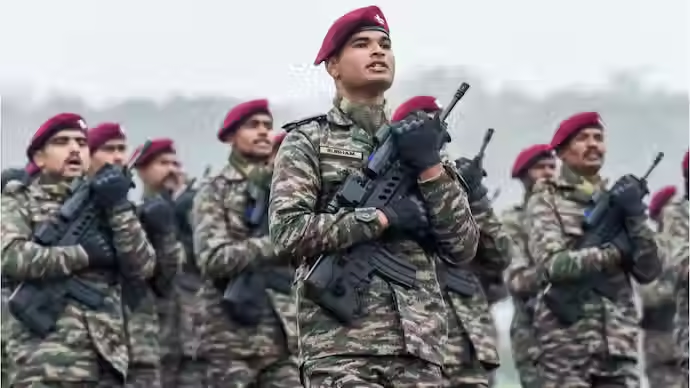
ree

It was the third week of August 1999. Our Assault Team had just returned to Jodhpur by train after three months in the Batalik Sub-Sector of Ladakh during the Kargil Conflict. Since late June, we had been operating independently under an infantry division, detached from our unit, which had been moved to Rajasthan in anticipation of the localised conflict escalating across the International Boundary.


Seeing my wife and little daughter, barely a year and a half, felt surreal. The first televised war in India had clearly taken a toll on my better half, though the relief in her eyes was palpable. She had borne the brunt of the uncertainties wars cast on loved ones, especially with a small child to rear. Our little girl, of course, was bemused to see her father, as her reactions showed.


After freshening up at home, it was time to head to Battalion Headquarters, meet our Commanding Officer (CO), and give him an in-person rundown of operations from late June to the ceasefire on 26 July 1999. First-hand accounts always provide a clearer picture than Situation Reports (SITREPs) sent through military channels. We had been operating in such a remote area that even basic line communication with Battalion Headquarters, nearly 1500 km away, was absent. Today’s briefing to the CO was thus crucial. And since our Assault Team had done the Unit proud, my Second-in-Command, Major Rajesh Sheoran (my right hand through those times), and I were eager to meet the CO and our fellow officers and men at the earliest. It was not about basking in glory; it was about announcing that we had all returned by the grace of Maa Durge Bhawani, heads held high.


Before I left home, my wife told me that she was preparing my favourite “Rajma-Chawal” and she hoped that I would return for a timely meal. I nodded affirmatively as I said goodbye.


After an engrossing interaction with the CO, we met our other comrades. The CO reminded the Adjutant that Major Rajesh Sheoran had not been pipped formally. He was promoted to Major's rank a couple of months ago, but the customary pipping by the CO and Subedar Major could not be done. The adjutant promptly organised it. And as is the tradition, we moved to the Officers' Mess for an impromptu "Pre-Lunch Drinks (PLD)".


The "Band of Brothers" from our unit were together after a long time. As we celebrated Rajesh Sheoran's much-deserved promotion, we also caught up on our individual and collective battle experiences and everything under the sun that had happened since May 1999. The PLD continued into lunchtime. The Dining-in members of the Mess asked the married officers to stay on for lunch. A request that was impossible to turn down. The CO and everyone stayed on, and so did I.


Back then, there were no telephones in our residences. And I did not have the heart to send someone three kilometres from the unit to inform my wife about the unplanned delay in my return. "I will tell her when I get home," I said to myself.


It was 4:30 pm when I reached my residence. She was still waiting for me and had not taken a morsel. For her, this wait was probably as difficult to fathom as the wait when I was far away in the barren Ladakh mountains. She was visibly disappointed since she expected me to keep the date, at least this time.


I did tell her the reason, but I probably could not explain the rationale well. The bonhomie and camaraderie amongst those who go to battle together is to be experienced and understood, but perhaps difficult to explain, I discerned.


Over the years, she realised that we had sworn our allegiance to the Olive Greens well before we got married to our soulmates. We were "Married to the Army First”!!


As time went by, she not only absolved me for not keeping that afternoon date but also remained my pillar of strength and source of inspiration through the rough and tumble of life in the Army till I hung up my boots. She, too, was married to the Olive Greens!!


Post Script: Major Rajesh Sheoran rose to the rank of a Brigadier. With his astounding leadership qualities, positivity, spirited attitude, and heart of gold, he touched so many lives within and outside Uniform. Unfortunately, he left us too soon for his heavenly abode on 10 June 2025 while still in service. He shall always be remembered. Rest in peace, my brother.

(The writer is an Indian Army veteran and Vice President CRM, ANSEC HR services Ltd. He is a skydiver and a specialist in Security and Risk management. Views personal.)

Comments


bottom of page