

Mere Illusion or a Battle for Survival?

The Congress’ ‘Sangathan Srijan Abhiyaan’ in Jharkhand seeks to rebuild its base and assert independence from its allies, but the party continues to be plagued by deep-rooted factionalism and a fundamental public disconnect.
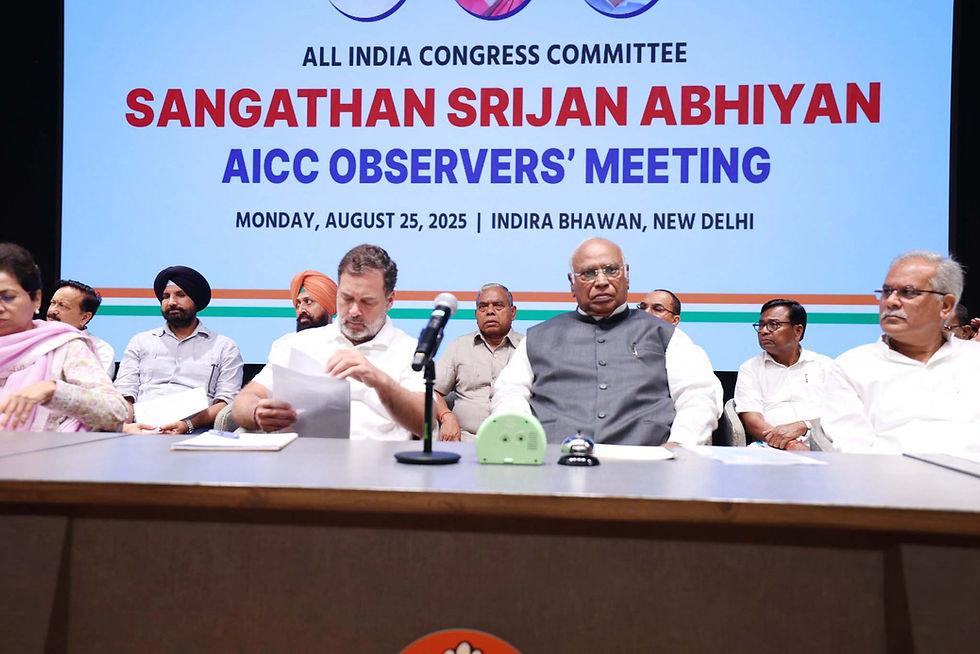
Last month, the Congress Party in Jharkhand launched with great fanfare the ‘SangathanSrijanAbhiyaan.’ It was projected as a turning point in rebuilding the grand old party’s fortunes in the Eastern Indian state. The message being sent out by the Congress through this vigorous organizational overhaul drive is that it will no longer remain in anyone’s shadow, nor will it depend on its allies for its political survival. The party wants to signal that it will emerge as an independent and powerful political force in the future.
Yet, the million-dollar question that remains is whether the Congress can overcome its perennial malaise of decrepit organization, old factional feuds, an opportunistic leadership and a fundamental disconnect from the public? Will these structural flaws turn this campaign into yet another exercise in noise making rather than any
genuine transformation?
No magic formula
To begin with, the Congress’ plan certainly appears ambitious on paper. From district committees to booth workers, the party wants to energize its outfit at every level, including blocks, panchayats and the grassroots. But are Congress leaders and workers truly ready to struggle and sweat it out to achieve this? Will this grand brainstorming session be reduced to mere rhetoric in an air-conditioned hall?
The party has set itself a bold goal of establishing a functional presence at the grassroots level within 90 days. The obvious question that arises is whether the Congress really possess the magic formula to suddenly activate workers in what has largely been a moribund outfit in Jharkhand. Organizational work requires consistency, time, tireless effort and constant contact with the electorate. The point is just how will the Congress shake itself out of the inertia that has kept it on the margins of Jharkhand’s politics for years in a mere 90 days.
The Congress’s biggest announcement in this campaign is its pledge to put social justice at the heart of its organizational renewal. By promising greater representation for Scheduled Tribes, Scheduled Castes, and Other Backward Classes, the party seeks to project itself as an inclusive alternative.
As noble as this sounds, it is steeped in familiar clichés. It also raises an uncomfortable question: is this truly a bold reimagining of representation, or merely the same electoral arithmetic that every party performs before an election only to abandon once the votes are counted?
Congress insists that it is dismantling the strongholds of nepotism and factionalism to make room for new faces. Yet history tells a different story. Every reshuffle in the party has ultimately meant little more than the promotion of a new protégé from the same family or faction. Why, then, should the public believe that this campaign is any different?
Competition or Illusion?
In Jharkhand, the BJP’s organizational machinery runs deep. Under the disciplined command structure of Narendra Modi and Amit Shah, it has built a booth-level apparatus that stands as both a challenge and an intimidation to weaker, loosely bound rivals like the Congress. The Congress claims to be evolving into a parallel force. Yet on the ground, voters hardly see it as a credible alternative in the state’s anti-BJP space.
This raises a critical question: is the Congress’s campaign genuinely aimed at taking on the BJP head-on, or is it merely seeking leverage through allies such as the Jharkhand Mukti Morcha (JMM)? Unless it learns to operate outside the shadow of its partners, the slogan of becoming ‘self-reliant’ will ring hollow and will ultimately turn into little more than an exercise in self-deception.
No matter how expansive the campaign rhetoric, public concerns remain unchanged. Jharkhand’s youth are struggling with chronic unemployment. The exploitation of labour in the mining belt continues unchecked. Indigenous communities face displacement and forced migration. Women and other marginalised groups remain unheard.
How forcefully has the Congress confronted these realities? Will its so-called organizational drive remain confined to internal meetings, caste balancing and appointments? Or will it extend beyond that, into grassroots struggles, mass mobilisations and genuine engagement with the people? Without introspection and sincerity, this effort risks appearing as just another political spectacle.
Congress has declared 2025 as the year of its organizational renewal in Jharkhand. In truth, this is a battle for the party’s very survival in Jharkhand. With every passing year, the Congress slips further into irrelevance. If it fails to reinvent itself meaningfully this time, this could well be its last chance in the state to pose as a credible alternative.
It seems almost axiomatic to say that history is unkind to parties that lose touch with the people’s pulse. The Congress in Jharkhand has two paths to carry on its future course. It can either use this campaign to genuinely reconnect with the state’s deep and unresolved anxieties or it can fade into history as another failed experiment in revival.


Comments