top of page

By:

Correspondent

21 August 2024 at 10:20:16 am

Phantom Promises

The unravelling of the Mukhyamantri Majhi Ladki Bahin Yojana was always a matter of when, not if. Announced with theatrical flourish ahead of the 2024 Assembly election by the ruling Mahayuti coalition, the scheme promised Rs. 1,500 a month to women across the state. It became the Mahayuti government’s showpiece welfare programme and, by all accounts, a decisive political instrument that helped propel the ruling alliance to a comfortable victory. Less than two years later, the curtain has now...

Phantom Promises

The unravelling of the Mukhyamantri Majhi Ladki Bahin Yojana was always a matter of when, not if. Announced with theatrical flourish ahead of the 2024 Assembly election by the ruling Mahayuti coalition, the scheme promised Rs. 1,500 a month to women across the state. It became the Mahayuti government’s showpiece welfare programme and, by all accounts, a decisive political instrument that helped propel the ruling alliance to a comfortable victory. Less than two years later, the curtain has now fallen. Nearly 92 lakh beneficiaries – a whopping 38 percent of those initially enrolled – are now being shown the door as the scheme becomes economically untenable. If such a staggering proportion of beneficiaries never qualified in the first place, what exactly was the government doing when it rolled out the scheme with such urgency? The scheme is a classic case of welfare as a cold election strategy rather than a governance policy. The scheme’s benefits flowed generously just before the election. The scrutiny that has now arrived has exposed it for what it was: a fiscal white elephant. The Comptroller and Auditor General has now compounded the Mahayuti’s embarrassment with its report, which questions expenditure of more than Rs. 3,541 crore under the scheme. Such spending places an unsustainable burden on Maharashtra’s finances. The CAG’s report is an indictment of a style of governance that treats the public exchequer as an extension of the campaign war chest. Across India, governments of every political persuasion have perfected the art of competitive populism. Cash transfers, freebies and subsidies are unveiled with increasing frequency, often without credible fiscal planning or robust verification mechanisms. Welfare has become less about empowering citizens than about cultivating dependable vote banks. Schemes designed primarily for electoral dividends inevitably collapse under their own contradictions, leaving beneficiaries disillusioned and public finances weakened. The greatest injustice is borne not by politicians but by ordinary citizens. Honest taxpayers finance these extravagant promises. Genuine beneficiaries build their household budgets around them. When governments later discover that millions were ‘ineligible,’ it is ordinary families, and not the politicians or their families, who suffer the consequences. If money has indeed been squandered because of political haste, accountability cannot stop with bureaucrats or clerks processing applications. Those who conceived, announced and relentlessly campaigned on the scheme must also bear responsibility. The leaders of the three ruling Mahayuti partners – the BJP, the NCP and the Shiv Sena - who converted public money into political capital should be prepared to answer financially as well as politically. Democracy cannot become an auction where elections are won with taxpayers’ wallets. It is time to end the politics of fiscal bribery masquerading as welfare. Maharashtra deserves governments that create opportunity, not dependency, and policies that survive beyond polling day.

MVA accuses Mahayuti of ‘banditry, betrayal’
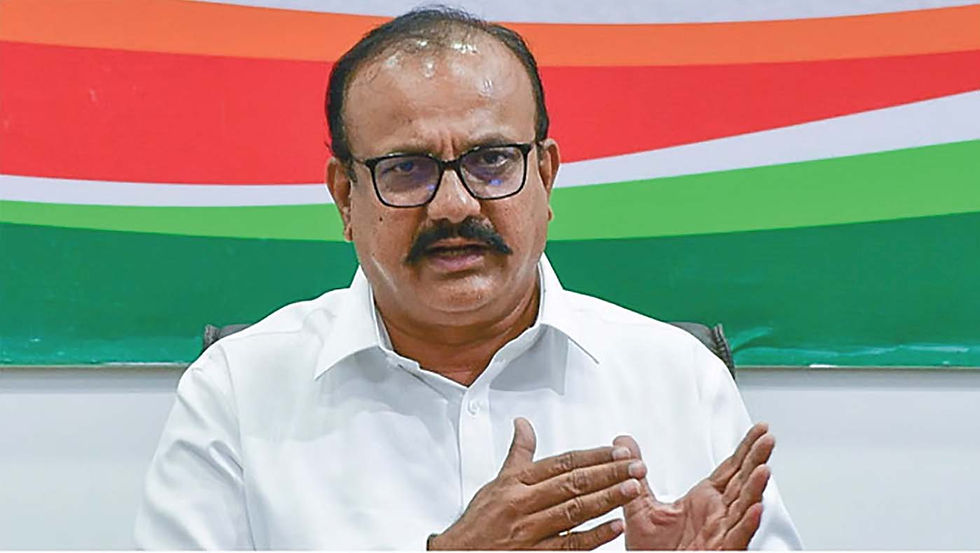
Mumbai: The simmering political storm over the Mahayuti government’s ‘Mukhyamantri Majhi Ladi Bahin Yojana’ intensified with the Maharashtra Vikas Aghadi (MVA) taking the recent CAG Report’s cautionary signals on state finances, to question if the state regime is a ‘gang of bandits’.


State Congress President Harshwardhan Sapkal, Nationalist Congress Party (SP) National Spokesperson Clyde Crasto and Shiv Sena (UBT) MP Sanjay Raut attacking the government over the CAG revelations pointing to Rs 3,541-cr excess spending plus significant shortcomings in financial management, budget estimation and expenditure control.


Sapkal slammed the Mahayuti for allegedly committing a financial fraud of Rs 3,500-cr, while Crasto termed the removal of 92-lakh women beneficiaries as ‘betrayal’ and Raut accusing that the scheme was launched only to collect the votes of ‘Ladki Bahin’ in the 2024 Assembly elections.


The Congress chief reiterated that a potential welfare scheme degenerated into another vehicle for corruption as the “step-brothers in power have looted their own beloved sisters”. “After looting every sector of the government, they have plundered the ‘Ladmi Bahin’ scheme… Is this a government or a gang of bandits,” demanded Sapkal sharply.


Various Reasons

Terming the government’s move to delete 38 pc (92 lakh) ‘Ladki Bahins’ from the scheme for various reasons as ‘fooling’ the women of Maharashtra to grab their votes. “They are citing different excuses for this act… Then how were they eligible before the elections, they took the votes, gave them money for so long, and now they are betraying them,” said an irked Crasto.


Sapkal pointed out how, as per the CAG Report, an amount of Rs. 29,693-cr was budgeted for the scheme, but the government spent over Rs 3,500-cr beyond the sanctioned amount without maintaining proper records or accounts, and unsolicited withdrawals.


Schemes Sacrificed

“Spending on housing had fallen by 54 pc, and expenditure on water supply-sanitation slashed by nearly 32 pc. The CAG had cautioned against prioritizing the ‘Ladki Bahin’ scheme at the cost of other critical infrastructure projects that could hit long-term sustainability of public services,” Sapkal pointed out.


He further stated that an amount of Rs 3,490-cro intended for the ‘Lek Ladki’ scheme (beloved daughters, launched in Oct. 2023) from economically backward families was allegedly diverted to ‘Ladki Bahin’, and earlier funds from the Social Justice Department were also rerouted.


Raut and other SS (UBT) leaders raised questions on the government’s financial management as the CAG’s findings vindicate their stance over how the ‘Ladki Bahin’ scheme was launched hastily for reaping a rich electoral harvest in November 2024.


Several NCP (SP) leaders demanded a detailed explanation for the excess expenditure red-flagged by the CAG, deflecting funds from other projects to ‘Ladki Bahin’ and pinning accountability for all such irregularities.


The MVA allies urged the Mahayuti to present a comprehensive report on the scheme and fixing accountability in the legislature while ensuring that genuine beneficiaries are not deprived of the assistance.


Major lapses in fiscal discipline
Among other things, the Comptroller and Auditor General (CAG) Report of 2024-2025, pinpointed an excess spend of Rs. 3,541-cr, plus major lapses in fiscal discipline over the flagship ‘Ladki Bahin’ scheme.

It said that the Women and Child Development Department spent Rs. 33,237 cr against the sanctioned Rs. 29,693-cr – or, Rs. 3,541-cr extra – without providing a proper explanation for the overspend.

Announced with great fanfare barely months ahead of the 2024 Assembly polls, the ‘Ladki Bahin’ scheme promised a monthly dole of Rs 1,500 - with a promise to hike it to Rs 2,100 per month – to eligible women, if the Mahayuti was returned to power.

It emerged the Mahayuti’s winning initiative, helped strengthen its support among the women, especially rural voters and enabled the coalition romp home – barely six months after it was badly mauled in the Parliament elections of 2024.
bottom of page