
‘Never Give Up’
- Shiv Sethi
- Feb 2
- 4 min read

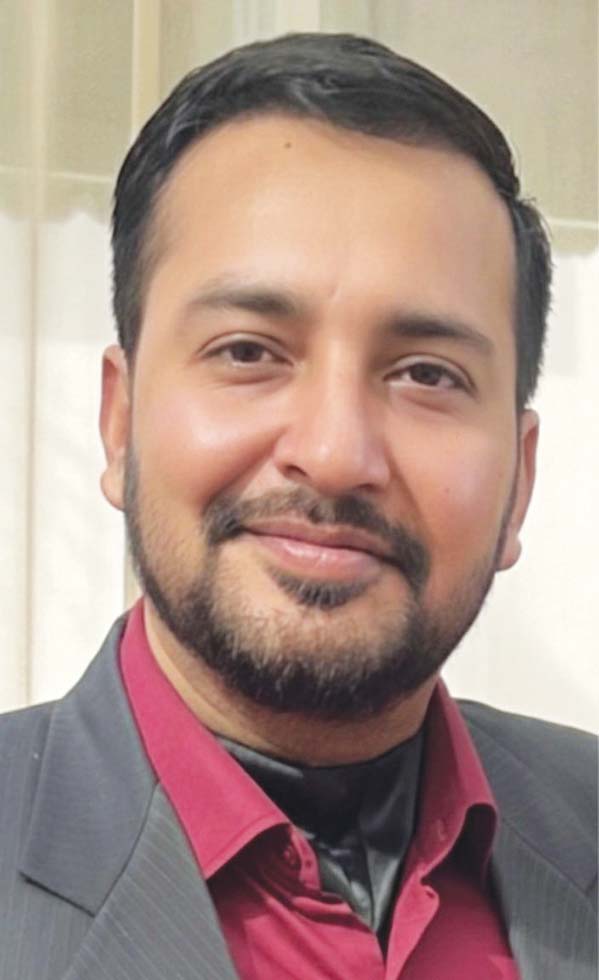
Get ready to meet the extraordinary Dr. Shadab Ahmed, a true gem of a person whose story is sure to inspire and impress you. Dr. Ahmed is a professional Oral & Maxillofacial Surgeon and Quality-Assurance expert based in India, who as the protean author of more than 12 books on Ethnic Culture, Linguistic Historiography and Socio-Cultural Analysis, is renowned globally as an author, poet, translator and columnist.
Over the past decade, Dr. Ahmed has carved an unparalleled place for himself in the Indian, Ottoman and Persian anthropological prose poetry. An extra-academic scholar of Persian, Turkish, Arabic, Urdu, Sanskrit, Pali, Prakrit, Brajbhasha and Castilian literature, Dr. Ahmed has translated, paraphrased, transliterated, composed, edited and published numerous books and articles, several of which are trailblazing in the Indian and overseas literary communities and libraries.
Dr. Ahmed is self-taught in several literary traditions and critics and scholars often remark on the way he reconstructs complex verses, preserving the spirit of the original text while expanding its imagery and context.
Here are the excerpts of his interaction with Shiv Sethi.
Can you tell us more about the inspiration behind your writing, and what readers can expect from it?
My inspiration to write was precociously initiated by my father, who asserted that you won't be able to write a book ever. Since my formative years, I was into books and reading, so much so that books became my avocation. Preceding to mature as a Bibliomaniac, I became a Bibliophile penultimately. My readers can expect from me an abridged version of history across the Indian, Ottoman and Turkish empires and dynasties, which is versified considering both the “pre-text” of the verse in the bygone times and the “cont-text” of the verse in contemporary times.
Can you tell us about your background?
I come from a deprived and destitute background, strictu sensu, and it was an arduous endurance to keep up reading and adopt a multi-linguistic attitude. I would just say over the years, I have seen my pneuma altering perception from a protagonist to an antagonist and vice-versa.
How do you balance your work as a doctor with your passion for writing?
When I am working, I am not writing? When I am writing, I am not working? This is the most fundamental and elementary balance I maintain. I love both working and writing. When you love the things you do, they aren't things anymore. They become your love affairs.
So much so, my perception & outlook has adapted over it. I find explicit words in arbitrary observations which most people will attribute to inexplicit randomness. My submerged mind keeps making climacteric observations all through the commotions by the day, and the panorama of the silent night develops those implicit annotations the mind has made, extrapolating them in words. The words combine to form sentences. The sentences get rearranged to rhyme versified. The verses together form a narrative.
What challenges have you faced as a writer, and how have you overcome them?
The road up there was not so easy, a lot was sacrificed to retain so many. When I started writing - I was mocked, ridiculed, hated, despised and disliked from my near and dear ones. It was made abundantly clear to me that writing is a colossal mistake, and you would incur the wrath of all the authoritative and benevolent Gods across the Abrahamic and Non-Abrahamic religious spectrums. But at the end, it was just a poor simple boy who followed his dreams. He fought and prevailed against all odds. But when the steaks are juicy, the lobsters would be buttery as well.
One last question before we conclude the interview for today. What are your future plans for writing, and can we expect more books from you in the future?
I am working on several academic and non-academic books at the moment, and I am focusing on the foremost publishing conglomerates across both the Eastern and Western Hemispheres for future publications. My future books will be more contextually verified and historiographically informed. There would be a key balance of both the Revisionist and the Dialectical historico-critical analysis. Progress is undoubtly slow for my other professional and personal commitments, but the books are coming out substantially interesting that I presumed, both perceptively and contextually.
This year, two of my books would be releasing - "The Capetian House", which is translated from Latin and Anglo-Norman, and takes the reader back to the dominant influence of religion in Europe through the House of the Capet monarchs, and documents the rise and fall, heroism, persecution and Holy Wars, religious upheaval and adulterous affairs of the most powerful kingdom of Christendom in Medieval France.
Another book based on Medievalist and Feudal History would be "The Lord's Battalions - The First Crusade for the Holy Land", and takes the readers back to the rise of Militant Catholicism and the consolidation of Papal power in the Levant and Anatolia against the Seljuk Empire, Sultanate of Rum, Fatimid Caliphate and Turkish Danishmends. Stay tuned and make sure to buy your copy. Godspeed and Godbless!


Comments