

Nishant Kumar: Bihar's reluctant heir steps into the political arena
- Akhilesh Sinha

- Mar 9
- 3 min read

New Delhi: In Bihar's swirling political cauldron, Nishant Kumar has emerged as the hottest topic. Once a man who shunned not just politics but public life altogether, he has now plunged headlong into the fray. The key to this transformation likely lies in his family dynamics.
His mother, Manju Kumari Sinha, played a pivotal role in shaping his path, while his father, Nitish Kumar, devoted his entire life to serving the public after completing his studies. Having fulfilled his mother's wishes by prioritising education, Nishant is now stepping up to shoulder his father's social and political responsibilities at a crucial juncture. Nitish Kumar has set an extraordinarily high bar for development in Bihar's politics, leaving Nishant with formidable challenges ahead. The question is whether he will convert these hurdles into opportunities and climb the ladder of success, or stumble while trying.
To grasp Nishant's political worldview and motivations, one must delve into his family background. Born on July 20, 1975, in Patna, Nishant entered a world where his father had already joined active politics during the 1974 movement against Indira Gandhi's Emergency under the leadership of Lok Nayak Jay Prakash Narayan. Nitish dedicated his life thereafter to Bihar's development dreams and upliftment of the deprived. In contrast, his mother, Manju Sinha, was a school teacher who passed away in 2007 and never favoured misusing power for personal gain.
Family associates recall that Manju Sinha explicitly discouraged Nishant from stepping into politics. Whenever he showed interest, she urged him that "First study, become a good citizen and self-reliant, then step into social and national service."
Early Life
Under her guidance, Nishant began his schooling at Patna's St. Karen's School, followed by studies at Mussoorie's Manav Bharti India International School. He also attended Patna's Kendriya Vidyalaya briefly. After school, he earned a software engineering degree from Birla Institute of Technology (BIT) Mesra in Ranchi, Jharkhand, mirroring his father's engineering background. Notably, for his first two years at BIT, classmates had no idea he was Nitish Kumar's son. In an interview, his classmate and Islampur (Bihar) MLA Ruhail Ranjan (son of Rajiv Ranjan) revealed that "No one knew Nishant was Nitish's son for those initial two years."
Now nearing 50 and unmarried, Nishant leads a spiritual life marked by daily yoga, prayers, and simplicity. Media reports note his reading habits include books on socialism, contemporary Bihar, RSS publications, and the Shrimad Bhagavad Gita. He prefers family time or solitude. He shares a deep bond with his father, often hugging him affectionately like a child on special occasions.
Curiously, while working in the private sector, Nishant has amassed more wealth than his father. His total movable and immovable assets stand at 3.61 crore, surpassing Nitish's 1.66 crore. Beyond inheritance from his late mother, this includes ancestral property in Kalyan Bigaha, Nalanda (a family home and farmland), plus real estate in Patna and Bakhtiyarpur.
‘Parivarwaad’
After years of steering clear of politics, Nishant's entry into the Janata Dal (United) drew accusations of dynastic politics from the opposition, like Rashtriya Janata Dal (RJD). Yet, there's no evidence of him chasing power's perks. If that were his aim, he could have joined active politics when Nitish was a union minister or during his 21-year stint as chief minister (in multiple terms). Instead, as Nitish honourably announces his exit from the chief minister's post, Nishant steps in to carry forward his father's public legacy and vision. He has vowed to propel Bihar into the ranks of developed states.
Challenges Ahead
With Nishant now in JD(U) and eyeing the deputy chief minister's role, power brings fresh tests. First, Nitish built his base by consolidating Extremely Backward Classes (EBCs). Nishant must rally them while preventing the erosion of JD(U)'s core voters. Second, Nitish championed women's empowerment, from bicycles for girls to educate them, self-help groups for 'Jeevika Didis', and alcohol prohibition to restore dignity. How will Nishant advance this agenda and turn challenges into gains? Ahead looms the 2030 Bihar Assembly elections, where he must forge an identity, win over party workers, and earn leaders' trust.
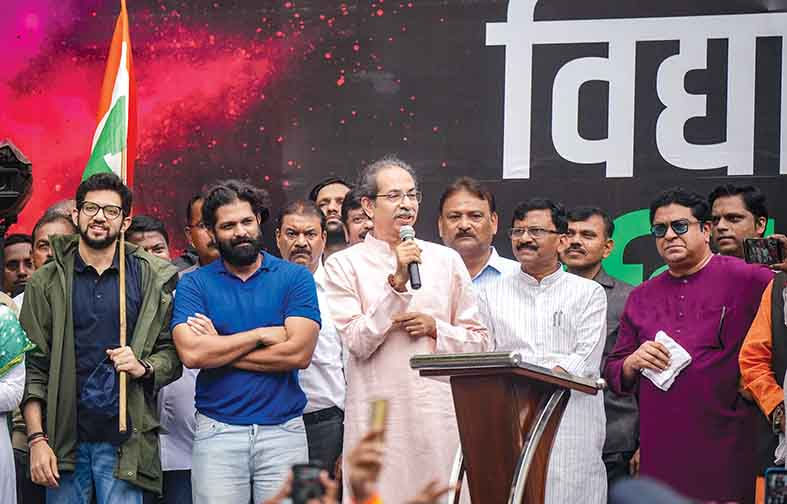
Nitish enjoys an image as a clean, trustworthy politician. Can Nishant match this stature and live up to public faith? Comparisons arise with Uddhav Thackeray, who inherited Bal Saheb Thackeray's mantle but veered from ideology, allying with Congress and NCP for power. Will Nishant compromise similarly, or draw an even bolder developmental line for Bihar? Many queries linger, unanswered in the hush of now — only time, the silent sage, shall unveil their truth somehow.


Comments