

Persepolis on the Edge

West Asia’s combustible geometry suggests that any strike on Iran has a habit of widening into systemic crises that no single power can neatly contain

Barely eight months after Operation Midnight Hammer, Washington and Jerusalem have once more moved from calibrated warning shots to direct blows against Iran. In broad daylight on Saturday, Israel, with overt American participation, launched a “preventive attack” on Tehran, triggering an immediate exchange of missiles and pushing West Asia into renewed military confrontation.
The prospect of a direct clash between the US and Iran rattles has been rattling markets and chancelleries across the globe for a while now. President Donald Trump had shown no sign of lowering the temperature and had declared himself dissatisfied after nuclear talks in Geneva had collapsed while warning that a “very big decision” loomed.
The clock has been ticking for Iran since Trump’s State of the Union address earlier this week, where he stressed that the Islamic Republic must never be permitted to acquire nuclear weapons, while invoking a long American tradition of strategic alarm.
Ominous Precedent
The precedent for such thinking is not encouraging. In 2003, the United States had convinced itself that Iraq posed an intolerable strategic risk and could be swiftly eliminated through speed and superior firepower. While the US invasion dismantled the Iraqi state and deposed Saddam Hussein, it released forces that no amount of military precision could later contain.
From the wreckage emerged the Shiite cleric Muqtada al-Sadr, whose Mahdi Army militia fused populism, sectarianism and armed resistance into a durable political brand. Another was Islamic State (ISIS), which thrived in the vacuum left by collapsed institutions and brutalised communities.
Advocates of limited military action argue that Iran is not Iraq circa 2003. They point to last year’s U.S. attacks (in conjunction with Israel) on Iranian-linked targets - ‘Operation Midnight Hammer’ - as evidence that calibrated force can deter without escalating. But Iran is a system built to absorb punishment.
At the heart of that system lies the Islamic Revolutionary Guard Corps (IRGC), which is less an army than a fraternity. Born in the crucible of the 1979 revolution, the IRGC received its baptism by fire during the eight-year war with Iraq, which forged a generation of commanders through shared sacrifice, martyrdom and paranoia.
When Iraqi forces crossed into Iran on September 22, 1980, the Islamic Republic was close to strategic insolvency. Its officer corps had been purged and arms’ supplies from America and Israel - the Shah’s former patrons - had vanished. The oil fields in Khuzestan were falling. For a moment, it seemed possible that Saddam Hussein might crush the revolution outright.
Geopolitical Hypocrisy
What followed was a tutorial in geopolitical hypocrisy in which Israel played a formative role. While Ayatollah Ruhollah Khomeini publicly denounced Israel as an illegitimate state destined for destruction. Privately, his regime accepted Israeli arms with little hesitation. As Ronen Bergman documents in his book ‘The Secret War with Iran,’ Israel had secretly armed Iran under Operation Seashell beginning in 1980, at the very moment the Islamic Republic appeared most vulnerable.
Israeli strategists feared a victorious Saddam more than an isolated Iran. They also hoped that prolonging the war would weaken two regional enemies simultaneously.
At the same time, Iran compensated for its material weakness by mobilising faith as a weapon. In 1981–82, Khomeini authorised boys as young as twelve to volunteer for the front. Thus, the Basij militia was born where teenagers cleared minefields with their bodies.
By the time the brutal Iran–Iraq War ended in 1988 at the cost of more than a million lives, Iran had absorbed two decisive lessons. First, the Islamic Republic’s isolation could be mitigated through clandestine networks and morally flexible partners. Second, the leading cleric’s opacity was a strategic asset.
This shadow systems pioneered in the 1980s re-emerged decades later in new forms, whether in form of covert oil exports, deniable shipping, front companies or sanction-proof logistics.
Over time, the Revolutionary Guards evolved into a state within the state. They control elite military units, intelligence services and missile forces. Through vast commercial conglomerates like the Khatam al-Anbiya, they dominate construction, energy, ports and telecommunications.
Crucially, the Guards do not compete with the clerical establishment. While the clerics supply legitimacy, the Guards supply force and both know that the collapse of one would doom the other.
This cohesion is key to understanding Iran. Western bombs may destroy facilities, but they cannot dissolve networks bound by ideology, patronage and fear. History shows that any external attack has repeatedly strengthened the Guards’ hand, allowing them to present themselves as the nation’s shield while silencing rivals as collaborators.
This is why the assumption that Iranian protesters are waiting for an American strike is badly misplaced. A U.S. strike today would almost certainly sideline protesters and elevate the very institutions (above all the Guards) that Washington professes to oppose.
Tehran’s deterrence strategy is deliberately dispersed and, despite Israel’s severe degradation of Hezbollah, is far from exhausted. In Iraq, the Popular Mobilisation Forces (PMF) - funded or guided by Iran - retain the capacity to harass American personnel and infrastructure. In Yemen, the Houthis have shown how relatively cheap drones and missiles can disrupt global shipping without provoking decisive retaliation. In Syria, residual networks remain capable of calibrated violence. Even in the Gulf, energy infrastructure and maritime chokepoints offer opportunities for disruption that fall short of open war.
Iran’s posture is one of a state that is determined to ensure that any conflict is prolonged and politically costly for its adversaries. History offers a cautionary parallel. In 1973, a war fought ostensibly over territory and security triggered an oil embargo that reshaped global politics.
That year, a regional war launched by Egypt’s Anwar Sadat and Syria’s Hafez al-Assad against Israel on Yom Kippur metastasised into a global economic convulsion. The war itself was fought over territory seized by Israel from these Arab nations in 1967, namely the Sinai Peninsula and the Golan Heights. But its most enduring consequences lay in oil. In October 1973, Arab members of the OPEC, led by Saudi Arabia under King Faisal, announced an oil embargo against states perceived as supporting Israel, chiefly the United States and the Netherlands. Production was cut by roughly 5 percent per month. Prices quadrupled within months, rising from around $3 a barrel to nearly $12. What had seemed a distant desert war abruptly translated into petrol queues in Ohio, inflation in London and recession across Western Europe.
While the embargo did not defeat Israel militarily, it transformed the political economy of the West.
The simple moral is that any strike on Iran cannot unfold in a strategic vacuum. The Islamic Republic was forged in war and has sustained itself through isolation. Tactical blows may satisfy immediate strategic instincts. But in West Asia’s combustible geometry, they have a habit of widening into systemic crises that no single power can neatly contain.
Crude Leverage
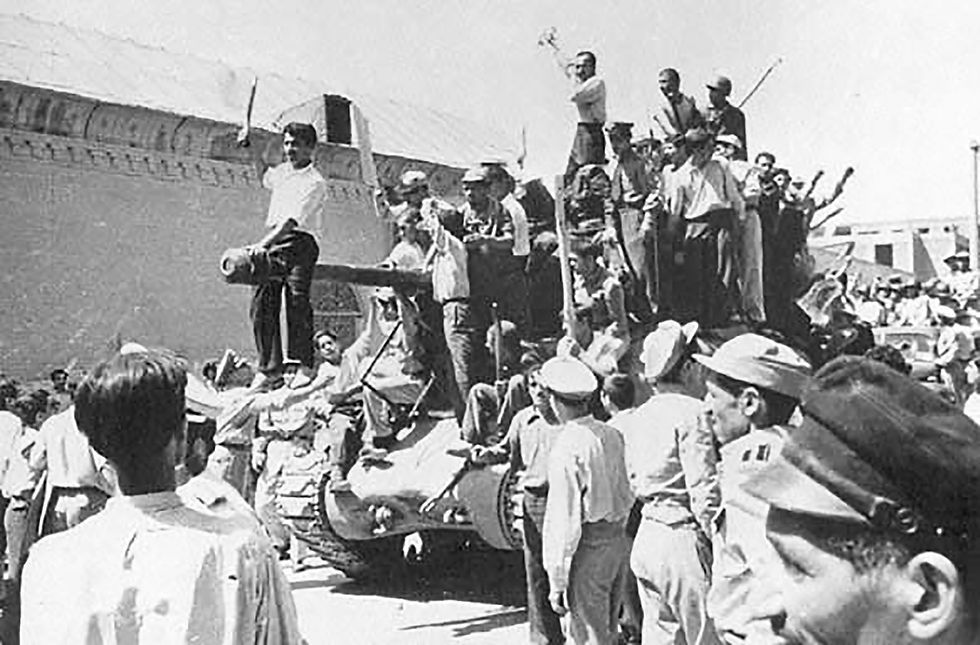
Since 1953, when the CIA and MI6-backed coup known as ‘Operation Ajax’ overthrew Prime Minister Mohammad Mossadegh following his 1951 nationalisation of the Anglo-Iranian Oil Company, crude has been Iran’s chief card in the geopolitical deck. It has served as a revenue stream, a bargaining chip and a deterrent.

The 1979 revolution, culminating in the Shah’s departure and Ayatollah Khomeini’s return, transformed this reality rather than erased it. The clerical regime inherited the world’s fourth-largest proven oil reserves - an asset that has underwritten almost every facet of statecraft, from subsidies for poor families to subsidies for militias, and from industrial patronage to the machinery of repression. In the decades since, oil has been both a blessing and burden: deepening economic dependency even as it offered a route to survival under sanctions and isolation.
Despite repeated Western efforts to choke off its energy trade, Iran’s oil sector remains the lifeline of its economy. Production has rebounded from its post-sanctions nadir, with output often exceeding 3 million barrels a day in recent years. Exports have regularly topped 1.5–2 million barrels per day, overwhelmingly bound for China. Seaborne estimates over 2024–25 hovered around 1.5–1.85 million bpd on average, with occasional monthly peaks above 2 million—testament to Tehran’s ability to push volumes even under pressure.
That resilience owes much to ingenuity. After 2018, when official sales were curtailed, a shadow fleet of tankers sailing under false flags, disabling transponders and operating through front companies, kept oil flowing and revenues accruing to the state and its external networks. Discounted crude, traded through opaque channels, still generates billions of dollars a year, funding state payrolls, missile programmes and the logistics chains that sustain allied groups from Lebanon to Yemen.
Iran’s Revolutionary Guards are not merely beneficiaries of this system; they are its custodians. In recent years, the Guards have tightened their grip over crude exports, with Western analysts estimating that they oversee as much as half of all Iranian oil shipments. Control thus extends from battlefield to tanker deck, blurring the line between military power and commercial enterprise.
If oil finances Iran’s survival, geography magnifies its leverage. Iran sits astride the Strait of Hormuz, the narrow artery through which roughly a fifth of the world’s traded oil passes each day. That chokepoint has long been both a strategic threat and a psychological one. Markets respond instantly to any hint of closure—not because disruption is inevitable, but because even its possibility injects risk premium into global crude prices. As recently as early 2026, conflict fears alone pushed oil above $75 a barrel.
The Strait’s power has rarely depended on use. During the Arab oil embargo of 1973, no tanker was halted in Hormuz, yet prices quadrupled and a permanent sense of vulnerability entered global markets. What mattered was not interruption, but intent. Energy chokepoints, traders learned, need not be closed to be effective.
That lesson hardened during the ‘tanker war’ of the 1980s, when Iranian and Iraqi forces attacked shipping across the Gulf. The Strait technically remained open, but insurance premiums soared, routes were rerouted and prices jumped with every escalation. America’s decision to reflag and escort Kuwaiti tankers was less about restoring flows than restoring confidence—an acknowledgement that fear itself was already warping markets.
The same dynamic resurfaced during Iran’s nuclear standoff with the West. In 2011–12, as sanctions tightened, Tehran openly threatened to close the Strait. Naval exercises and missile tests followed. No blockade materialised, yet Brent crude surged above $120 a barrel at points, driven not by lost supply but by the credible prospect of disruption.
Even limited incidents have proved sufficient. Tanker attacks and seizures around Hormuz in 2019 again sent prices and insurance costs higher. Since Russia’s invasion of Ukraine fractured energy markets in 2022, that sensitivity has only intensified. With spare capacity thin and supply chains strained, even rhetorical escalation in the Gulf now carries outsized weight.
Iran has never had to close the Strait to extract a political cost. The mere spectre of such a move in mid-2025 sent oil prices climbing and forced Saudi Arabia to raise output pre-emptively as a hedge against potential shortages. That threat also explains why major powers tread carefully. Striking Iran’s oil infrastructure would not merely wound Tehran but would rattle global markets, squeezing economies from Europe to China and India. Even America, which imports little Middle Eastern oil, would feel the indirect shock.
The paradox of Iranian oil is that it is both its vulnerability and shield. Attacking it might hasten economic collapse. It might also trigger retaliation capable of sending tremors far beyond Iran’s borders. In a world still addicted to crude, Tehran’s hydrocarbons continue to underwrite not only its survival, but its strategic immunity.
Dangerous Liaisons

Israel and Iran have had a long and devious history, rife with Byzantine intrigue. For nearly three decades before 1979, they were discreet partners in what Israeli strategists called the ‘periphery doctrine’ - a concept articulated by the first Prime Minister of the Jewish State, David Ben-Gurion, in the 1950s to align Israel with non-Arab regional powers against hostile Arab states.

Under Shah Mohammad Reza Pahlavi, Iran became one of Israel’s most important ‘silent’ allies. Intelligence cooperation between the Mossad and SAVAK (the Shah’s dreaded secret service) was intimate. Israeli advisers trained Iranian security forces while Israeli firms worked on irrigation and infrastructure.
Most crucially, oil flowed after the two countries in 1968 constructed the Eilat–Ashkelon pipeline under a joint venture known as the Trans-Israel Oil Pipeline Company, allowing Iranian crude to bypass the Suez Canal and reach European markets. The arrangement deepened after the 1967 Arab–Israeli war, when the canal closed and energy routes were scrambled.
For the Shah, Israel offered agricultural technology, intelligence sharing and a discreet channel to Washington. For Israel, Iran provided strategic depth and a non-Arab anchor in a region fraught with hostility.
The revolution of 1979 threatened to sever those ties overnight. Ayatollah Khomeini denounced Israel as illegitimate and recast Tehran as the champion of Palestinian liberation.
But, as the world would soon learn, West Asia had not yet exhausted its capacity for Janus-faced geopolitics. That moment came when Saddam Hussein’s Iraqi forces seemed poised to decapitate the fledgling Islamic revolution in 1980. Much of the Shah’s officer corps had been purged or imprisoned and American and Israeli arms pipelines - once the arteries of the Pahlavi state - had dried up.
Even as Ayatollah Khomeini publicly denounced Israel as a “cancerous tumour,” and Tehran handed Israel’s former embassy to the PLO and made anti-Zionism a pillar of revolutionary identity, yet privately, the Islamic Republic accepted Israeli weapons with little hesitation.
In a bid to check Saddam, who seemed a bigger threat at the time, Israeli officials authorised covert arms transfers to Tehran almost from the outset of the conflict under what became known as ‘Operation Seashell.’
The logic in Jerusalem was better an isolated Iran under a ‘mad Mullah’ than a triumphant Saddam. After all, Iraq had fought Israel in 1948 and 1973; its army was large, Soviet-equipped and ideologically hostile. A swift Iraqi victory in 1980 would have elevated Baghdad into the dominant Arab military power. By keeping Iran in the fight and prolonging the war, Israel calculated that two adversaries could be weakened simultaneously.
In 1985–86, covert dealings between US, Israel and Iran metastasised into the Iran-Contra affair. Senior figures in the Reagan administration, including Robert McFarlane and Oliver North, facilitated arms sales to Iran - some routed through Israel - in exchange for the release of American hostages held by the Hezbollah in Lebanon.
The profits from this sale were diverted to fund anti-Communist Contra rebels in Nicaragua. The scandal exposed the elasticity of ideological lines. Even as Washington branded Tehran a sponsor of terrorism, and Tehran branded America the ‘Great Satan,’ transactional channels persisted when it suited all sides.
Meanwhile, Tehran refined its strategy of indirect encirclement. The creation of Hezbollah in Lebanon in 1982 with the assistance of the Revolutionary Guard provided Iran with a forward deterrent against Israel’s northern border. After the 2006 Lebanon war, Hezbollah emerged bloodied but unbroken, its rocket arsenal vastly expanded. In Syria’s civil war after 2011, Iranian forces and proxies entrenched themselves further westward.
Israel has since decimated much of Hezbollah’s top leadership in the months following the October 7, 2023 attacks while mounting a series of spectacular assassinations of its nuclear scientists in a prolonged and lethal shadow war. Iran, too, has retaliated asymmetrically with drone and missile attacks through proxies and maritime harassment in the Gulf.


Comments