

Ramanujan, the Wizard of Numbers

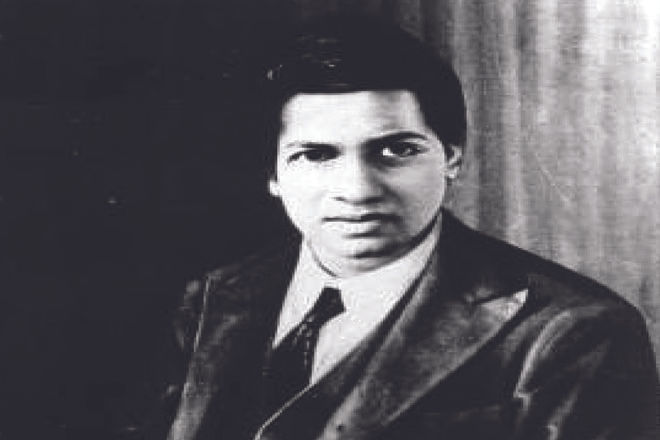
India’s great mathematician Srinivasa Ramanujan was a globally acclaimed genius who made unforgettable contributions across various branches of mathematics, giving the subject a new dimension. His discoveries, such as the “Ramanujan Theta” and “Ramanujan Prime,” inspired researchers worldwide for further study and development. About a decade ago, former Prime Minister Manmohan Singh, while paying tribute at Ramanujan’s 125th birth anniversary in Chennai, remarked that such individuals of extraordinary talent and profound knowledge are born only rarely. Ramanujan is counted among those modern Indian figures who pioneered the pursuit of new knowledge on a global scale.
Born on December 22, 1887, in Erode, Tamil Nadu, about 400 kilometers from Madras, Srinivasa Iyengar Ramanujan’s childhood was marked by hardship and poverty. He did not begin speaking until the age of three, raising concerns among his family. Little did anyone know that this child would go on to achieve greatness in mathematics and be remembered for centuries. He showed exceptional interest in mathematics, often scoring full marks, but struggled in other subjects, as nothing captivated him like mathematics. Notably, he had no formal training in the subject.
Despite receiving the K. Ranganatha Rao Award for his extraordinary contribution, his obsession with mathematics led him to neglect other subjects. He even solved mathematical problems during other classes. As a result, he failed in all subjects except mathematics in his 11th-grade examination, losing his scholarship. With his family already facing financial difficulties, he took up a clerical job at the Madras Port Trust with the help of mathematician Ramaswamy Aiyer. Even during work, he would spend his free time solving mathematical problems on scraps of paper.
Leaving Impression
One day, a British official noticed his work and was deeply impressed by his talent. Through this connection, Ramanujan came in contact with renowned British mathematician G. H. Hardy of Oxford University. Recognising his brilliance, Hardy invited him to London and arranged for his admission at Trinity College, Cambridge. This marked the beginning of Ramanujan’s global recognition. Hardy placed him alongside great mathematicians such as Euler, Gauss, Archimedes, and Isaac Newton. In 1917, he was elected a member of the London Mathematical Society, and the following year, he was honored as a Fellow of the Royal Society. During his five years at Cambridge, he produced numerous research papers, primarily in number theory. In collaboration with Hardy, he published several important works, and for one of them, Cambridge University awarded him a B.A. degree.
The illustrious torchbearer of India’s rich mathematical tradition, Srinivasa Ramanujan, was not merely a story of genius but a remarkable example of resilience, self-belief, and unwavering dedication to knowledge. Despite limited resources, lack of formal education, and numerous socio-economic challenges, he left an indelible mark on some of the most complex domains of mathematics, showcasing the boundless potential of human intellect. Ramanujan’s contribution extends far beyond the thousands of theorems he formulated; he transformed the very way mathematics is perceived and understood. His formulas exhibit a rare elegance and simplicity, as if numbers themselves communicated with him. He demonstrated that mathematics is not just a discipline of logic and computation, but also a creative and intuitive art.
New Avenues
His discoveries—such as the Ramanujan theta functions, Ramanujan primes, and the partition function—opened new avenues in modern mathematics, physics, computer science, and cryptography. Even today, researchers continue to explore his work, and his mathematical legacy remains a profound source of inspiration for generations to come. Notably, many of his results were so advanced that their proofs were established only years later by other mathematicians. Ramanujan’s life teaches us that true talent does not depend on formal degrees or abundant resources. With curiosity, dedication, and determination, one can transcend limitations and create history. His journey is especially inspiring for today’s youth, illustrating that confidence and persistent effort can turn the impossible into reality.
At a time when India is advancing toward global leadership in science and technology, Ramanujan’s legacy reminds us of the importance of innovation, originality, and the relentless pursuit of knowledge. If the younger generation draws inspiration from his life and develops a deeper interest in mathematics and science, it will not only foster personal growth but also contribute significantly to nation-building. Ultimately, Ramanujan was not just a great mathematician but a symbol of India’s intellectual heritage, proving that true brilliance knows no boundaries. His legacy remains as vibrant today as it was during his lifetime, and the echoes of his ideas will continue to resonate across the global mathematical landscape for years to come.
(The writer is a senior journalist. He has authored several books.)


Comments