
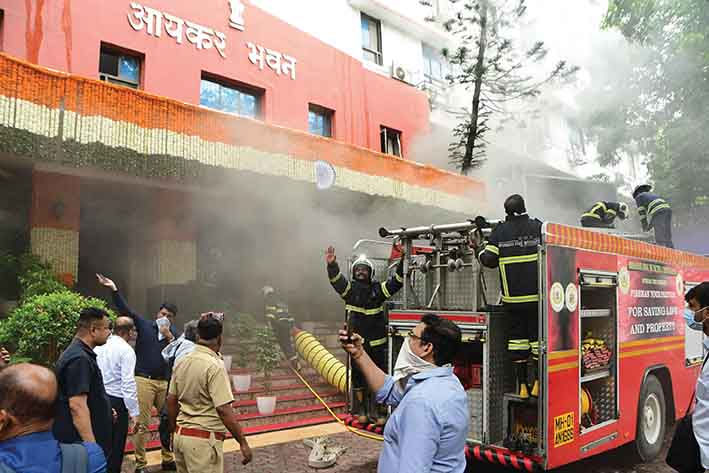
Renaming of Pune mayoral bungalow sparks controversy
- Rajendra Pandharpure

- 1 day ago
- 2 min read
The proposed name change comes nearly 20 years after the bungalow was built

Pune: The recent controversy over renaming the Pune Mayoral bungalow has less to do with a name than with the timing of the proposal. The property built specifically as the Mayor’s official residence nearly two decades ago had until now, been known simply as ‘Mayor’s Bungalow.’ The BJP’s proposal to rename it ‘Ramdoot’ has now turned a seemingly insignificant civic decision into a political argument.
The bungalow, on Ghole Road near the Pune Municipal Corporation headquarters, was conceived during a very different phase of Pune’s economic transformation. As the city’s IT sector expanded, Pune and Bangalore were competing to attract technology companies and global investment. Representatives of Indian and international firms regularly visited the Municipal Corporation to understand the city’s infrastructure, taxation and other civic arrangements. Meetings that began in the Mayor’s chamber eventually prompted the idea of a separate residence where the Mayor could host visiting business representatives and hold more extended discussions.
The proposal was backed by then-MP and senior Congress leader Suresh Kalmadi. The choice of Ghole Road was also shaped by precedent. The Municipal Commissioner and Additional Commissioner already had official bungalows, and the argument was that the Mayor, as the city’s elected political head, should have an equivalent institutional residence.
Whether the bungalow ever became the business and diplomatic salon envisaged by its proponents is harder to establish. There is little public evidence of how many prominent entrepreneurs or international business delegations actually met there. What is better known is that political meetings, particularly those involving the ruling party’s corporators, have frequently taken place on the premises.
For Pune’s residents, therefore, the building acquired an identity that was both functional and institutional: it was simply the Mayor’s Bungalow. That convention has survived changes of political leadership and the three-year period between 2022 and 2025 when an administrator ran the civic corporation.
The BJP now wants to change that identity with its proposed name ‘Ramdoot’. Former Mayor Ankush Kakade has said that the Association of Former Mayors does not support the move and has issued a public statement against it.
The political context makes the dispute more consequential. The proposal comes after the controversy surrounding the theft at the Ram Mandir in Ayodhya, an episode that has created an uncomfortable political environment for the BJP. Critics therefore see ‘Ramdoot’ as an attempt at symbolic damage control.
That interpretation may or may not be fair. But it raises a legitimate civic question: why now?
The BJP controlled the Mayor’s office continuously from 2017 to 2022. The corporation was then administered for three years before the BJP returned to the Mayor’s office. Yet the idea of renaming the bungalow surfaced only now, roughly 20 years after the property was created.


Comments