top of page

By:

Archita Gaur

13 June 2026 at 3:25:13 pm

The Economics of Next-Generation FTAs

While India is rewriting its trade strategy, market access will matter only if domestic industry can turn it into investment, jobs and deeper global value-chain integration. After years of cautiously pursuing Free Trade Agreements (FTAs), India has signed landmark deals with the United Kingdom and the European Free Trade Association (EFTA), while talks continue with several other major economies. The move reflects a broader strategy to deepen integration with global markets, attract...

The Economics of Next-Generation FTAs

While India is rewriting its trade strategy, market access will matter only if domestic industry can turn it into investment, jobs and deeper global value-chain integration. After years of cautiously pursuing Free Trade Agreements (FTAs), India has signed landmark deals with the United Kingdom and the European Free Trade Association (EFTA), while talks continue with several other major economies. The move reflects a broader strategy to deepen integration with global markets, attract investment, strengthen manufacturing, and diversify supply chains amid growing geopolitical and economic fragmentation. However, the success of these agreements cannot be measured in the number of deals signed or tariffs reduced. Their true value lies in strengthening export competitiveness, increasing participation in global value chains, generating quality employment, and enhancing long-run productivity. This article analyses the economic implications of India’s recent FTAs, the challenges to their effective implementation, and measures needed to maximize their benefits New Strategy India’s recent push towards FTAs marks a shift from its earlier cautious stance to trade liberalization. Concerns over widening trade deficits and impact of imports on domestic industries had earlier made India reluctant to pursue comprehensive FTAs, which was evident from its decision to remain outside the Regional Comprehensive Economic Partnership (RCEP). However, changing global dynamics, including supply chain disruptions, geopolitical realignments, and the “China+1” strategy, have prompted India to adopt a more proactive trade policy. Recent agreements with the United Kingdom and the European Free Trade Association (EFTA) emphasize expanding market access, attracting investment, and integrating more deeply into global value chains. Unlike traditional FTAs, which focus primarily on tariff reductions, India's recent agreements aim to promote deeper economic integration. The India–UK FTA expands market access for goods and services while including provisions on digital trade, intellectual property, government procurement, and mobility of professionals. Similarly, the India–EFTA Trade and Economic Partnership Agreement (TEPA) go beyond trade liberalization by combining tariff concessions with a landmark investment commitment of USD 100 billion over 15 years to support industrial growth and employment generation. These agreements reflect a shift in India’s trade strategy, focusing not just on expanding exports but also on attracting investment, facilitating technology transfer, bolstering supply chains and enhancing competitiveness of local industry. Their success, however, will hinge on strong implementation and competitiveness of domestic industries. Economic Impact Free trade agreements can promote economic growth by reducing trade barriers, expanding market access, and facilitating greater participation in global value chains. For India, recent FTAs are expected to boost exports in textile, pharmaceuticals, engineering goods and services while attracting greater foreign direct investment (FDI) through improved market access and investment provisions. Greater competition can also encourage domestic firms to innovate, improve productivity and achieve economies of scale. However, these gains are not automatic. Labour-intensive industries and MSMEs may struggle to compete with cheaper imports without adequate policy support. Tariff reductions may also lead to short-term revenue losses, while restrictive rules of origin and non-tariff measures may limit the full utilization of trade preferences. Moreover, Indian firms may be unable to fully capitalize on expanded market access without improvements in logistics, infrastructure, and the ease of doing business. Ultimately, the economic success of India’s FTAs will depend not only on the agreements themselves but also on complementary domestic reforms that enhance export competitiveness and strengthen industrial capacity. Although India’s recent FTAs offer significant economic opportunities, realizing their full benefits will depend on effective implementation and complementary domestic reforms. Several structural challenges could constrain the ability of Indian firms to fully capitalize on these agreements. MSMEs are particularly exposed. Many lack the technological capabilities, access to finance and compliance infrastructure required to meet international quality, environmental and sustainability standards. Export-readiness programmes, easier access to credit, technology upgradation and stronger institutional support can therefore be as important as the tariff concessions negotiated abroad. Rules of origin deserve particular attention. They are necessary to prevent trade diversion and ensure that preferential access benefits genuine producers, but excessive complexity can turn an FTA preference into an administrative burden. Simplifying procedures, strengthening customs coordination and making compliance easier for smaller exporters will be essential to improving utilisation. High logistics costs and infrastructure bottlenecks have long weakened India’s export competitiveness. A product that receives zero or low tariffs in a foreign market can still be uncompetitive if it is expensive or slow to move from an Indian factory to a foreign customer. This makes investments in multimodal transport, port modernisation, warehousing, customs digitisation and initiatives such as PM Gati Shakti central to the success of the new trade strategy. Faster clearances and more predictable logistics can effectively create a second layer of competitiveness alongside tariff preferences. The same applies to the broader ease of doing business. Reliable power, faster approvals, access to finance, skilled labour and predictable regulations are not peripheral issues in an FTA strategy. India’s next-generation FTAs represent a strategic shift from tariff-focused liberalisation towards deeper economic integration. They offer an opportunity to expand exports, attract investment, diversify supply chains and strengthen India’s position in global value chains. But the signing of an agreement should be seen as the beginning of the process, not its culmination. The more meaningful measure of success will be whether Indian firms increase their exports, whether new investment creates productive capacity, whether MSMEs enter global supply chains and whether workers gain access to better and more productive employment. (The writer is an economics postgraduate from Jawaharlal Nehru University with research interests in economic policy, trade and global governance. Views personal.)

Return of the Gods

The repatriation of a centuries-old Kartikeya idol from Australia underscores the importance of ‘civilisational diplomacy’ on India’s part.
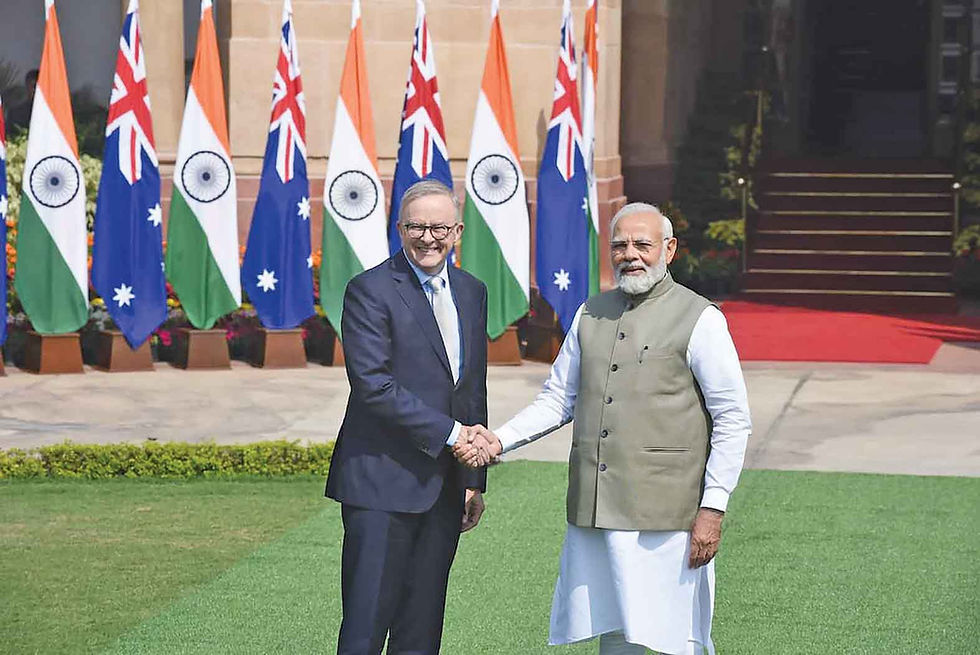
 India and Australia have spent the past two decades discovering that they have more in common than cricket, the Commonwealth and a shared affection for the Indian Ocean. What began as a cautious strategic courtship has matured into one of the Indo-Pacific's most consequential partnerships, spanning defence, critical minerals, education, technology and trade. Yet the most intriguing development during Narendra Modi’s visit to Australia this month was not an agreement on security or commerce. It was the return of a centuries-old stone sculpture of Lord Kartikeya.


Innovative Diplomacy

Three Indian antiquities—a bronze Bhadrakali, a granite Nandi and a rare six-headed Kartikeya—were repatriated by Australia as part of a broader agreement that also saw India return the ancestral remains of Australian First Nations people. In an era when cultural identity has become an increasingly important currency in international affairs, the restitution of heritage is no longer merely about correcting historical wrongs. It has become a form of diplomacy.


The return of Kartikeya carries symbolism that resonates well beyond archaeology. Known as Skanda or Murugan across much of India, Kartikeya is traditionally associated with courage, wisdom and the triumph of knowledge over ignorance. His six faces signify mastery over the senses and the mind, while his spear—the Vel—represents the piercing power of knowledge. His peacock mount symbolises the conquest of vanity, and the rooster associated with him represents vigilance.


Whether one interprets these images religiously or culturally is beside the point. Nations rely upon symbols to narrate their past and imagine their future. For India, recovering stolen antiquities has become part of a broader effort to reclaim a fragmented civilisational inheritance. Since 2014, hundreds of artefacts have been returned from museums, collectors and governments around the world. Australia has emerged as one of the more willing partners in that effort, having already returned 29 Indian artefacts in 2022 before this latest handover.


The symbolism complements a relationship that is becoming increasingly substantive. Modi’s visit produced agreements across defence, maritime security, cyber cooperation, critical minerals, education, tourism and investment.


Defence cooperation has advanced particularly rapidly. Shared concerns over an increasingly contested maritime environment have encouraged greater military interoperability, intelligence sharing and joint exercises. Both countries have embraced the vision of a free, open and rules-based Indo-Pacific without framing it as an explicitly anti-China alliance. That ambiguity is deliberate. Canberra and New Delhi understand that strategic partnerships are strengthened less by rhetorical confrontation than by practical cooperation.


Security Ties

Economic considerations reinforce the security logic. Australia possesses abundant reserves of critical minerals essential for electric vehicles, batteries and advanced manufacturing. India, meanwhile, seeks secure supply chains as it expands domestic manufacturing and clean-energy infrastructure. Collaboration on lithium, rare earths and uranium serves both countries' interests while reducing dependence on concentrated global suppliers.


Australia’s uranium exports support India’s expanding civilian nuclear programme, itself an essential component of India's long-term strategy to balance energy security with decarbonisation.


Education provides another area where strategic interests and people-to-people ties converge. Indian students now constitute one of Australia's largest international student communities, contributing economically while strengthening long-term social links.


Perhaps the greatest strength of the bilateral relationship, however, lies outside official communiqués. Australia’s large Indian diaspora has become an enduring bridge between the two democracies. Cultural festivals, sporting exchanges, research collaborations and business networks have woven together societies that once viewed each other largely through the prism of migration or cricket.

This is where the return of Kartikeya acquires its broader diplomatic significance. The restitution of cultural heritage allows governments to build trust and acknowledge histories that conventional diplomacy frequently overlooks.


There is, of course, a temptation to imbue such gestures with excessive political or spiritual significance. No returned idol, however ancient or sacred, can substitute for sustained policy. Yet symbols matter precisely because they reinforce interests already moving in the same direction. The return of Kartikeya reflected the confidence of two countries increasingly comfortable viewing each other as long-term collaborators rather than distant acquaintances.


The sculpture’s journey home therefore represents something larger than cultural restitution. It illustrates how diplomacy in the twenty-first century increasingly blends hard power with heritage, economics with identity, and strategy with symbolism. In an Indo-Pacific defined by shifting balances of power, that combination may prove more durable than either sentiment or security alone.


(The writer is a foreign affairs expert. Views personal.)

Comments


bottom of page