
Sindh and the Strains of Rhetoric: Why Rajnath Singh’s Statement Jolted Pakistan
- Ruddhi Phadke

- Nov 30, 2025
- 5 min read
The Indian Defence Minister’s casual remark on Sindh exposes Pakistan’s deepest fault-lines far more than it wounds India
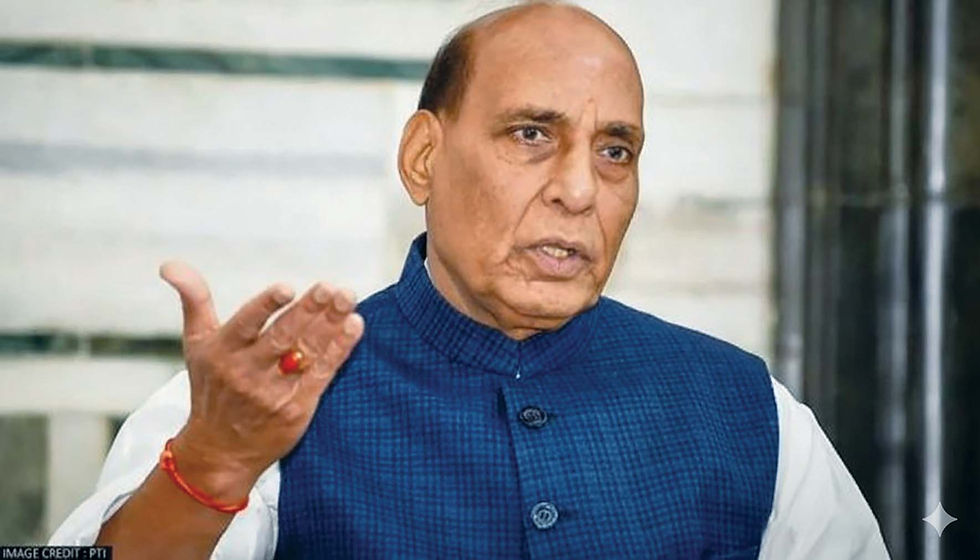
India and Pakistan do not need tanks to provoke each other when a sentence can admirably perform that function. That salvo was recently delivered by Indian Defence Minister Rajnath Singh at a public event. Quoting stalwart Bharatiya Janata Party (BJP) leader L.K. Advani, Singh mused that “borders may change” and that Sindh might one day “return” to India. Pakistan responded with ritualised outrage, condemning what it called “delusional and dangerously revisionist remarks.”
The Sindhis are among the subcontinent’s oldest settled peoples - an Indo-Aryan community shaped by the Indus, sustained by trade, and distinguished by a language, literary tradition and mercantile ethic that long predate the modern nation-state. For centuries, Sindh was a commercial bridge between South Asia, Central Asia and the Arabian Sea. Its ports connected India to the Persian Gulf; its merchants ranged as far as East Africa. Under British rule, Sindh was administered as part of the Bombay Presidency until it was carved out as a separate province in 1936 in an early recognition of its distinct identity.
Partition in 1947 shattered that continuity. More than a million Hindu Sindhis fled almost overnight to India, stripped of land, language and livelihood. Unlike Punjabis and Bengalis, they were not resettled in a linguistically contiguous homeland. Instead, they dispersed across India - into Maharashtra, Gujarat, Rajasthan and beyond, forming one of the country’s most economically successful yet culturally uprooted diasporas. Muslim Sindhis, meanwhile, remained in Pakistan, inheriting an undivided province but one soon eclipsed by the political and military dominance of Punjab. What followed was not secession, but a slow corrosion of autonomy.
It is this unresolved history that gives Rajnath Singh’s remark its charge. By hinting, however casually, at Sindh’s future alignment, India’s Defence Minister appeared, deliberately or otherwise, to question Islamabad’s authority over one of its most vital provinces.
Violent protests
The unease in Sindh long predates Singh’s remark. In April and May this year, the province was convulsed by violent protests against a federally backed canal project that threatened to divert water away from the Indus basin - Sindh’s economic and ecological lifeline. Demonstrators blocked highways, halted trains and attacked government convoys. For a province that already feels short-changed in Pakistan’s federal resource bargain, control over water is existential.
The unrest has since broadened. This month alone, Sindh has witnessed successive waves of protest over enforced disappearances widely attributed to the security agencies; over months of unpaid salaries owed to teachers; and most explosively, over a sweeping constitutional amendment rammed through Pakistan’s Senate roughly two weeks ago. The proposed 27th Amendment aims to overhaul both the judicial system and the military command structure. Its critics argue that it weakens civilian oversight while fortifying the position of the army chief, General Asim Munir. Through changes to Article 243 of the constitution, the amendment would effectively shield senior military commanders from criminal prosecution—while further hollowing out provincial authority.
In Sindh, the reaction was immediate and furious. Hundreds poured into the streets, accusing Islamabad of stealing not just their water and revenues, but now their remaining constitutional protections. The province’s restiveness is structural. Sindh has long been riven by ethnic tensions, resource disputes with other provinces, a low-grade separatist current, and persistent human-rights grievances. Even under the British Raj it was regarded as among the most politically volatile regions of western India. Pakistan inherited that volatility, but never truly resolved its causes.
It is against this backdrop of accumulated resentment that Rajnath Singh’s remark acquired its destabilising potency. In most countries, a speculative comment about borders would be dismissed as political noise. In Sindh, it landed as a provocation precisely because the federal compact already appears frayed. More awkwardly for Islamabad, some voices within the province greeted it with approval rather than outrage.
Shafi Burfat, the exiled chairman of the Jeay Sindh Muttahida Mahaz, a separatist organisation, publicly welcomed the Indian Defence Minister’s comment. In a sharply worded statement, he argued that Sindhis were never historically tied to “Arab or Turkic powers” through religion or ideology, but belonged civilisationally to what he termed “Sapt Sindhudesh, India.” He accused the Pakistani state of crushing the Sindhudesh freedom movement through repression, enforced disappearances and extrajudicial killings, and called Pakistan “lethal poison” for the survival of the Sindhi nation. Singh’s remark, he said, offered “a ray of hope.”
Such rhetoric represents a fringe current rather than majority sentiment. Yet its political significance lies precisely in its existence. When a separatist leader can openly frame an Indian defence minister’s statement as validation, it underscores how far Sindh’s relationship with the Pakistani state has deteriorated.
Sindh’s uneasy relationship with the Pakistani state is rooted in the architecture of the colonial exit. Under British rule, Sindh was administered as part of the Bombay Presidency, grouped with present-day Maharashtra and Gujarat - a coastal, commercial world oriented more towards the Arabian Sea than the Punjabi heartland. By the 1920s, a broad-based movement, supported by both Hindu and Muslim elites, emerged to separate Sindh from Bombay on the grounds of cultural and administrative distinctiveness. The campaign succeeded with the Government of India Act of 1935, which granted Sindh its own provincial legislature in 1936.
That legislature would prove decisive a decade later. In 1947 it voted in favour of joining the newly created state of Pakistan. Unlike Punjab and Bengal, the two flashpoints of Partition, Sindh was transferred to Pakistan intact, without a line being drawn through its villages and fields. Yet territorial unity did not prevent social rupture. More than a million Hindu Sindhis fled almost immediately to India, stripping the province of a substantial portion of its commercial middle class and irrevocably altering its demography. For those who remained, the promise of provincial autonomy inside Pakistan soon gave way to rule by a centre increasingly dominated by Punjab.
Fragile nation
From the earliest years, Pakistan evolved less as a balanced federation than as a centralised security state. The army, bureaucracy, intelligence services and much of the corporate economy came to be overwhelmingly Punjabi in composition. Decades later, the imbalance is stark. Sindhis comprise over 14 per cent of Pakistan’s population, yet account for barely 2 per cent of its armed forces and around 5 per cent of the civil services. Karachi generates a large share of national revenue; Sindh exercises only a thin influence over how it is spent.
The same pattern, in even harsher form, defines Balochistan. Comprising four former princely states, one of them initially opted for independence in 1947. Islamabad tolerated that ambiguity briefly. In 1948, Pakistani troops marched in, leaving annexation as a fait accompli. Today Balochistan accounts for roughly 44 per cent of Pakistan’s territory and much of its mineral wealth, yet remains its poorest province, scarred by repeated insurgencies, enforced disappearances and militarised governance.
Pakistan likes to describe itself as a federation. In practice, it has long functioned as a hierarchy, with Punjab at the apex and the peripheries managed through force, patronage and periodic constitutional improvisation. This skewed balance lies behind the periodic tremors in Sindh, the chronic rebellion in Balochistan and the enduring instability of Khyber Pakhtunkhwa. It also explains why remarks such as Singh’s, however speculative, carry such destabilising echo.
India’s own post-1947 experience points in a different direction. At Independence, nearly 48 per cent of its territory lay outside the Union in the form of princely states. Their integration was neither peaceful nor automatic. It required diplomacy, coercion, constitutional innovation and, above all, sustained political accommodation. Over subsequent decades, linguistic reorganisation, fiscal federalism and massive investments in connectivity were used to knit diversity into a functioning national framework. Today, that project continues in Kashmir and the north-east through infrastructure, political restructuring and economic integration.
Pakistan chose a narrower path. It built a state designed first for security, then for cohesion. The consequences are now visible in its restive provinces and brittle federal compact. In that sense, the episode over Sindh offers a reminder that building a durable nation is harder than issuing condemnations, and that no amount of outrage abroad can permanently compensate for disaffection at home.


Comments