top of page

By:

Kiran D. Tare

21 August 2024 at 4:53:13 pm

From Fighter Jets to Faith

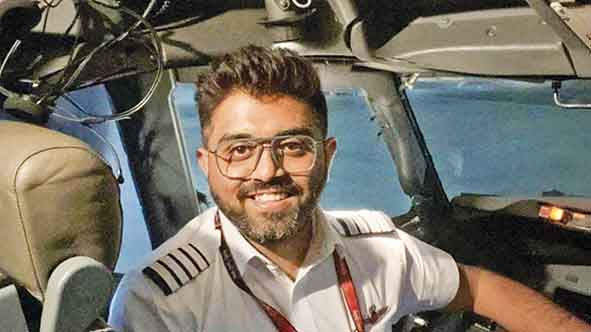
Air Marshal (retd.) Jeetendra Mishra brings discipline, integrity and command experience to the Ram Mandir Trust as it seeks to rebuild faith shaken by the donation scandal. The biggest challenge facing Air Marshal (retd.) Jeetendra Mishra, who was recently appointed first chief executive officer of the Shri Ram Janmabhoomi Teerth Kshetra in Ayodhya, can be articulated in a single word. It is not security or the vast machinery that keeps the Ram Mandir functioning. It is trust. Mishra takes...

From Fighter Jets to Faith

Air Marshal (retd.) Jeetendra Mishra brings discipline, integrity and command experience to the Ram Mandir Trust as it seeks to rebuild faith shaken by the donation scandal. The biggest challenge facing Air Marshal (retd.) Jeetendra Mishra, who was recently appointed first chief executive officer of the Shri Ram Janmabhoomi Teerth Kshetra in Ayodhya, can be articulated in a single word. It is not security or the vast machinery that keeps the Ram Mandir functioning. It is trust. Mishra takes over the management of the Shri Ram Janmabhoomi Teerth Kshetra Trust takes charge at an awkward moment for an institution that derives much of its moral authority from the faith of millions of devotees. Till date, allegations of theft and irregularities involving temple donations have resulted in criminal investigations, eight arrests, changes in the Trust’s composition and the resignation of its general secretary, Champat Rai. The scandal has raised uncomfortable questions about whether offerings made in faith are being handled with the seriousness that faith demands. Mishra’s appointment suggests that the Trust understands the scale of that challenge. Known for his key role in Operation Sindoor, his CV is almost an advertisement for disciplined institutional management. It certainly sends out a reassuring message at a time when the scam-battered Trust is in danger of losing faith among devotees. A fighter combat leader, experimental test pilot and veteran commander, Mishra retired in April this year as Air Officer Commanding-in-Chief of the Western Air Command. He has held a succession of demanding operational and organisational appointments, including Deputy Chief of Integrated Defence Staff (Operations), commander of a fighter squadron, Chief Test Pilot at the Aircraft and Systems Testing Establishment and commander of two frontline air bases. These are qualities that are needed to steer the Ram Mandir Temple Trust out of its present quagmire. Notable in Mishra’s military record is that the Western Air Command was at the centre of Operation Sindoor, India’s robust and swift response to Pakistan and the terror bases lodged in that country. He was among its top planners and received a medal for distinguished service of exceptional order for his role. His other honours include the Sarvottam Yudh Seva Medal, Ati Vishisht Seva Medal and Vishisht Seva Medal. No one perhaps is more suitable to hand the Trust’s current crisis as he. Asked about his strategy as CEO, Mishra, in interviews, has stressed that it would have to be developed under the guidance of the Trust and with his team. By this, Mishra appears to suggest that the CEO is being brought in not simply to impose military-style discipline on a religious institution but to make an existing institution work better. After all, the donation controversy cannot be repaired merely through arrests or administrative reshuffling. Those actions may establish accountability for alleged wrongdoing. They do not automatically restore confidence among devotees. A devotee dropping money into a donation box does so with an expectation that the offering will be handled honestly, efficiently and transparently. Once that assumption is disturbed, even an impeccably managed ledger cannot immediately restore what has been lost. When asked how his Air Force background would help, Mishra unassumingly pointed not to some special military formula but to qualities such as discipline, hard work and integrity. That selection process to the top job itself was unusually competitive. The Trust received 5,585 applications for the CEO’s post. A search panel headed by retired judge Pramod Kohli, with retired Lieutenant General Vishnukant Chaturvedi and former scientist Suresh Haware, assessed candidates through a 600-mark framework before interviewing 16 finalists in Ayodhya on August 11 and 12. Mishra has emerged from that field at a moment when the Trust needed more than another administrator. It needs someone capable of signalling that the institution takes stewardship seriously.
“Lord Ram does not require my service,” Mishra has said. “It’s the nation and the people who require my service.” This attitude may be his greatest asset. The Ram Mandir is not short of devotees. What its management now needs is to convince those devotees that their faith is being matched by institutional integrity. Mishra has spent a career dealing with systems in which mistakes can carry enormous consequences. His real mission in his new assignment is to make devotees confident that when they give donations, their faith is not being misplaced.

Slouching towards India

Washington’s envoy to New Delhi is bringing an unusually blunt style to a relationship that prefers results over diplomatic choreography.

Diplomacy usually rewards the careful sentence. But Sergio Gor, unbridled by diplomatic posturing, appears to prefer the ‘useful’ one.


As his recent visit to India showed, Gor, ever since taking charge as the United States ambassador to India, has made a habit of saying plainly what previous American diplomats had only implied or altogether avoided speaking about.


Unlike the career diplomats who have traditionally occupied the U.S. embassy in New Delhi in the past, Gor is a political operative and a close Trump confidant who arrived in India carrying something more valuable than a diplomatic pedigree: the President’s confidence. His appointment came at a particularly awkward moment, when Washington and New Delhi were struggling over trade, tariffs and India’s continuing purchase of Russian oil.


One of the highlights during his India tour was his description of Jammu and Kashmir as an “important part of India” was the most consequential example. Gor’s visit to Kashmir on August 19 was the first standalone visit by a US ambassador since New Delhi revoked Jammu and Kashmir’s special status in August 2019 and reorganised the former state into the Union Territories of Jammu and Kashmir and Ladakh. His subsequent description of the region as an important part of India was therefore unlikely to be treated as diplomatic small talk.


A section of political observers have read Gor’s remark as potentially signalling a shift in Washington’s approach to a thorny issue on which successive American administrations have generally practised studied neutrality. New Delhi, on its part, has been prudent not to declare victory. The Ministry of External Affairs neither welcomed nor dismissed his formulation. Instead, spokesperson Randhir Jaiswal simply reiterated India’s established position that Jammu and Kashmir and Ladakh “have been, are, and will continue to be integral and inalienable parts of India”.


Gor’s statement drew predictable outrage from Pakistan, given the latter has spent the past year ingratiating itself with the United States, particularly after Operation Sindoor. Since that military confrontation between India and Pakistan in May 2025, Trump has repeatedly claimed a role in stopping the fighting. A statement by an ambassador that appears to tilt towards India is therefore welcome in Delhi, but hardly something the government will build a foreign-policy doctrine around.


For decades, American diplomacy in South Asia has been fond of hyphenation: India-Pakistan, Kashmir, regional stability. The formula has had the virtue of sounding even-handed, while often flattening the very different histories and security challenges confronting the two countries.


Now, Gor’s formulation cuts through that tradition. His praise for the Centre and the Jammu and Kashmir government over improvements in security, coupled with his suggestion that Washington could reconsider its travel advisory for the region, gives his remarks a practical dimension.


At the Economic Times World Leaders Forum, he said the US-India trade agreement was “almost” finalised in principle, with the remaining work largely involving legal and technical language. The formulation was revealing given the chill in Indo-U.S. trade relations, especially in wake of President Donald Trump’s tariffs on India.


Gor described Donald Trump and Prime Minister Narendra Modi as sharing a “deep and personal friendship”, portraying both as action-oriented and impatient with delay. He said Trump retained particular regard for Modi’s support during his period out of office after the 2020 presidential election.


Gor has also begun pushing an idea that could prove more consequential for the long-term relationship: bringing American universities to India. He has said that institutions including Harvard, New York University and Purdue are exploring an Indian presence, and that he has spoken to the provost of the Massachusetts Institute of Technology about bringing American universities to India within the next year.


For Washington, it is a way of deepening the relationship beyond governments. For India, it could help expand access to globally recognised higher education without requiring every Indian student to cross the Pacific.


The US-India relationship has matured beyond the stage when symbolism alone could sustain it. Trade, technology, education and security now demand constant negotiation, and the relationship has acquired too many moving parts for carefully scripted statecraft to do all the work.


But whether Gor’s candour represents a genuinely new American line on India remains to be seen. Until then, Delhi is likely to enjoy the words without betting its relationship with the U.S. on them.

Comments


bottom of page