top of page

By:

Rajendra Joshi

3 December 2024 at 3:50:26 am

Procurement first, infrastructure later

Procurement at multiples of market price; equipment before infrastructure; no accountability Kolhapur: Maharashtra’s Medical Education and Public Health Departments have been on an aggressive drive to expand public healthcare infrastructure. Daily announcements of new centres, advanced equipment and expanded services have reassured citizens long denied dependable public healthcare. Procurement of medical equipment, medicines and surgical supplies is reportedly being undertaken at rates two to...

Procurement first, infrastructure later

Procurement at multiples of market price; equipment before infrastructure; no accountability Kolhapur: Maharashtra’s Medical Education and Public Health Departments have been on an aggressive drive to expand public healthcare infrastructure. Daily announcements of new centres, advanced equipment and expanded services have reassured citizens long denied dependable public healthcare. Procurement of medical equipment, medicines and surgical supplies is reportedly being undertaken at rates two to ten times higher than prevailing market prices. Basic economics dictates that bulk government procurement ought to secure better rates than private buyers, not worse. During the Covid-19 pandemic, equipment and consumables were procured at five to ten times the market rate, with government audit reports formally flagging these irregularities. Yet accountability has remained elusive. The pattern is illustrated vividly in Kolhapur. The Dean of Rajarshi Shahu Government Medical College announced that a PET scan machine worth Rs 35 crore would soon be installed at Chhatrapati Pramilaraje (CPR) Government Hospital for cancer diagnosis. But a comparable machine is available in the market for around Rs 6.5 crore. A senior cancer surgeon at a major cancer hospital in western Maharashtra, where a similar machine was recently installed, remarked that the gap between what his hospital paid and what the government is reportedly paying was enough to make one ‘feel dizzy’. The label of a ‘turnkey project’ does not adequately explain a price differential of this magnitude. High Costs CPR Hospital recently had a state-of-the-art IVF centre approved at a sanctioned cost of Rs 7.20 crore. Senior fertility specialists across Maharashtra note that even a modern IVF centre with advanced reproductive technology equipment typically costs between Rs 2.5 crore and Rs 3 crore. The state’s outlay is reportedly approaching Rs 15 crore. Equipment arrived in June 2025 and lay idle for months owing to indecision about the site. Similarly, digital X-ray machines approved for CPR Hospital and a government hospital in Nanded; available in the market for roughly Rs 1.5 crore; were reportedly procured at Rs 9.98 crore per unit. Doctors in CPR’s radiology department, apprehensive about being drawn into potential inquiries, reportedly resisted accepting the equipment. One departmental head was transferred amid disagreements over signing off on the proposal. What’s Wrong These cases point to a deeper structural failure: Maharashtra has perfected what might be called the ‘equipment first, infrastructure later’ model. In any public hospital, the administrative sequence ought to be: identify space, create infrastructure, sanction specialist posts, and only then procure equipment. Compounding the procurement paradox is a parallel policy decision. On 20 December 2025, the state government decided to introduce radiology diagnostic services through a Public-Private Partnership model (PPP). Following this, an order issued on 6 February 2026 authorised private operators to provide PET scan, MRI and CT scan services at six government medical college hospitals: in Pune, Kolhapur, Miraj, Sangli, Mumbai and Baramati. CPR already has a 126-slice CT scan machine and a 3 Tesla MRI scanner, with another CT scan proposed. If the PPP arrangement proceeds, the hospital could simultaneously run one PET scan machine, two MRI scanners and three CT scan machines. Medical experts warn this could lead to unnecessary diagnostic testing simply to keep machines occupied, thus exposing patients to excess radiation while government-owned equipment gathers dust. A similar pattern was seen during the pandemic, when the Medical Education Department spent hundreds of crores on RT-PCR machines, only to award swab-testing contracts to a private company. Many of those machines remain unused today.

State opens its heart, hearth for Lord Ganesha

Mumbai: Maharashtra is all set for an unprecedented scale of pomp and glory at the 2025 Ganeshotsav celebrations as the state government has proclaimed the 11-day fest as a ‘Rajya Mahotsav’ (State Festival), now in its 133rd year.


This year, the glittering Ganeshotsav extravaganza will span 11 days – from Aug. 27 to Sep. 6 – and the city plus other celebration hubs like Pune, Konkan are expected to witness a boom in devotees, domestic and foreign tourists, culture buffs and the commoners who would join in wholeheartedly.


Marking a first in the efforts, the Maharashtra Tourism Department, in tandem with the Maharashtra Tour Guides and Tourist Facilitators Association (MTGTFA) and the Tour Guides Association (TGA), will conduct special guided Ganeshotsav tours.


These curated “pandal-hopping” experiences will cover five of Mumbai’s most iconic Ganesh mandals, offering visitors both cultural insight and an organized avenue to explore the city’s festive spirit during what ranks as the biggest public festival of Maharashtra transcending religious boundaries in which people – irrespective of religion/caste – participate enthusiastically.


Starting August 28 to September 3, the two daily tours will kick-off at 9:30 a.m. and 11:20 a.m. from the Fort-cha Icchapurti Ganesha marquee, opposite the GPO, near Chhatrapati Shivaji Maharaj Terminus.


The excursions come at a cost – Rs. 1,441 for Indians and Rs. 1,963 for foreigners - but the confident organisers promise absolute VFM.


“These tours will not only showcase the artistry and devotion behind each of the selected pandals but also give visitors a sense of Mumbai’s awesome living heritage,” said an official spokesperson on the venture.


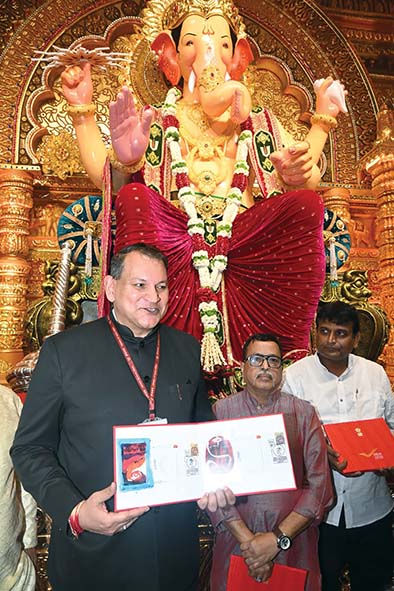
In a philatelic boost to the cultural revelry, the Maharashtra Postal Circle’s Chief Postmaster General Amitabh Singh released a special set of four picture postcards and a unique cancellation for Ganeshotsav fest, at the famed Lalbaugcha Ganesh’s ‘Pratham Darshan’ in the marquee late on Sunday.


Flanked by Assistant Postmaster General Dr. Sudhir Jahkere, Lalbaugcha Raja Sarvajanik Ganeshotsav Mandal Chairman Babasaheb S. Kamble, Secretary Sudhir S. Salvi, philatelist Ashiwini Manjure, Singh unveiled the post-cards, themed “Ganesh Utsav: Cultural Heritage of Maharashtra,” designed by Padmashi laureate and calligrapher Achyut Palav.


“Though Ganeshotsav is already known world over, the ‘Rajya Mahotsav’ status has given the festival an elevated stature at the international arena that showcases not just a religious celebration but showcases Maharashtra’s rich cultural heritage globally,” commented BrihanMumbai Sarvajanik Ganeshotsav Samanvay Samiti President Naresh Dahibhavkar.


In the run-up to Ganeshotsav, Mumbai has transformed into a dazzling carnival of twinkling lights, grandly adorned pandals, and freshly spruced-up streets and bylanes in the past few days — all prepared to welcome devotees, tourists, and citizens alike for the 11-day celebration beginning August 27.


A festival with global resonance

Mumbai is fully geared to soak in the festive spirit of Ganeshotsav 2025 with richly decorated pandals, thematic presentations with ‘Operation Sindoor’ being a favourite, cultural programs, and now guided tours.


The two daily trips will take the participants on an exciting journey to these legendary marquees.

1. Fortcha Icchapurti Ganesh – This year’s theme recreates the grandeur of the Somnath Temple.


2.    Keshavji Naik Chawl, Girgaum – Where it all started, the birthplace of Ganeshotsav in Mumbai in 1893, taking inspiration from Lokmanya Bal Gangadhar Tilak’s small fest in Pune.


3. Mumbai-cha Raja, at Ganesh Galli, Lalbaug: Ranks among the oldest and houses one of the tallest Ganesh idols.


4. Chinchpokli-cha Chintamani – A beloved pandal that has bagged numerous awards for its creativity and devotion. 


5. (A) GSB Seva Mandal, King’s Circle – The state’s ‘richie-rich’ Ganpati, with the idol, decorated with gold, silver, diamonds and other precious stones and metals, along with the marquee where it is installed, insured for a staggering Rs 474.46 crore this year.

(B) GSB Sarvajanik Ganeshotsav, Wadala – Another popular draw for devotees and tourists alike for its unique idols.


Comments


bottom of page