
The Drought that Haunts Maharashtra


There are some memories that do not disappear with time. In parts of rural Maharashtra, the mention of 1972 is enough to bring back memories of empty wells, dry fields, disappearing cattle and families leaving their villages in search of work. Fifty-four years later, Maharashtra is again confronting a serious drought. Much has changed since 1972: roads are better, state capacity is stronger, employment schemes and food-distribution networks are wider, and information travels faster.
Yet the anxiety in farming households is familiar. The crop has suffered, money has already been spent and the next agricultural season is approaching. The problem this year is not simply a weak monsoon. In many parts of Maharashtra, the rains arrived and sowing took place - only for a prolonged dry spell to strike when the standing crop most needed water.
The state has declared drought in 265 of its 358 talukas, covering more than 70 percent of Maharashtra. Between June 1 and September 24, the state received 795.1 mm of rain against an expected 965 mm, with the sharpest deficits in Marathwada, followed by Vidarbha.
But drought is never about numbers. For a farmer, the arithmetic is harsher: money has already gone into seeds, fertiliser, pesticides, labour and cultivation; when the crop fails, that investment is lost, but the loan remains. That is one reason the present drought feels different from 1972, despite the same fear of water scarcity. The 1972 drought, too, followed successive poor monsoons, with the state’s 1972-73 annual plan noting that adverse weather had depressed agricultural production in both 1970-71 and 1971-72.
Grim Situation
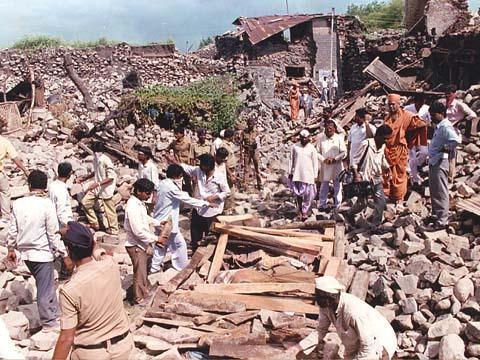
Scarcity had already been declared in around 15,000 villages across 20 districts. For rural families, the loss of a crop meant the loss of income. For livestock owners, the shortage of fodder and water meant the loss of cattle. For landless workers, there was simply no work in the fields. People travelled from districts such as Solapur, Beed, Osmanabad, Ahmednagar and parts of Pune in search of employment. Older residents still remember the period not only as a drought but as a time when an entire rural economy had almost stopped functioning. Studies of the period show how deeply the crisis affected rural households. Small and medium farmers suffered crop and livestock losses and increasingly depended on wage labour. Food availability also fell sharply for many rural families.
The government’s response at the time was therefore not limited to farmers. Drought-relief works were opened on a large scale. Roads, canals, ponds, percolation tanks, soil works and community wells were taken up. People who had lost agricultural employment could earn wages through these works. The figures were remarkable for the time.
The material based on historical studies records expenditure of about Rs. 212.5 crore on drought works in 1972-73. At the peak, millions of workers were engaged on relief works. Food was another priority.
Between September 1972 and March 1973, about six million tonnes of grain were distributed through the public distribution system, according to parliamentary records. Wells were dug and deepened, water was transported and new sources were created. More than 56,000 community wells were reportedly taken up in 1972-73. Cattle camps were established, fodder was transported and animals were moved from areas where water and fodder had become scarce. Farmers received relief through land revenue concessions and credit support. The system was not perfect. Historical studies record delays in starting works and paying wages, problems in measuring work and complaints of irregularities. But the experience produced an important lesson: drought relief could not be only about distributing money or food. It also had to provide work and create something useful for the future. That experience eventually contributed to Maharashtra's employment guarantee system. The Maharashtra Employment Guarantee Act was enacted in 1977, creating a more permanent mechanism for providing rural employment during difficult periods. The state now has systems that were unavailable in 1972. The government has begun crop-loss assessments in drought-affected areas.
District administrations have been asked to record damage, including through field surveys and photographs. Relief measures announced so far include land-revenue concessions, restructuring of crop loans, deferment of recovery, concessions on agricultural electricity bills, drinking-water arrangements and fodder supplies. Employment under the rural employment guarantee programme is also being expanded. The government has planned thousands of crores of rupees for employment and water-conservation works in drought-hit areas.
Complex Economy
The difference from 1972 is that the government is now dealing with a much larger and more complex economy. Farmers today are more dependent on purchased inputs, credit and markets. A failed crop therefore affects not only food production but also household finances.
The question that cannot be postponed is how to ensure that a farmer who has lost one crop has enough financial strength to plant the next one. The drought of 1972 changed the way Maharashtra thought about rural employment and water.
The crisis pushed the state towards a system where relief work was not merely relief; it also created roads, ponds, wells and other assets. In 2026, Maharashtra has more technology, more infrastructure and more government programmes. What it needs now is to make sure that these systems reach the village when they are needed most.
The farmer looking at a dry field today is not thinking about rainfall statistics. He is thinking about the crop that did not survive, the loan that has to be repaid, the family that has to be supported and the next season that is already approaching. That is why 1972 continues to live in Maharashtra's collective memory.
The challenge before the government today is to learn from it and build a system in which a failed monsoon does not have to become a failed year for an entire family. For Maharashtra, that would be the real measure of drought relief.
(The writer is a political observer. Views personal.)


Comments