

The Gender Justice-Blind Spot in India’s Fiscal Policy

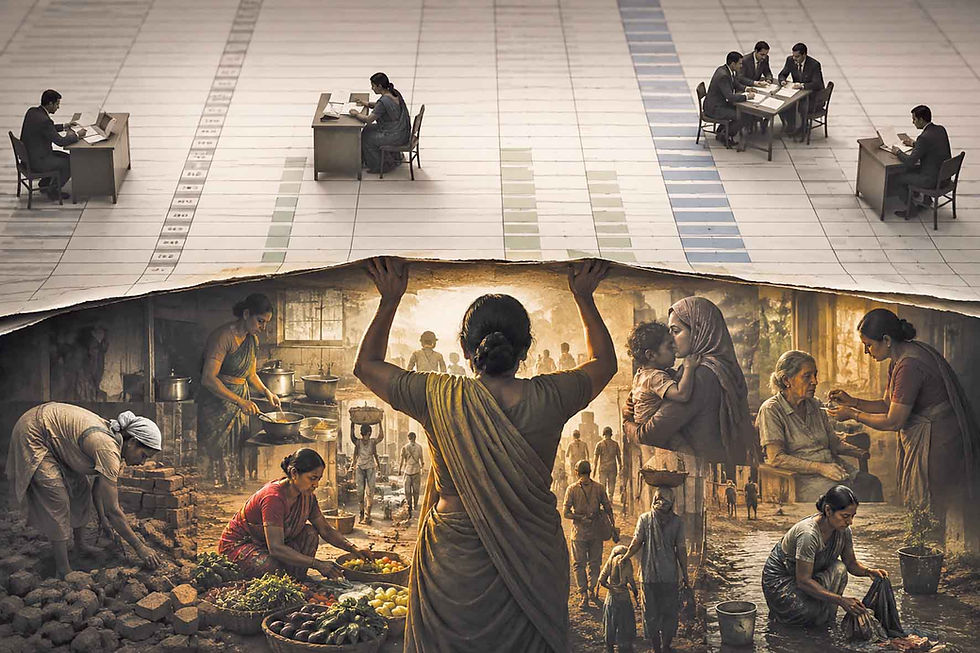
India’s gender budget reached 9.37 percent of total Union Budget expenditure in FY26 (2026-27), marking a significant increase from 8.86 percent in FY25 (2025-26) and 6.8 percent in FY24 (2024-25). This represents the largest-ever allocation for promoting gender equality. Yet gender disparities in employment, nutrition and mobility persist despite this historic commitment. Why? Because our gender budgeting framework does not measure what matters. It is accounting theatre: a performance that counts allocations but ignores outcomes.
The problem lies in what we are counting. The Gender Budget Statement (Statement 13) was introduced in India in 2005-06 to track funds allocated to schemes benefiting women. Yet it largely captures women in the formal economy - healthcare workers, bank employees and government teachers. It fails to adequately account for the 94.5 percent of women workers employed in the informal economy: daily wage labourers, home-based workers, street vendors, migrant caregivers and participants in the invisible care economy. Even within the non-agricultural sector, 61 percent of women workers are informally employed. Women who do not appear on budget sheets often remain outside the ambit of policy protection. This is not a minor accounting oversight; it is fiscal myopia that perpetuates gender inequality while claiming to address it.
Definitional Gap
The first gap is definitional. Statement 13 classifies schemes as either 100 percent women-focused (Part A), 30-99 percent women-focused (Part B), or new schemes with less than 30 percent allocation for women (Part C). This categorisation assumes that benefits accruing to women are easily identifiable and measurable. Yet in schemes such as PM Awaas Yojana (Gramin), what matters is not merely whether a woman's name appears on a property deed but whether she exercises meaningful control over the asset.
The second gap concerns the care economy. Childcare, eldercare and domestic work together contribute an estimated 15-17 percent of India’s GDP, but nearly 90 percent of this work remains unrecorded and unpaid. The documentation of unpaid care work is largely absent from the Union Budget. According to the 2019 and 2024 Time Use Surveys, women spend between 4.8 and 6 hours each day on unpaid care work, compared with 1.25 hours for men. This significantly limits women's participation in the labour market. Yet the issue is treated as a social concern rather than a budgetary one. Digital finance platforms and UPI-linked care applications may promote inclusion, but they also obscure economic contributions when unpaid work is not recognised as productive activity.
The third gap is outcomes. A report by UN Women examining PM Awaas Yojana and the Jal Jeevan Mission in Andhra Pradesh and Rajasthan found that women saved time, children's study hours improved and mobility increased. Yet these gains are not systematically linked to indicators such as the Gender Gap Index (GGI) or the Gender Inequality Index (GII). The budget measures spending rather than empowerment. That is the essence of accounting theatre: celebrating allocations instead of celebrating change.
The problem extends beyond Statement 13 to India’s wider fiscal architecture. Tax policy still assumes a male breadwinner as the default economic actor. Home-loan interest deductions disproportionately benefit men, who account for 78 percent of beneficiaries. Most women-owned micro-enterprises remain unregistered and therefore ineligible for many tax incentives. The GST structure also places a heavier burden on goods disproportionately consumed by women, including food and hygiene products.
The new Digital Personal Data Protection (DPDP) Act is founded on the principle of privacy but assumes universal digital consent capacity. For many daily wage workers using gig platforms, consent is often nominal rather than informed. If a woman street vendor's UPI transaction data is used to train profitable AI models without any return flowing back to her community, inclusion becomes a form of digital extraction. This is the fiscal mystique: the belief that budgets signal policy success while deeper structural inequalities remain hidden.
The data reveals the scale of exclusion. According to the PLFS of December 2025, women’s labour-force participation stood at 35.3 percent, compared with 40.1 percent for rural women and 25.3 percent for urban women. As of January 2026, only 54 percent of registered unorganised workers were women. Women in informal employment earn between 40 and 50 percent less than men performing similar work. Among casual labourers, women earned only 69 percent of male wages, while among the self-employed they earned just 36 percent. Only 26 percent of women, compared with 39 percent of men, are covered by at least one social-protection measure. Moreover, 55 percent of women in the informal sector lack social-security coverage, 59 percent do not have formal job contracts and 45 percent are not entitled to paid leave (PLFS 2021-22).
Outcome-based Gender Auditing
India needs a framework that shifts gender budgeting from accounting theatre to accountability. One solution would be to make Outcome-Based Gender Auditing (OBGA) a mandatory component of the Union Budget.
Women’s Economic Visibility Index (WEVI): A parallel indicator to the Gender Budget Statement should document women working in unregistered sectors. Based on PLFS and Time Use Survey data, WEVI would estimate informal employment, care-economy contributions and migration patterns. Budget allocations would then be informed not only by Statement 13 classifications but also by WEVI scores.
Every gender-budgeted scheme should report at least one measurable outcome linked to GGI or GII indicators. For PM Awaas Yojana, success should be measured not simply by houses built but by the percentage of homes in which women hold ownership rights. For Jal Jeevan Mission, the metric should be hours saved per day by women rather than merely the number of tap connections installed.
A defined share of profits generated from women’s data within digital-finance ecosystems should be channelled back to rural women’s collectives. This would recognise data as labour rather than as a free resource.
The Union Budget should include a dedicated chapter documenting unpaid care work through time-use surveys, care-worker registration and investment in care infrastructure. What is invisible must be made visible.
Gender Budgeting Cells in every ministry should include representatives of informal-worker unions alongside bureaucrats. Their role would be to ensure that allocations reach women beyond the formal economy.
The Political Imperative
The NDA government has consistently championed “women-led development” through initiatives such as Mission Shakti, Beti Bachao Beti Padhao and expanded opportunities for women across public services. Yet the contradiction remains stark. The FY26 Budget allocates 9.37 percent of expenditure to gender budgeting while roughly 92 percent of working women remain in the informal economy and largely invisible to the framework that measures success.
This is not accidental; it is structural. The current framework was designed in 2005, when formal employment accounted for a larger share of women’s work. Today, barely 6 percent of women hold formal jobs with social-security benefits. A 2005 map is being used to navigate a 2026 landscape. When informal work goes uncounted, wage gaps widen, access to social protection shrinks and vulnerability to economic shocks increases. Accounting theatre is not merely wasteful but actively damaging.
Gender budgeting was conceived as an instrument of inclusion. Instead, it risks becoming a display of commitment without corresponding transformation. The 9.37 percent allocation is a meaningful figure on paper, but it means little to daily wage workers in Bengaluru, home-based workers in Kolkata or migrant caregivers in Delhi if their labour remains invisible.
Fiscal policy must move beyond accounting theatre to accountability, beyond formal-sector visibility to genuine inclusion. The Women’s Economic Visibility Index is not a luxury; it is a necessity. Without such reforms, India risks constructing an elaborate stage set for gender justice while leaving justice itself offstage.
(The writer is Professor at Christ (Deemed to be University). Views personal.)


Comments