

The Night Democracy Changed

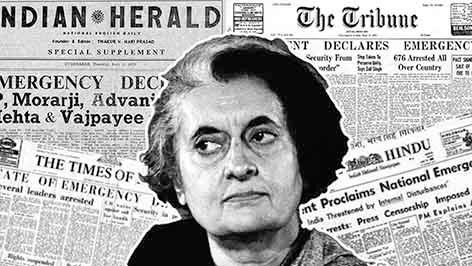
Nearly half a century separates today's journalism students from the midnight of June 25, 1975. For many of them, the Emergency belongs to textbooks, examination questions and occasional political debates. Yet, history acquires a different texture when narrated by someone who has spent decades in the newsroom, understands the anatomy of power and appreciates the indispensable role of a free press.
That opportunity came alive at Jain (Deemed-to-be University), where the Department of Journalism and Mass Communication organised a thought-provoking lecture on “The Emergency of 1975: Precedents, Proclamation, Paralells.”
The session featured Krishna Prasad, former Group Editorial Officer of The Hindu and former Editor-in-Chief of Outlook magazine. Rather than recounting familiar historical facts, Prasad challenged students to view the Emergency as a continuing lesson in constitutional vigilance, democratic responsibility and journalistic courage.
Historical Lens
“Remember June 25. Keep it permanently etched in your mind.” That simple appeal perhaps captured the spirit of the lecture better than any elaborate analysis.
Tracing the political turmoil preceding the proclamation, Prasad explained how the Allahabad High Court verdict against Prime Minister Indira Gandhi, the nationwide movement led by Jayaprakash Narayan and the constitutional advice reportedly offered by Siddhartha Shankar Ray converged into one of independent India's most consequential decisions. At around 11.45 pm on June 25, 1975, the President signed the proclamation under Article 352, citing "internal disturbance", fundamentally altering India's democratic landscape.
The presentation moved well beyond dates and legal provisions. Through archival newspaper pages, rare photographs, political cartoons, constitutional amendments and the covers of landmark books on the Emergency, history unfolded almost frame by frame. The visual journey reminded students that journalism is often history's first draft.
The presentation also examined constitutional changes during the period, including the 38th, 39th, 41st and 42nd Amendments, illustrating how legal instruments can reshape democratic institutions when extraordinary powers remain unchecked.
Press Matters
For journalism students, however, the most compelling lessons emerged from the discussion on the media.
Prasad vividly recalled how censorship became one of the defining characteristics of the Emergency. Newspapers were prohibited from publishing material critical of the government. In Delhi, electricity supplies to newspaper offices were reportedly disconnected to prevent presses from rolling. News was no longer determined solely by editorial judgement but increasingly by official approval.
Perhaps the most haunting image shown during the lecture was the famous front page of The Indian Express, where blank spaces silently protested censorship more powerfully than words ever could. Another memorable slide highlighted that 253 editors and journalists were arrested, while yet another recalled the detention of over one lakh individuals during the 21 months of the Emergency.
Prasad also drew attention to Motherland, the RSS-owned newspaper that continued to symbolise journalistic resistance despite intense censorship. Its editor, K. R. Malkani, became the first journalist to be arrested during the Emergency, underscoring the personal risks borne by members of the press.
Yet the lecture encouraged critical thinking rather than easy conclusion. One slide quoted Vinoba Bhave's description of the Emergency as an “era of discipline” while another examined why many sections of society, including certain industrial, labour and political groups, initially viewed aspects of the Emergency differently.
Prasad’s advice to future journalists was refreshingly practical. Do not confine yourself to one newspaper, he urged. Read widely. Compare perspectives. Question assumptions. Journalism, he reminded the audience, flourishes not through certainty but through inquiry.
His message carried particular relevance in an age flooded with information, algorithms and competing narratives. Independent thinking remains the journalist’s most valuable professional asset.
The organisers also deserve appreciation for selecting a theme that remains academically relevant even after five decades.
One thought lingered above every constitutional amendment, every archival photograph and every censored newspaper page displayed on the screen: democracy rarely disappears overnight. More often, it is gradually weakened when institutions stop questioning, when citizens stop caring and when journalists stop asking uncomfortable questions.
For students entering the profession today, the Emergency is not merely an episode to remember. It is a reminder that freedom of the press is neither permanent nor self-sustaining. Every generation inherits it, tests it and ultimately decides whether it will endure. That may well have been the most enduring lesson of the lecture. History is valuable not because it remains in the past, but because it quietly shapes the choices we make in the present
(The writer is a retired banker and author. He can be reached at krs1957@hotmail.com. Views personal.)


Comments