top of page

By:

Abhijit Mulye

21 August 2024 at 11:29:11 am

Mahayuti struggles with seat-sharing formula

Mumbai: The ruling Mahayuti alliance is currently navigating a treacherous political minefield. With the crucial Legislative Council elections rapidly approaching, deep-seated differences over seat-sharing have surfaced. Chief Minister Devendra Fadnavis on Monday offered a candid admission of these unresolved disputes. His statements underscore the immense pressure on the coalition partners. The state is preparing to vote for sixteen council seats and one bypoll seat in Nagpur. Voting is...

Mahayuti struggles with seat-sharing formula

Mumbai: The ruling Mahayuti alliance is currently navigating a treacherous political minefield. With the crucial Legislative Council elections rapidly approaching, deep-seated differences over seat-sharing have surfaced. Chief Minister Devendra Fadnavis on Monday offered a candid admission of these unresolved disputes. His statements underscore the immense pressure on the coalition partners. The state is preparing to vote for sixteen council seats and one bypoll seat in Nagpur. Voting is scheduled for June 18, with the all-important counting set for June 22. Addressing the media after inaugurating the Jawahar Balbhavan in Mumbai, Fadnavis sought to project a calm exterior. He emphasised that detailed discussions are still ongoing to evaluate various aspects of the electoral battle. He expressed confidence that the alliance would soon reach an amicable solution. However, the specific geographies he mentioned reveal the exact fault lines. Negotiations with the Shiv Sena are heavily concentrated on Chhatrapati Sambhaji Nagar and Nashik. Meanwhile, talks with the Nationalist Congress Party are focused squarely on Pune. Alliance Arithmatic The arithmetic of the alliance is proving incredibly difficult to balance. The Shiv Sena had firmly demanded seven seats even as the BJP was offering only 3. They justify this claim by pointing to their strong support bases in Mumbai, Thane, Raigad, Sambhajinagar, Ratnagiri, Nashik, and Yavatmal. The Bharatiya Janata Party has a vastly different calculation. The BJP plans to assert its dominance by contesting twelve seats. This aggressive stance would leave only three seats for the Sena and a mere two seats for the Sunetra Pawar-led NCP. With the nomination process already underway, the clock is ticking loudly for the Mahayuti leadership. This intense internal friction prompted a sudden political maneuver by Deputy Chief Minister and Shiv Sena chief Eknath Shinde. He flew to New Delhi over the weekend amid the escalating deadlock. Sena sources indicated that Shinde sought the intervention of the BJP’s central leadership. A Sena minister, however, quickly tried to downplay the optics of the trip. He insisted that Shinde travelled for an unscheduled programme before heading to Bengaluru for a planned event. Despite these official denials, the timing strongly suggests a high-stakes crisis intervention. Bitter Conflict The most bitter conflict within the alliance centers on the Thane local authorities constituency. Both the BJP and the Shinde-led Sena are fiercely staking their claims. A BJP legislator recently argued that political tickets should be distributed based strictly on numerical strength. He pointed out that the BJP commands 444 corporators in the region. In stark contrast, the Shinde-led Sena and the allied Jijau organisation possess a combined total of only 346 corporators. However, political reality in Maharashtra is rarely dictated by numbers alone. The Shinde faction views Thane as its emotional and traditional stronghold. Surrendering this territory to their alliance partner is considered politically unthinkable. This local dispute is already threatening to severely damage the broader coalition. A Sena Member of Parliament recently issued a stark warning regarding the upcoming Thane Zilla Parishad elections. He boldly asserted that Sena workers are fully prepared to fight alone and hoist their saffron flag, regardless of the alliance’s survival. The battle lines are extending further across the state map. The Sena is demanding the Jalgaon seat, which the BJP is equally determined to contest. Furthermore, reports suggest the Sena is preparing to unilaterally field a candidate in Raigad. This would further complicate the already delicate negotiations. Despite these mounting tensions, BJP minister Girish Mahajan has publicly maintained that the deadlock will be resolved shortly. A final decision now rests on an impending high-level meeting between Fadnavis, Shinde, and Sunetra Pawar. MVA Crisis Meanwhile, the political turbulence is not restricted to the Mahayuti alliance. The opposition Maharashtra Vikas Aghadi is dealing with its own severe crisis in the Vidarbha region. The Chandrapur-Gadchiroli council seat has triggered frantic political poaching. As many as sixty corporators and Zilla Parishad members from the Congress party reportedly went missing recently. Congress leaders have directly accused BJP legislator Banti Bhangadiya of orchestrating this disappearance. They allege he has shifted the corporators to an undisclosed location to manipulate the voting outcome. The Congress has responded with an aggressive counter-narrative. Senior Congress leader Vijay Wadettiwar made a startling claim that over one hundred BJP corporators are secretly in contact with him. While Wadettiwar strategically hid their exact whereabouts, his statement highlighted a critical vulnerability. He suggested that the BJP is also suffering from severe internal factionalism. Wadettiwar warned that these hidden rifts will ultimately cost the ruling party dearly in the forthcoming elections.

The Land Where Silence Speaks to the Soul

Ladakh is more than a destination — it is a place where silence, simplicity, and the soul quietly meet.
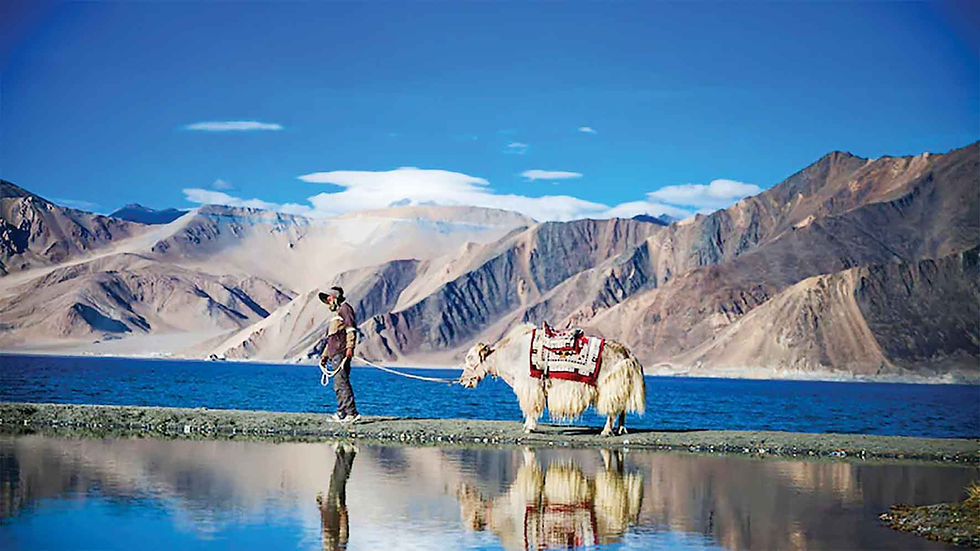
Surrounded by the mighty Himalayas and rugged Karakoram ranges, Ladakh feels like a world where time slows down and nature speaks to the heart. Endless mountains, fluttering prayer flags, crystal-clear skies, and deep silence create an indescribable beauty. In a fast-moving world, Ladakh teaches the rare art of stillness.


Geographically, Ladakh is one of India's most important regions. Located close to the borders of China and Pakistan, it holds immense strategic value for the country. The region is home to sensitive border areas and important army bases that protect India in extremely difficult conditions. The mighty Indus River also flows through Ladakh, lending the region both historical and ecological significance. Ladakh is not only India’s pride for its beauty but also for its strength and courage.


Life in Ladakh, however, is far from easy. Winters are extremely harsh, with temperatures falling far below freezing. Heavy snowfall cuts off villages for months, oxygen levels remain low, and even simple daily activities become difficult. Yet the local people live with remarkable warmth and simplicity. Their smiles, honesty, and hospitality often leave a deeper impression on travellers than the landscapes themselves.


The Indian Army faces even tougher challenges in Ladakh. Indian soldiers guard the nation at very high altitudes where breathing becomes difficult and temperatures can reach dangerous extremes. Despite snowstorms, isolation, and harsh terrain, they continue their duty with courage and discipline. Visiting Ladakh often fills travellers with immense respect for the soldiers protecting the country in such unforgiving conditions.


The best time to visit Ladakh depends on the kind of experience one seeks. Summer, from May to September, is the most popular season because the weather remains pleasant and roads stay open. This is the ideal time for sightseeing, road trips, and photography. Autumn brings quieter landscapes, clear skies, and golden shades across the valleys, making it perfect for peaceful travel. Winter transforms Ladakh into a magical snow-covered world. Though extremely cold, it attracts adventure lovers who wish to experience frozen rivers, snow-covered monasteries, and the famous Chadar Trek.


Among Ladakh’s most famous attractions is Pangong Lake, known for its breathtaking blue waters that change shades with sunlight. Nubra Valley surprises visitors with sand dunes, double-humped camels, and dramatic mountain views. Khardung La, one of the world’s highest motorable roads, gives travellers a thrilling sense of achievement. Offbeat places like Hanle, Turtuk, and Zanskar Valley reveal a quieter and more untouched side of Ladakh filled with raw Himalayan beauty.


Ladakh is accessible both by air and road. Travellers can fly directly to Kushok Bakula Rimpochee Airport, but many believe the true spirit of Ladakh is best experienced through its legendary road journeys. The highways from Manali and Srinagar pass through dramatic mountain passes, rivers, valleys, and breathtaking landscapes that turn the journey itself into an unforgettable adventure.


Ladakhi food carries warmth perfectly suited for the cold climate. A bowl of steaming thukpa comforts travellers after long journeys, while freshly prepared momos remain everyone’s favourite snack. Traditional dishes like Skyu reflect the simplicity of local life. Ladakh is also known for delicious apricots, apples, walnuts, and seabuckthorn products. Shopping in Ladakh is equally special, with pashmina shawls, Tibetan handicrafts, prayer wheels, woollens, and handmade jewellery carrying the essence of the mountains.


Spiritually, Ladakh feels deeply peaceful. Often called “Little Tibet", the region is strongly influenced by Buddhism. Monasteries, prayer flags, chanting monks, and spinning prayer wheels create an atmosphere of calmness and reflection. Famous monasteries such as Hemis Monastery, Thiksey Monastery, Diskit Monastery, and Lamayuru Monastery are not only architectural wonders but also places where travellers experience inner peace.


Festivals in Ladakh are vibrant celebrations of faith and culture. The famous Hemis Festival fills monasteries with colourful masked dances, music, and spiritual rituals, while the Losar Festival marks the Ladakhi New Year with joy, prayers, and community celebrations.


Ladakh has also gained global attention through cinema. The 2009 blockbuster 3 Idiots featured its iconic climax at Pangong Tso, one of the world's highest saltwater lakes. The character of Phunsukh Wangdu, played by Aamir Khan, was heavily inspired by the real-life Ladakhi engineer, innovator, and educational reformer, Sonam Wangchuk. Wangchuk is recognised for his work in transforming learning systems for remote communities in the Himalayas.


Since the release of the film, the western end of Pangong Lake near the village of Spangmik has become a major, must-visit tourist attraction known as 3 Idiots Point.


Beyond adventure and sightseeing, Ladakh offers something rare — silence, reflection, and a deep sense of inner calm. Somewhere between the mountains and endless skies, travellers often rediscover themselves. It is a place where silence feels meaningful, where nature feels sacred, and where memories remain alive long after the journey ends.


(The writer is a tourism professional and runs a company, Global Voyages. She could be connected at goglobalvoyages@gmail.com. Views personal.)

Comments


bottom of page