

The Next Chapter in India–Japan Ties

The future of the partnership will be measured less by investment pledges than by the industrial ecosystems the two countries build together.
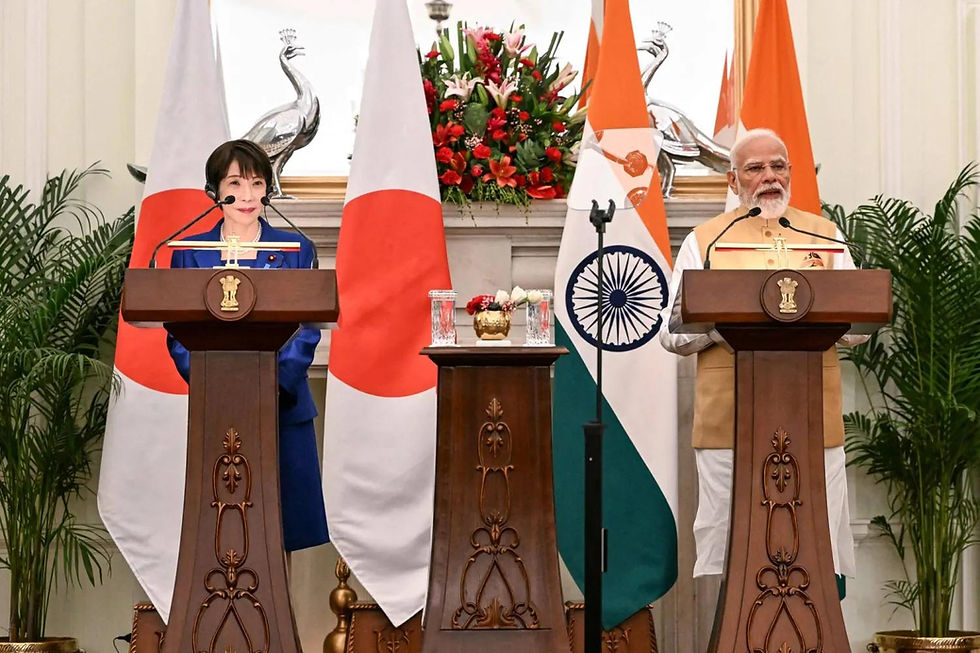
The 16th India-Japan Annual Summit held in New Delhi earlier this month produced 16 outcome documents and close to 120 cooperation agreements. Japanese Prime Minister Sanae Takaichi arrived with more than 150 company representatives. The two governments signed a Memorandum of Cooperation for a 10-billion-dollar investment package and confirmed that 2 trillion yen of the earlier 10 trillion-yen private investment target has already been committed. These figures dominated the headlines that followed.
The more important shift sits in the text of the Joint Statement itself. For three decades, Japan functioned mainly as a financier for India. Japanese Official Development Assistance funded the Delhi Metro, the Dedicated Freight Corridor and the Mumbai-Ahmedabad High-Speed Rail. Those projects addressed a real infrastructure gap at a time when India had limited domestic capital to spend on them.
India’s problem today is different. The country wants to build a manufacturing base that competes globally, not simply absorb foreign money. That goal needs institutions, not transfers. It needs supplier networks, testing facilities, quality standards, worker training systems and predictable regulation. Capital alone does not build any of these.
Read the 2026 Joint Statement closely and the vocabulary confirms the shift. The document repeats terms like resilient supply chains, trusted technologies, economic security and industrial value chains. The two countries adopted three separate outcome documents at the summit: a Joint Declaration on Economic Security Cooperation, a Joint Statement on AI cooperation, and a statement on energy resilience. None of these are financing instruments. They describe how two economies coordinate standards, share risk and build shared production systems.
Japan’s own manufacturing strength never came from money alone. It came from tight coordination between manufacturers and suppliers, continuous worker training, strict quality control and production cycles planned years in advance. Japan’s precision engineering base is the product of institutions built over decades, not capital injected in a single budget cycle.
Manufacturing Strategy
India has started building its own version of this. The Production Linked Incentive scheme, PM Gati Shakti, the National Logistics Policy and the National Industrial Corridor Development Programme all point toward the same goal: linking logistics, land, skills and production planning under one strategy rather than treating them as separate ministry mandates. The problem is that these schemes still operate separately, run by different ministries working to different timelines. A single manufacturing strategy needs all of them to move together.
The summit gives India a chance to link these schemes to a real project. Defence is the clearest starting point. The two sides signed their first bilateral defence co-development project at the summit: the Unified Complex Radio Antenna, known as UNICORN, a naval system built jointly rather than bought off the shelf. Prime Minister Modi called it the start of a new chapter in defence technology cooperation. That description is fair, but a single antenna project does not create a defence manufacturing base on its own. Precision suppliers, certification labs, specialised technicians and steady procurement pipelines have to exist first. Without them, imported technology stays dependent on the exporting country instead of generating capability inside India.

Semiconductors follow the same logic. India’s semiconductor push has concentrated on fabrication capacity, a reasonable focus given how far behind India starts. But a semiconductor industry runs on more than fabs. It needs materials suppliers, equipment maintenance networks, testing standards and specialised technicians. These take years to build and depend more on coordination between government agencies than on subsidy size. The Joint Declaration on Economic Security Cooperation names semiconductors, critical minerals, information and communication technology, clean energy and pharmaceuticals as its five priority sectors. That list describes an institution-building agenda, not an investment list.
Artificial intelligence follows a similar pattern. The two countries launched their first AI Strategic Dialogue at the summit and adopted a Joint Statement on AI cooperation, committing both sides to joint research on large language models, shared computing resources, talent development and a framework for moving skilled AI professionals between the two countries. None of that is investment. It builds a pipeline of trained people and shared infrastructure that neither country builds alone at the pace AI development now demands. If that pipeline works, India gains researchers trained inside Japanese institutions, with skills its own labs do not yet teach at scale.
Building a Working Relationship
The two governments also agreed to expand the India-Japan Industrial Competitiveness Partnership, covering logistics, agriculture, healthcare, textiles, industrial manufacturing, payment systems, and support for MSMEs and startups through an SME Forum and a related support initiative. Nothing on this list generates a headline the size of a ten-billion-dollar figure. But building a working relationship between Japanese and Indian small manufacturers, one that survives changes in government and shifts in exchange rates, does more for India’s industrial base than a single large investment announcement. Manufacturing depth grows from thousands of these unglamorous connections, not from a handful of marquee projects.
The two sides also agreed to speed up the review of the Comprehensive Economic Partnership Agreement, signed 15 years ago. A trade agreement that old rarely matches the industries it now needs to serve. Updating it is slow, technical work with no ceremony attached, and it determines whether Indian exporters use the tariff concessions already on paper.
The repeated use of economic security across the 2026 documents deserves attention for the same reason. Takaichi warned in her summit remarks that both economies face pressure from the weaponisation of trade and non-market practices, and called resilient supply chains for critical materials essential. Indian and Japanese officials tied that framing to a specific goal: reducing dependence on China for critical minerals and active pharmaceutical ingredients, and on West Asia for energy. Read this way, economic security is not a slogan. It measures whether a country holds resilient production systems, dependable standards and enough domestic capability to withstand a shock.
Industrial Depth
For policymakers tracking this relationship, the measure of success should change to match. Investment totals and the count of signed agreements are easy to report but say little about industrial depth. Better indicators exist: whether Indian suppliers enter globally competitive value chains, whether quality standards in Indian factories rise to Japanese benchmarks, whether workforce training keeps pace with what advanced manufacturing needs, and whether the UNICORN project builds Indian engineering capability rather than an assembled Japanese design. These indicators take longer to confirm than a headline investment figure, but they show whether the partnership builds something that lasts.
India and Japan describe their relationship as a Special Strategic and Global Partnership, built on trust accumulated since diplomatic ties began in 1952. That trust is real and it matters. The next stage of the relationship needs something harder to build than trust: institutional depth.
Capital builds infrastructure. Technology transfer strengthens specific projects. Neither converts into lasting industrial capability without institutions that outlast the agreement that created them. The most useful outcome of the 16th Annual Summit will not show up in the 120 documents signed in New Delhi. It will show up years from now, in whether Indian firms built on this partnership compete on their own terms, without Japanese or Indian government support standing behind them.
(The writer is an independent public policy researcher. Views personal.)


Comments